PSY388 Lecture 10/11 - Disorders of Childhood 1 (ASD focus)
 Call Kai
 Learn
Learn Practice Test
 Spaced Repetition
 Match
Match Flashcards
 Knowt Play
1/16

There's no tags or description
Looks like no tags are added yet.
Name | Mastery | Learn | Test | Matching | Spaced | Call with Kai | Chat |
|---|
No analytics yet
Send a link to your students to track their progress
17 Terms
Neurodevelopmental Disorders
• Onset during developmental period
• Developmental deficits or differences that result in impairment in personal, social, academic or occupational functioning
• Intellectual disability (ID); Communication Disorders; Autism Spectrum Disorder (ASD); Attention-Deficit/Hyperactivity Disorder (ADHD); Neurodevelopmental Motor Disorders, including Tic Disorders; and Specific Learning Disorders.
• Co-occurring and overlapping conditions
Autism - Impairments in social interaction and social communication
•Social-emotional reciprocity challenges
•Deficits in non-verbal communicative behaviours
•Deficits in maintaining, developing, & understanding relationships
Autism - Repetitive and restricted patterns of behaviour
• Lining toys up, echolalia, idiosyncratic phrases, motor stereotypies
• Insistence of sameness & routines
• Restricted & fixated interests
• Hyper- or hypo-reactivity to sensory input
Autism - general notes
• 1 in 68 individuals UPDATE” 1 in 31 (2025)
• Social Communication challenges, Repetitive Behaviours and Interests
• Some sensory issues
• Some show regression
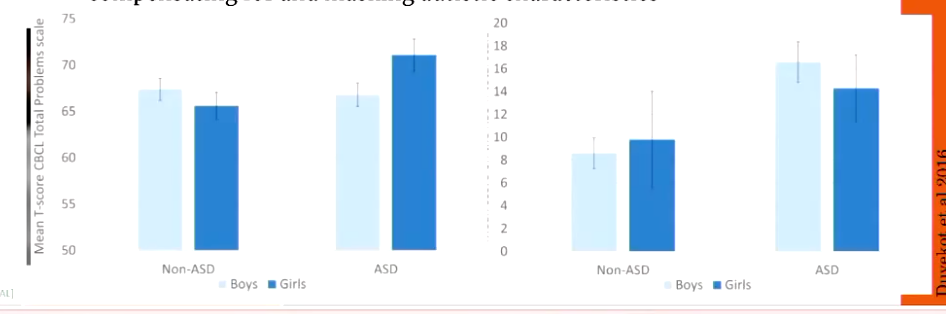
• Girls with Autism may ‘camouflage’
• Early intervention and appropriate support provide the best outcomes
Polygenic and developmental profiles of autism differ by age at diagnosis
• Zhang et al (2025) Nature
• N = 45,000+ • US, UK, Europe & Australia
• < 6 yo more social-comm, and behav challenges; >10 yo worsening behav challenges and mental health conditions
Social factors in Autism
Cultural factors, access to healthcare, gender, bias, stigma, ethnicity, camouflaging
Regression in Autism
• Loss or reduction of previously acquired skills
• In 20 – 30% of autistic children
• Usually occurs during second year of life
• Approx 76% regain lost skills
• Recovery can be partial, gradual or uneven • Communication trajectories remain variable
Intelligence is an imprecise predictor of functional abilities in diagnosis
The misnomer of ‘high functioning autism’
Camouflaging
• Females are underdiagnosed
• Practitioners overlook subtle social challenges and internalizing behaviors (Dean et al 2016)
• Compensating for and masking autistic characteristics
Is autism “over diagnosed” in Australia? or is it being better identified?
More overall autistic people accessing NDIS
1 in 31 children in VIC ages 1 – 3.5 are autistic

Autism in Aboriginal children
An increase in ASD diagnosis for younger Aboriginal children may reflect a take-up of NDIS services, increased awareness and confidence

What causes autism?
Genetic
‘Environmental’ factors that influence genes - such as Measles & VPA in pregnancy which makes children very likely to develop autism
Random genetic changes
Autism - Epigenetics & Other factors
• Concordance 50 – 80% for identical twins
• No single cause
• MANY GENES, no one common genetic change
• Older fathers
• Frequent fevers and infections in pregnancy
• No good evidence for/links with vaccines
Autism - Pregnancy Risks/Complications
• (poor) link between acetaminophen use in pregnancy and developmental disorders
• Valproic acid
• NO link between epidurals and Autism
Autism & paracetamol in pregnancy
No association
• Ahlqvist et al 2024
• N = 2.5 million Swedish children
• National records
• Children exposed to Paracetamol during pregnancy vs those who were not
• Sibling control : pairs of siblings, one exposed to paracetamol, the other had not
Autism Psychological theories
• Weak Central Coherence - strengths/hypofocus for detail, miss the big picture
• Executive Functioning - planning, problem solving - keep instructions short & clear - visual aids
• Theory of Mind - M&M smartie box
• Others : Enhanced Perceptual Functioning, Social motivation, Predictive Coding, Intolerance of Uncertainty
Evidence-based Interventions

+incorporate child’s interest