2 - Disease of Vulva, Vagina, and Cervix
 Call Kai
 Learn
 Practice Test
 Spaced Repetition
 Match
 Flashcards
 Knowt Play
1/39

There's no tags or description
Looks like no tags are added yet.
40 Terms

What is this, and what does it indicate?
A slit-like external os, a sign that the cervix has been stretched by a vaginal delivery
Types of cells lining different parts of the cervix/vagina
Ectocervix and vagina: Non-keratinized stratified squamous epithelium
Endocervix: Simple columnar epithelium
What is the SCJ, and what are it’s cells?
SCJ is the squamocolumnar junction where the squamous epithelium meets the columnar epithelium
It’s cells are SCJ cells, cuboidal cells believed to be stem cells
What is squamous metaplasia, and is it malignant?
It is a condition where columnar epithelium of the endocervical canal becomes squamous epithelium
It isn’t malignant, it’s a normal thing
What is a hymen, and what’s the most concerning type, and why?
A hymen is a fold of mucous membrane at the entrance of the vagina, and the most concerning type is an imperforate hymen because this is where the hymen doesn’t open(which it should), and blood gets trapped in it
Typical presentation of an imperforate hymen
A teen girl with primary amenorrhea but normal puberty and normal period cramps
Main normal flora of the vagina
Lactobacillus
Is the vaginal pH basic or acidic, and why?
It’s acidic due to lactobacilli fermenting glycogen
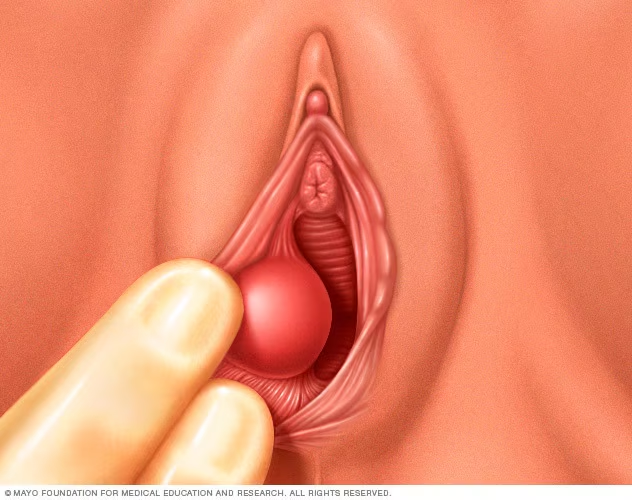
What is this condition?
Bartholin’s cyst
Where are the Bartholin glands located?
4 and 8 o clock of the vaginal opening
Bartholin’s cyst
How it happens
Clinical presentation
When the gland’s duct gets blocked → mucus builds up and forms a cyst
Asymptomatic soft lump at the lower part of one labium, noticed by chance
If painful, it’s likely become infected, forming an abscess

What is this condition?
Lichen sclerosus(LSA)
Lichen sclerosus
How it happens
Clinical presentation
Unknown, thought to be autoimmune
Itching, worse at night, and shows up as whiter/shiny/film-like skin around the vulva and anus.
Can progress to SCC

What is this condition?
Hidradenoma papilliferum
Hidradenoma papilliferum
What is it?
Clinical presentation
An appendage tumor(from structures growing down into dermis) that occurs at the vulva, forming a small, benign lump
Asymptomatic, a small lump found on accident

What is this condition?
Nabothian cyst
Nabothian cyst
What is it?
Clinical presentation
Associated with ___
Benign cyst of endocervical glands, often seen on the ectocervix
Nothing, found by chance
Squamous metaplasia

What is this condition?
Endocervical polyp
Endocervical polyp
What is it?
Clinical presentation
A benign growth of the lining of the endocervical canal that often pops through the external os
Often no symptoms, sometimes bleeding
Most common malignant neoplasm of the vulva, vagina, and cervix
Squamous cell carcinoma

What is this condition?
Malignant melanoma
Malignant melanoma
Cell of origin
Location
What is it?
Cancer of melanocytes
Mostly vulva, sometimes vagina
A malignant neoplasm where melanocytes acquire mutations and divide uncontrollably
Malignant melanoma
Typical symptoms
Typical demographic
Relation to UV light
Bleeding, itching, lump, sometimes pain
Older women
No strong relation

What is this condition?
Paget disease of vulva
Paget disease of vulva
What is it?
Causes
Demographic
Clinical presentation
An adenocarcinoma involving abnormal glandular cells living in the epidermis called Paget cells
Primary(unknown cause) or secondary(Adenocarcinomas at the urothelial or anorectal areas)
Older women, 60-70
Chronic itching, red, moist plaque with white patches(Strawberries and cream)

What is this condition?
Embryonal rhabdomyosarcoma
Embryonal rhabdomyosarcoma
What is it?
Clinical presentation
Demographic
A malignant tumor of mesenchymal cells resembling immature skeletal muscle cells
A tumor looking like “a bunch of grapes” found in girls under 5 with bleeding and a soft, grape-like mass protruding from the vaginal opening
Girls under 5, mostly in the first 2y
HPV
Stands for
What cells does it infect?
How does it spread?
Human papillomavirus
Squamous epithelium
Skin to skin and sexual contact
HPV main types
High risk: Can cause cancer, 16, 18
Low risk: Rarely causes cancers, causes warts instead(หูดหงอนไก่), 6, 11
Which epithelial cells does HPV want, and why?
Basal cells, because these replicate
Which cancer is 95% HPV related, and at which spot?
Cervical, specifically due to the SCJ
What is a gateway to SCC in older women that isn’t HPV?
Lichen sclerosus
SIL, LSIL, HSIL
SIL = squamous intraepithelial lesion, aka when HPV has infected squamous epithelium, but it’s still confined to the epithelium
LSIL: The virus replicates on it’s own(DNA stable) without inserting itself into the pt.’s chromosomes, most go away on their own, 70% caused by high-risk type HPV
HSIL: The virus now takes over the epithelium fully, the viral DNA is now inserted/integrated into patient’s chromosomes, 90% caused by high-risk type HPV, can progress to SCC
What grades of vulvar, vaginal, and cervical intraepithelial neoplasia(VIN, VaIN, and CIN) fit with LSIL and HSIL?
Grade 1 VIN, VaIN, CIN = LSIL
Grade 2-3 VIN, VaIN, CIN = HSIL

What is this cell, and how do we know, and what is it associated with?
Koilocyte
Clear halo, two nuclei, wrinkled nuclei
HPV infection, mostly LSIL
Where would we find adenocarcinoma: Cervix, vagina, or vulva, and why?
Cervix, because the other parts don’t have any glandular tissues(Except bartholin glands etc at the vulva)
Cervical adenocarcinoma
HPV associated or not?
Yes, around 85-90% while SCC is basically 100%
What area do screening tests sample for HPV, and why?
Transformation zone, the band where glandular endocervix has been replacd via squamous metaplasia to become squamous ectocervix tissue due to estrogen effect
SCC symptoms
Cervix: Abnormal bleeding, a cauliflower-like mass
Vagina: Bleeding, mass on examination
Vulva: A lump that won’t heal, itching(especially w lichen sclerosus), bleeding
Main screening tests for cervical CA
HPV testing: For high-risk HPV, tells us about risk
Cervical cytology: Tests cells appearance to see if they’re like LSIL, HSIL, or other abnormalities
Visual inspection with acetic acid(VIA): Using vinegar to the cervix to see if any areas turn white(those are abnormal)