Topic 3: Pyruvate Oxidation
0.0(0)
Studied by 2 people Note
 Call Kai
 Learn
 Practice Test
 Spaced Repetition
 Match
 Flashcards
 Knowt Play
Card Sorting
1/3

There's no tags or description
Looks like no tags are added yet.
4 Terms
1
New cards
Pyruvate
* A molecule produced during glycolysis that are transported through the mitochondrial membranes into the mitochondrial matrix via active transport
* Undergoes three changes during pyruvate oxidation
* Are transported through the mitochondrial membranes into the mitochondrial matrix
* Undergoes three changes during pyruvate oxidation
* Are transported through the mitochondrial membranes into the mitochondrial matrix
2
New cards
Acetyl-CoA
A compound produced when coenzyme A attaches to the 2-carbon portion of pyruvate during pyruvate oxidation.
3
New cards
Pyruvate dehydrogenase complex
A multi-enzyme complex that catalyzes the conversion of pyruvate to acetyl-CoA during pyruvate oxidation.
4
New cards
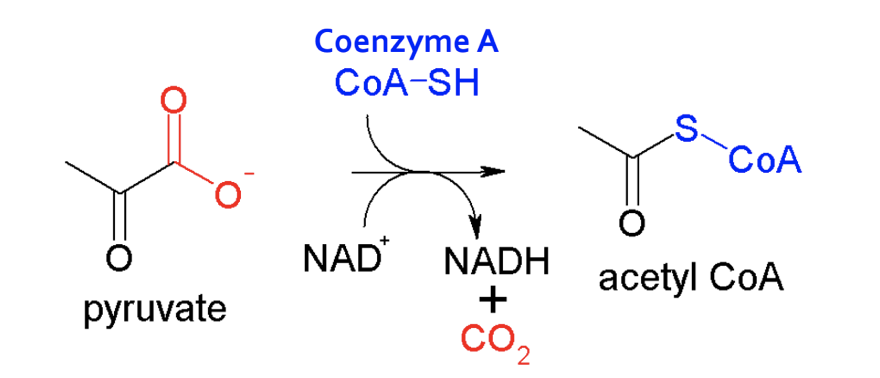
Pyruvate Oxidation Steps
1. Start with Pyruvate molecule
2. 3 changes catalyzed by pyruvate dehydrogenase complex
* A molecule of CO2 is removed from pyruvate
* Decarboxylation reaction
* A redox reaction occurs where the 2-carbon portion of the pyruvate is oxidized while NAD+ is reduced to NADH
* Coenzyme A (sulphur-containing, nonprotein organic molecule) is attached to the 2-carbon compound to produce acetyl-CoA
3. Left with acetyl-CoA which either enters Krebs cycle or produces lipids
4. Excess products
* 2 molecules of CO2 produced, diffuse out of mitochondrion and into the cytoplasm to be taken out of the cell as waste
* 2 NADH proceed to next stage of cellular respiration
* 2 H+ ions dissolve into the matrix