Lesson 6 : Inheritance, Variation and Evolution
 Call Kai
 Learn
 Practice Test
 Spaced Repetition
 Match
 Flashcards
 Knowt Play
1/40

There's no tags or description
Looks like no tags are added yet.
41 Terms
Meiosis
A type of cell division that results in the formation of 4 non - identical haploid cells
Gamete
A sex cell
Gametes in flowering plants
Pollen and egg
Gametes in animals
Sperm and egg
Sexual reproduction
Type of reproduction involving two parents and the fusion of gametes
Offspring produced through sexual reproduction are...
Genetically different
asexual reproduction
Type of reproduction involving only one parent and no fusion of gametes
Offspring produced by asexual reproduction are...
Genetically identical
How does meiosis halve the number of chromosomes?
The genetic material is copied once, but the cell then divides twice, forming four haploid gametes which are genetically different
Fertilisation
The fusion of two haploid gametes to form a diploid zygote
How does fertilisation restore the full number of chromosomes?
It restores the full number through the fusion of two haploid gametes, resulting in the formation of a diploid zygote
Advantages of sexual reproduction
produces variation in offspring
If the environment changes variation gives a survival advantage by natural selection
Natural selection can be sped up by humans in selective breeding to increase food production
Disadvantages of sexual reproduction
1. Takes time and energy to find a mate
2. Difficult for isolated members of species to reproduce
Advantages of asexual reproduction
1. Only one parent needed
2. More time and energy efficient as no mate needed
3. Faster than sexual reproduction
4. Many identical offspring can be produced when conditions are favourable (rapid population increase)
Disadvantages of asexual reproduction
1. Limited genetic variation in population
2. Population is vulnerable to changes in conditions and may only be suited for one habitat
3. Disease is more likely to affect the population as there is no genetic variation
Organisms that reproduce by both methods
1. Malarial parasites produce asexually in the human host, but sexually in the mosquito
2. Many fungi produce asexually by spores but also produce sexually to give variation
3. Many plants produce seeds sexually, but also produce asexually by runners such as strawberry plants, or bulb division such as daffodils.
DNA
A polymer made up of two strands forming a double helix
What is the structure of DNA?
A polymer made up of four different nucleotides
Genome
An organisms complete set of genetic material
Gene
A section of DNA that codes for a specific protein
What is the importance of understanding the human genome? (Human Genome Project)
1. Improved understanding of genes linked to some diseases and inherited genetic disorders
2. It has facilitated the study of past human migration patterns
It has helped improve the treatment of inherited disorders
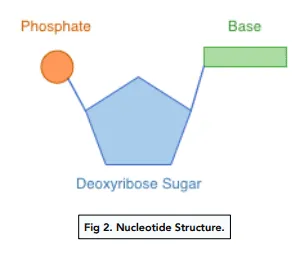
What is the structure of a nucleotide? (In order from outside to inside)
Phosphate group, deoxyrybose sugar, nitrogenous base
What are the four bases of DNA?
Adenine, Thymine, Cytosine, Guanine
According to the complementary base pairing rule, what bases always pair up?
Adenine ~ Thymine
Cytosine ~ Guanine
How much bases code for one amino acid?
A sequence of three bases
Protein Synthesis
1. DNA unwinds
2. Gene is copied into mRNA
3. mRNA moves out of nucleus into cytoplasm
4. mRNA passes through ribosome
5. The ribosome assembles amino acids, carried by specific tRNA molecules, into a particular order to make a protein
How dues the structure of DNA affect the protein made?
The order of bases in a gene decides the structure, shape and function of the protein being synthesised
What is a chromosome?
A long, coiled molecule of DNA found in the nucleus, which carries genes
What is an allele?
A different form of the same gene
What is a dominant allele?
An allele that is always expressed in the phenotype, even if only one copy is present
What is a recessive allele?
An allele that is only expressed if two copies are present and there is no dominant allele
What does homozygous mean?
When an individual has two identical alleles for a particular gene
What does heterozygous mean?
When an individual has two different alleles for a particular gene
What is an organism’s genotype?
The collection of alleles an organism has fur a specific characteristic
What is an organism’s phenotype?
The physical characteristic or expression of the alleles
What is an inherited disorder?
A disorder caused by the inheritance of certain alleles
Name 2 inherited disorders
Polydactyly (having extra fingers or toes)
Cystic fibrosis (a disorder of cell membranes)
Is polydactyly caused by a recessive or dominant allele?
Dominant allele
Is polydactyly caused by a recessive or dominant allele?
Recessive allele
What are the female sex chromosomes?
XX
What are the male sex chromosomes?
XY