Zoology lab Practicle 1
 Call Kai
 Learn
Learn Practice Test
 Spaced Repetition
 Match
Match Flashcards
 Knowt Play
1/99

There's no tags or description
Looks like no tags are added yet.
Name | Mastery | Learn | Test | Matching | Spaced | Call with Kai | Chat |
|---|
No analytics yet
Send a link to your students to track their progress
100 Terms
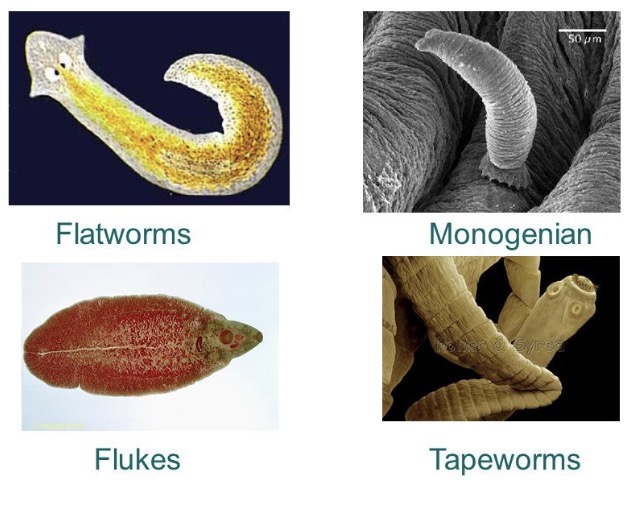
Defining features of Platyhelminthes:
Acoelomate
Triploblastic protostomes
Blind gut
Organ-level development
Protonephridia
Cephalization
Monoecious
Protonephridia
Classes within Platyhelminthes
Turbellaria
Trematoda
Monogenea
Cestoda

Turbellaria
Phylum: Platyhelminthes
Planarians
Non-parasitic, mostly free-living
Auricles used to detect chemicals in water
Light-sensitive eyespots
Reversible pharynx
Has flame cells

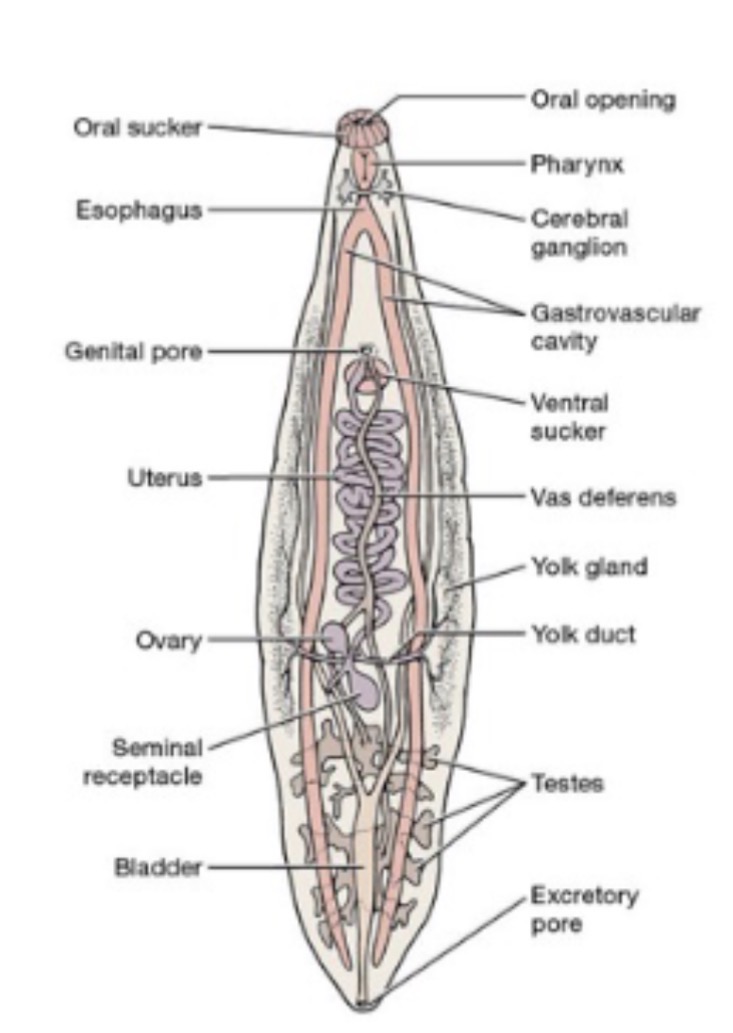
Trematoda
Phylum: Platyhelminthes
Flukes
Endoparasitic life cycle
Makes them very complex
Tegument present

Mongenea
Phylum: Platyhelminthes
Ectoparasitic
Lack respiratory, skeletal, and circularity systems
Have opistaptor

Cestoda
Phylum: Platyhelminthes
Endoparasitic
Do not have mouths - have scolex
Made of proglottids

Monoecious
Organism is both sexes at the same time
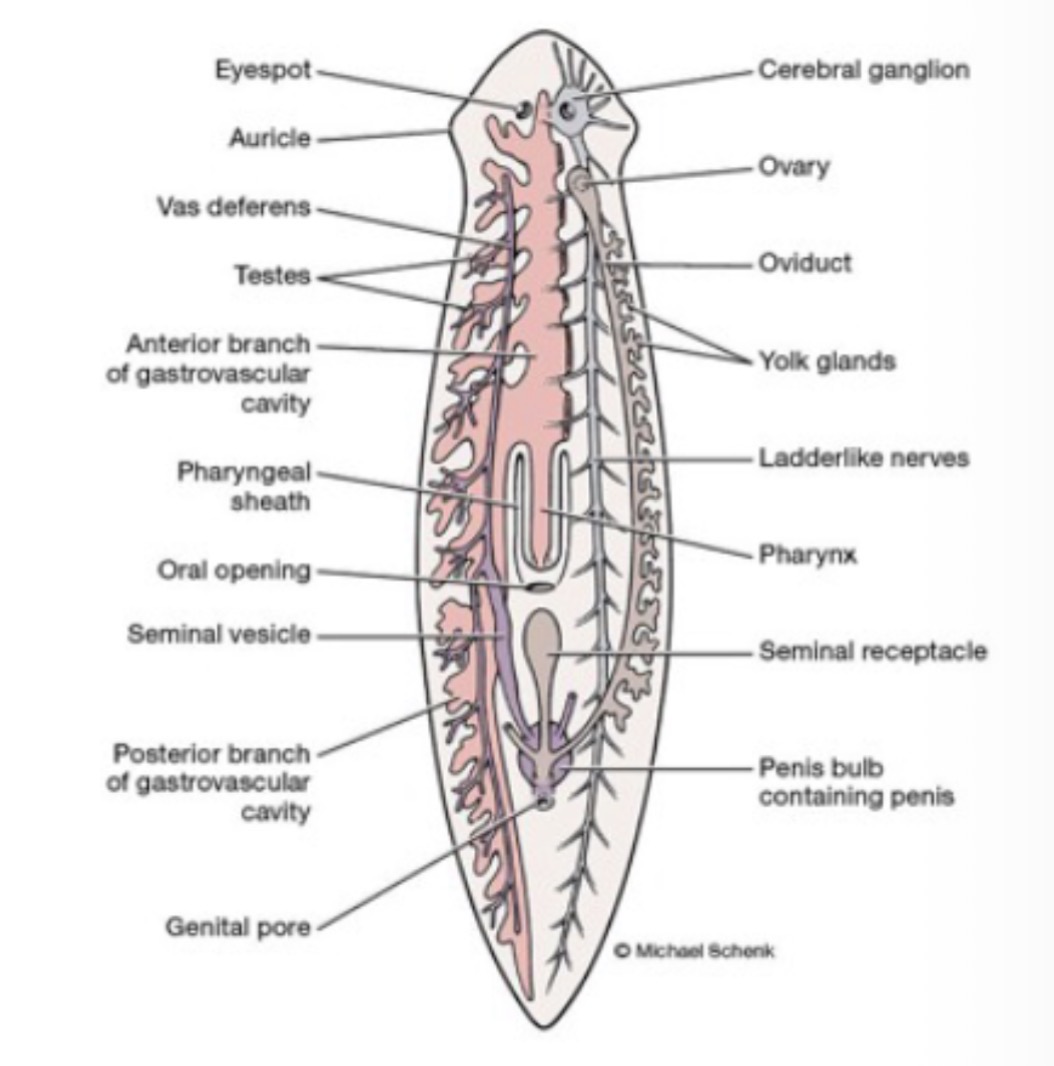
Flame cells
Fluid balance and excretion

Acoelomic
No true body cavity

Cephalization
Head region present

Blind gut
Only has a mouth, food and waste go in and out of it

Tegument
Special epidermal cuticle that prevents parasite from being digested
Hydrostatic skeleton
Body structure due to water pressure
Fluke life stages
Egg → Miracidium → Sporocyst → Radia → Cercariae → Metacercaria → Adult

Defining features of Nematoda:
Pseudocoelomate
Cephalization
Triploblastic protostomes
Complete gut
Dioecious
Tegument
Hydrostatic skeleton
Dorsal and ventral nerve cords
Lateral lines
Ecdysis

Dioecious
Either male or female

Pseudocoelmate
Primitive kidney

Ecdysis
The process of shedding/molting
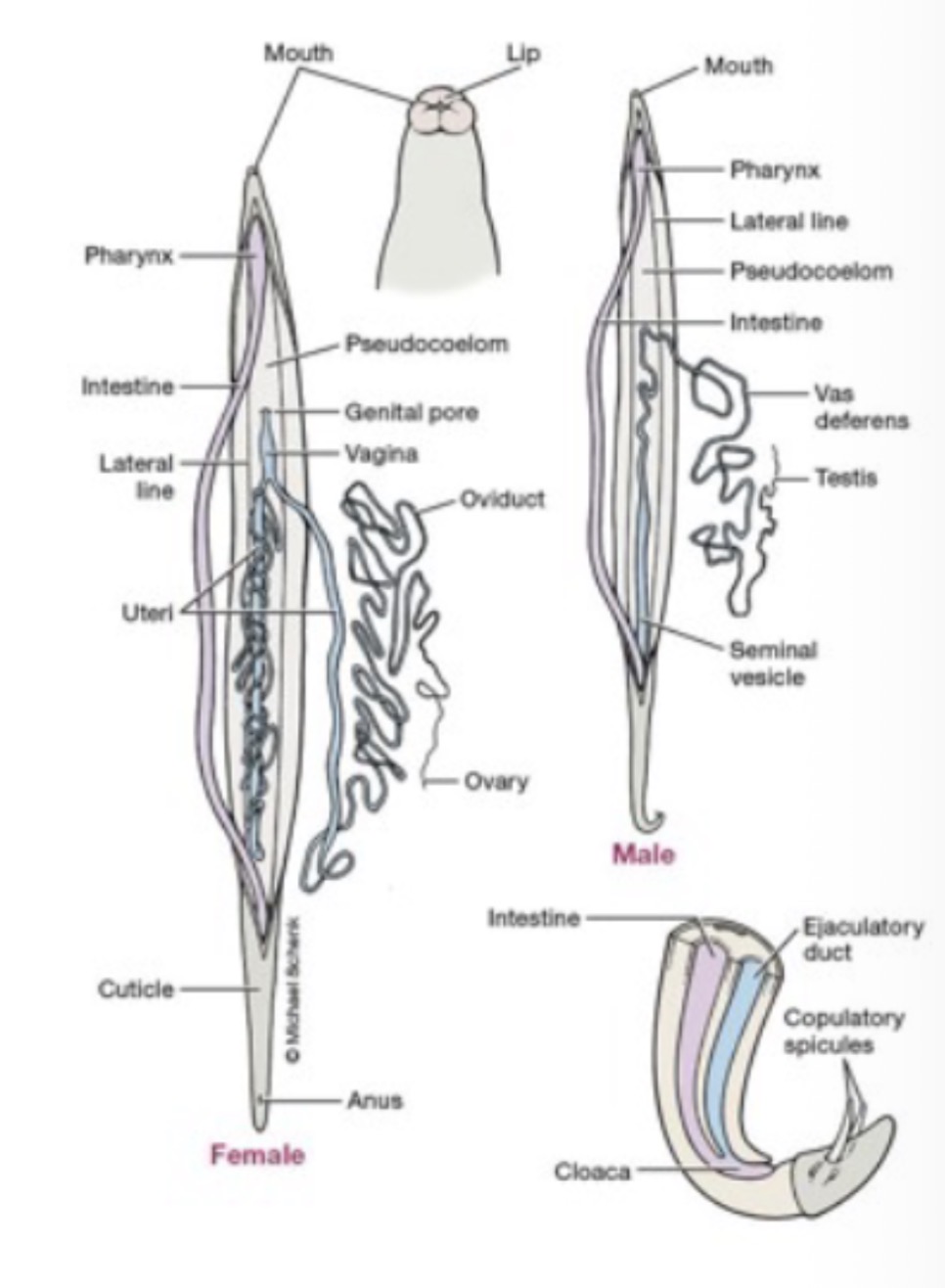
What are lateral lines used for in Nematodes?
Excretion

Defining characteristic of Annelida:
Eucoelomates
Segmented
Closed circulatory system
Complete gut
Hydrostatic skeleton
Setae
Dorsal brain
Ventral nerve cord
Hermaphroditic
Classes within Annelida:
Polychaetes
Oligochaetes
Leeches

Polychaetes
Phylum: Annelida
Lots of setae, attached parapodia
Well-developed head
Some have feeding tentacles

Oligochaetes
Few setae
Clitellum present
Underdeveloped head region
Marine, freshwater, and terrestrial life

Leeches
Phylum: Annelida
Anterior and posterior suckers
Ectoparasites
Clitellum ONLY during breeding season

Setae
Hair-like bristles

Clitellum
band of tissue used for reproduction and secretion of a cocoon that contains fertilized eggs

Esophagus
Pathway between pharynx and crop

Crop
Temporary food storage

Intestine
Nutrient absorption

Heart
Regulates blood pressure

Intestine
Nutrient absorption

Dorsal blood vessel
Return blood to arches

Ventral blood vessel
Distributes blood

Nephridia
Excretion of nitrogenous waste
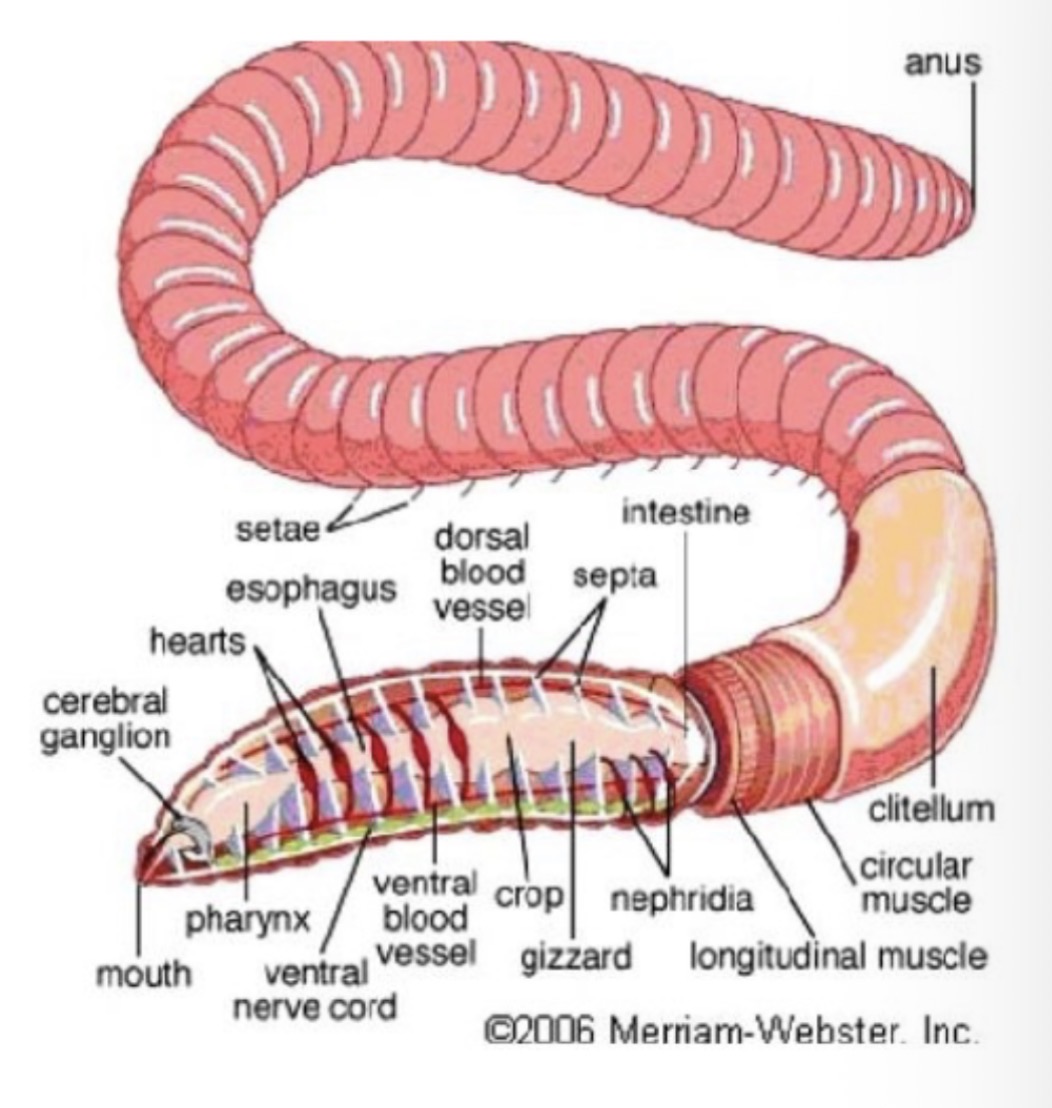
Septa
Partitions between segments
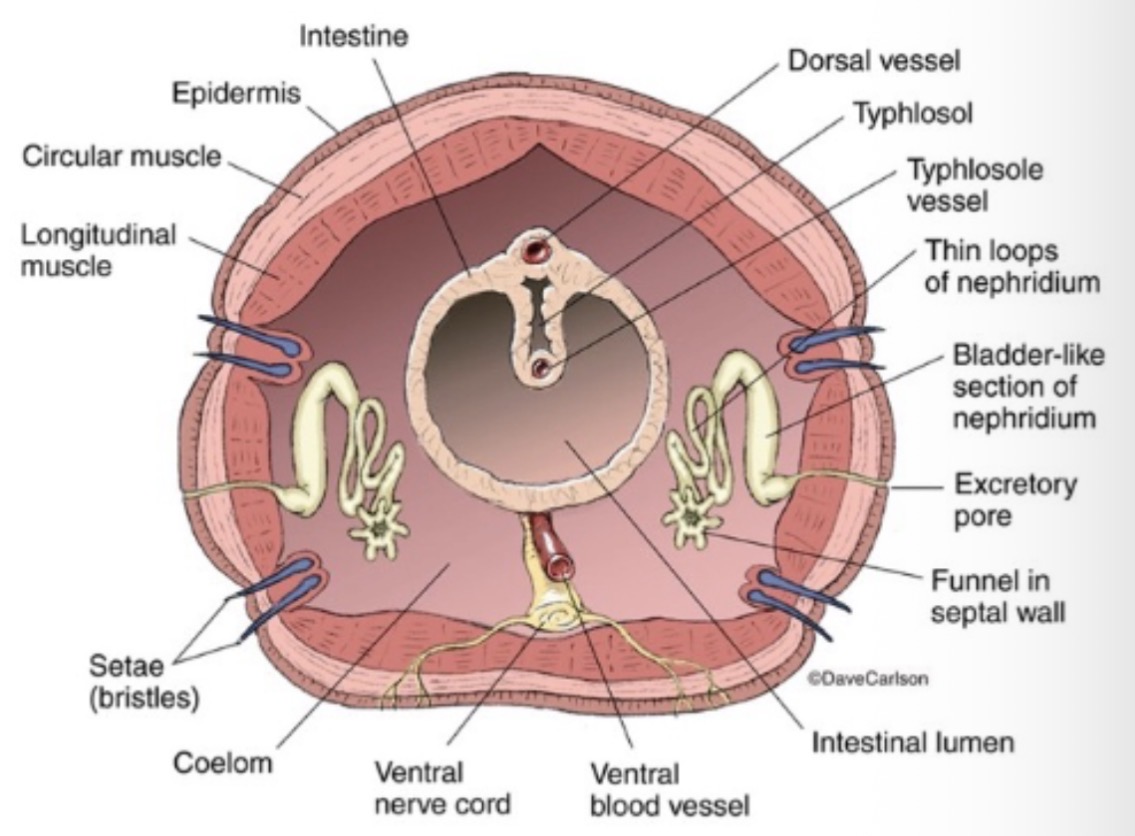
Circular/longitudinal muscle
Muscle for locomotion

Defining features of Porifera
Cellular level of organization - NO TRUE TISSUES/ORGANS
Sessile
Filter feeders
Spicules/ collagen fibers work as internal skeleton
Classes within Porifera
Calcarea
Hexactinellida
Demospongiae

Calcarea
Phylum: Porifera
Spicules of calcium
Asconoid, syconoid, or leuconoid
Small, tubular, or vase-shaped

Hexactinellida
Phylum: Porifera
Spicules of silica
Glass-like lattice when dead
Syconoid or leuconoid

Demospongiae
Phylum: Porifera
Spicules of silica or sponging
Leuconoid
Mostly large
Asconoid
One internal cavity lined with choanocytes
Reduced surface area (small)
Tube-shaped
Syconoid
Tubular with a singular osculum
Lining folded outward canals lines with choanocytes
Increased surface area
Tube-shaped
Leuconoid
Most complex
Small chambers lined with choanocytes
Increased surface area

Defining features of Cnidaria
Tissue-level organization - NO ORGANS
Neural net - limited coordinated movement and behavior
Cnidocytes - specialized stinging cells
Two distinct life phases
Hydrostatic skeleton
Classes within Cnidaria
Hydrozoa
Scyphozoa
Cubozoa
Anthzoa

Hydrozoa
Phylum: Cnidaria
Polyp dominant
Medusa form - bell projects inward to form velum
Most colonial
Specialized polyps for prey

Scyphozoa
Phylum: Cnidaria
Medusa dominant
No velum present on bell of Medusa (bell margin scalloped)
Four gastric pouches connected to radial canals and ring canals
Cubozoa
Phylum: Cnidaria
Medusa dominant
Bell is square
Velarium instead of velum
Flattened pedalium on each tentacle

Anthozoa
Phylum: Cnidaria
Polyp dominant
Flower-like appearance
NO medusa stage
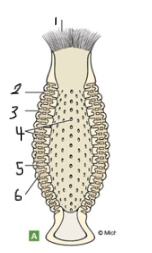
Identify 2
Dermal ostia

Identify 5
Incurrent canals
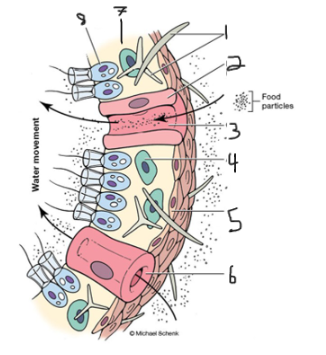
Identify 6
Porocyte - line dermal ostia
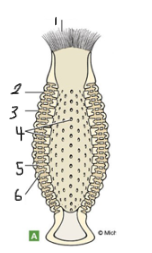
Identify 6
Radial canals

Identify 4
Spongocoel - secrete spongin collagen

Identify 1
Osculum

Identify 8
Choanocytes - create water flow to collect food/sexual reproduction

Identify 7
Mesophyl

Identify 4
Amoebocytes - phagocytize food
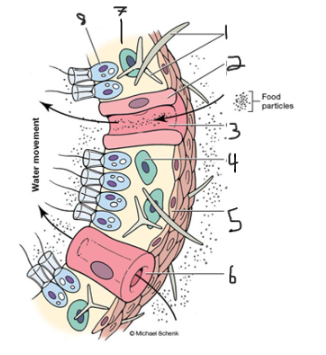
Identify 5
Pinacocytes - form pinacoderm/ incipient tissue

Identify what is happening
Budding

Identify the structure
Cnidocyte - cells that contain cnidae

Identify 9
Epidermis - protective outer-layer of cells

Identify 8
Gastrodermis - Nutritive muscular cells for digestion and muscular movement

Identify 10
Gastrovascular cavity - blind gut

Identify 7
Mesoglea - acts as an elastic skeleton

Identify 12
Mouth

Identify the structure
Nematocyst - specialized type of cnidocyte that contains toxin

Identify 11
Tentacles
Taxonomy
Practice of classifying organisms
Binomial nomenclature
Scientific naming in a two-part format
Systematics
Study of degrees of relatedness among species
Phylogenetic tree
Diagram showing potential evolutionary relationships among organisms across time
Character
Genetic-based feature
Plesiomorphic character
Ancestral characteristic NOT USED to build a phylogeny
Homology
Shared derived characteristics INHERITED from a COMMON ANCESTOR
Analogy
Shared derived characteristics due to CONVERGENT EVOLUTION
Are the wings of bats and birds homologous or analogous?
Homologous
Are the forelimb bones of birds and bats homologous or analogous?
Analogous
Tissue
Groups of similar cells that perform a common function

Epithelial tissue
Tissues that cover the external/internal surfaces of vessels as barriers and to aid in secretion/absorption.
Simple epithelium
Single cell layer
Simple squamous
Type of epithelial tissue where flattened, irregularly shaped single cell layer
Simple cuboidal
Type of epithelial tissue where box-shaped single cell layer
Simple columnar
Type of epithelial tissue where column-shaped single cell layer
Simple columnar
Type of epithelial tissue where column-shaped single cell layer

Connective tissue
Tissues that bind organs, support structures, and store nutrients
Cartilage
Type of connective tissue, widely-spaced cells within the gelatinous glycoprotein matrix. It provides firm, flexible support
Bone
Type of connective tissue that stores calcium and provides rigid support to overall structure
Adipose
Type of connective tissue that sequesters and stores energy as fat
Blood
Type of connective tissue that transports most anything that cells need and produce

Muscle
Type of tissue that contracts and creates movement
Smooth muscle
Type of muscle tissue with long, spindly shaped. Has no automatic control
Skeletal muscle
Type of muscle tissue that is made of long, unbranded fibers. Has voluntary movement and works with the skeleton
Cardiac muscle
Type of muscle tissue that is associated with the walls of the heart and has no automatic control
Nervous
Type of tissue that stores and transmits information
What is the species we are using for the research paper?
Tribolium casteneum (Herbst) - aka flour beetles
What was the Null hypothesis for the flour beetle experiment?
The beetles would NOT be responsive to light
How many beetles were used in the experiment?
48
What kinds of light were used in the flour beetle experiment?
LED and UV light