Green Chemistry - 1A03 (Term 1)
 Call Kai
 Learn
Learn Practice Test
 Spaced Repetition
 Match
Match Flashcards
 Knowt Play
1/30

There's no tags or description
Looks like no tags are added yet.
Name | Mastery | Learn | Test | Matching | Spaced | Call with Kai | Chat |
|---|
No analytics yet
Send a link to your students to track their progress
31 Terms
Sustainabilty
Sustainability is about "meeting the needs of the present without compromising the ability
of future generations to meet their own needs."
Case Study: Ibuprofen
Major ingredient in Advil and Motrin.
• Developed in 1960 as a potentially safer
alternative to Aspirin.
• NSAID (non-steroidal anti-inflammatory)
headaches, analgesic (pain relief), fever
relief, inflammatory diseases,
rheumatoid disorders, etc.
• Inhibits enzyme that produces
prostaglandins (chemicals that trigger
pain and inflammation).
Green Chemsitry
Green Chemistry is a revolutionary
approach to the way that products are
made; it is a science that aims to reduce
or eliminate the use and/or generation of
hazardous substances in the design
phase of materials development.
How can green chemistry be implemented?
1) Improve resource use
2) Increased energy efficiency
3) Reduced human health and enviornmental hazards
Improved Resource Use
We want materials to come from renweal feedstocks
If we can get our starting material from bacteria, fungi, algae, it will be much more efficient
Increased Energy Efficiency
Run processes at low temperatures and pressures
Reduced human health and environmental hazards
Protect workers at the chemical plant and consumers who use the products.
Use non-toxic or less toxic chemicals.
Make chemicals biodegradable so they break down into simpler substances (e.g., CO₂ and H₂O).
Example: DDT was used to repel/control mosquitoes but had harmful effects on the environment.
3 main factors for Reduced human health and environmental hazards
3 main factors:
1. Limit accidents during manufacturing.
2. Limit accidents during use.
3. Reduce hazards during disposal.
The Twelve Principles of Green Chemistry
1) Waste prevention
2) Atom Economy
3) Less hazardous chemical synthesis
4) Designing safer chemicals
5)Safer solvents
6) Design for energy efficiency
7) Use of renewable feedstocks
8) Reduce derivatives
9) Catalysis
10) Design for degradation
11) real time analysis for pollution prevention
12) Inherently safer chemistry for accident prevention
Catalyst
Speeds up the rate of a chemical requestion. Reaches equilibrium faster and is not consumed in a reaction.
Solvent
Substances are dissolved in a solvents, which are usually liquids to form solutions.
Solute is the minority, solvent is the majority.
Green Chemistry Benefits
• Energy optimization:
reduced temperature
• Many are reusable
• Direct synthesis routes,
reduced intermediate
products and waste
• Faster reaction time
What are solvents used for?
• Dissolving solutes
• Making solutions with a certain concentration
• Efficiently mixing a reaction
• Controlling the amount of energy (heating or cooling)
• Isolating and purifying a product from the unwanted byproducts
water is the safest solvent and has a high heat cpacity
others come with additional hazards
in green chemistry you use safer solvents
having no solvents is also better because it now has to be treated wich energy time and money.
How can we telll if something is '“green”
• To evaluate whether a process is
“green” requires metrics or calculations
to quantify how efficient it is, how much
waste is produced, how hazardous it is,
how renewable it is, etc.
• We typically compare two processes to
each other to determine which one is
greener
• “Green” is not a Binary – there are
“shades of green!”
Green is a spectrum
We use green to compare the process of things
Implications of Old synthesis of ibuprofen:
More reaction steps - 6
More chemical waste and pollution
Lower atom economy
Higher manufacturing costs
New synthesis of ibuprofen:
Fewer reaction steps - 3
Less chemical waste and pollution
Better atom economy
Lower manufacturing costs
Less environmental harm
Green chemistry Metrics
metrics are used to quantify the efficiency or environmental performance of a chemical process.
Three green chemistry metrics
1) Atom Economy
2) Reaction Mass Efficiency
3) E factor
These metrics target Waste prevention, and atom economy
Green chemistry metrics
• To evaluate whether a process is
“green” requires metrics or calculations
to quantify how efficient it is, how much
waste is produced, how hazardous it is,
how renewable it is, etc.
• We typically compare two processes to
each other to determine which one is
greener
• “Green” is not a Binary – there are
“shades of green!”
Old synthesis of ibuprofen:
More reaction steps
More chemical waste and pollution
Lower atom economy
Higher manufacturing costs
Higher e factor produces more waste
Lower RME because more reactant mass is wasted.
New synthesis of ibuprofen:
Fewer reaction steps
Less chemical waste and pollution
Better atom economy
Lower manufacturing costs
Less environmental harm
Lower e factor, produces less waste
Higher RME because more reactant mass becomes the desired product.
Atom Economy
Atom Economy: ratio of the molar mass of the desired product to the total molar mass
of all reactants
Goal: all atoms from the reactant materials should be incorporated into the final
(desired) product.
If atom economy is high, Most of the matter started out in the reactant goes into the desired product, which is good
Reaction Mass Efficiency
RME: A measure of how materially efficiently the mass of reactants is converted into the
desired product, considering both atom economy and reaction yield.
Goal: all atoms from the reactant materials should be incorporated into the final
(desired) product, with the best possible yield. (Note: there are different definitions of
RME)
If percent yield is anything other than 100%, the RME is always going to be lower than the atom economy
A lower reaction yield in a synthesis means more waste, and more energy to separate products from unwanted side reactions.
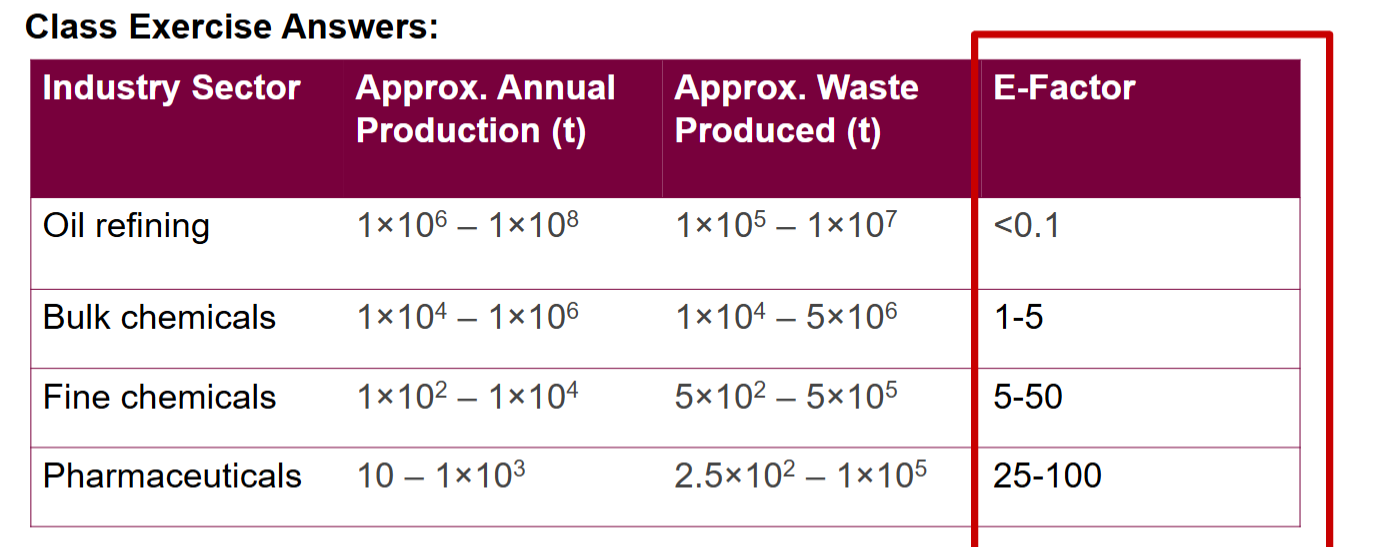
E - factor
E factor: ratio of the total mass of waste to the mass of the desired product.
Goal: reduce waste, including excess reactants, solvents, byproducts.
the larger the e-factor, the less sustainable the process is going to be
E-Factor values
Summary of green chemistry

Which is greener?

Life cycle assesment
LCA evaluates the environmental impact of a product, process, or service,
including all inputs and outputs, across its entire life cycle.

Summary of green chemistry and LCA

UN Sustainable Development Goals
• UN SDGs are an example of
systems thinking
• 17 goals to achieve world
peace and prosperity
• Found in the 2030 Agenda for
Sustainable Development
• 2015: adopted by all UN
member states (incl. Canada)
• Each goal has targets and
indicators used to monitor
progres
17 UN SDGS
