lab chapter 14-15
 Call Kai
 Learn
 Practice Test
 Spaced Repetition
 Match
 Flashcards
 Knowt Play
1/185

There's no tags or description
Looks like no tags are added yet.
186 Terms

Anatomy of peripheral nerve (1)
Nerve

Anatomy of peripheral nerve (2): ________
Fascicle

Anatomy of peripheral nerve (3): _____ _______
Blood vessels

Anatomy of peripheral nerve (4): __________
Epineurium

Anatomy of peripheral nerve (5): ___________
Perineurium

Anatomy of peripheral nerve (6): ___________
Endoneurium
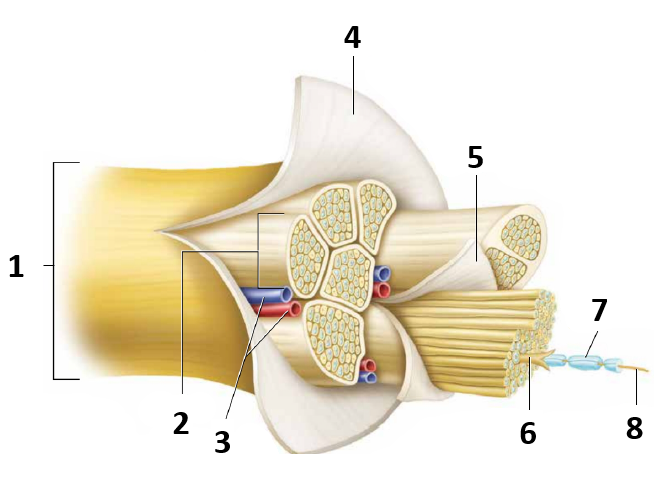
Anatomy of peripheral nerve (7)
_______ ____ (______ ______)
Schwann cell (myelin sheath)

Anatomy of peripheral nerve (8): ____
Axon
Consists of axons (nerve fiber), blood/lymph vessels, connective tissue sheaths.
_____
Nerve
Cell of membrane of axon: ________
Axolemma
Surrounds a nerve fiber: ___________
Endoneurium
A bundle of axons: ________
Fascicle
Surrounds neuron fascicle.
___________
Perineurium
Surrounds entire nerve.
__________
Epineurium

Cranial nerves (1 - I): _________ ____
Olfactory bulb

Cranial nerves (2 - II): _____ _____
Optic nerve

Cranial nerves (3 - III): __________ _____
Oculomotor nerve

Cranial nerves (4 - IV): _________ _____
Trochlear nerve

Cranial nerves (5 - V)
Trigeminal nerve
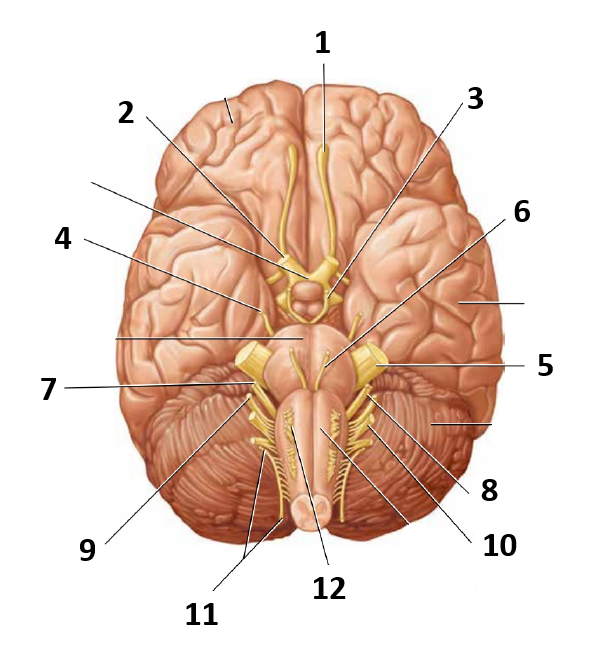
Cranial nerves (6 - VI): ________ _____
Abducens nerve

Cranial nerves (7 - VII)
Facial nerve

Cranial nerves (8 - VIII): ________________ _____
Vestibulocochlear nerve

Cranial nerves (9 - IX): ________________ _____
Glossopharyngeal nerve
Cranial nerves (10 - X): _____ _____
Vagus nerve

Cranial nerves (11 - XI): _________ _____
Accessory nerve

Cranial nerves (12 - XII): ___________ _____
Hypoglossal nerve
function of these nerves: olfactory, optic, vestibulocochlear
_______ ____ ______
Sensory only nerves
Function of these nerves: Oculomotor, trochlear, abducens, accessory, hypoglossal
_____ ____ ______
Motor only nerves
Function of: Trigeminal, facial, glossopharyngeal, vagus
_____ ______
Mixed nerves
Smell
Action of nerve: _________ _____. (I)
Olfactory nerve
Vision
Action of nerve _____ _____. (II)
Optic nerve
Movement of eyelid
Action of nerve __________ _____. (III)
Oculomotor nerve
Movement of eyeball
Action of nerve ___. (IV)
Trochlear
Chewing
Action of nerve ___. (V)
Trigeminal
Movement of eyeball
Action of nerve ________ _____. (VI)
Abducens nerve
Taste, facial expression, tear secretion, salivation
Action of nerve (VII): ______ _____
Facial nerve
Equilibrium and hearing
Action of nerve _________________ _____. (VIII)
Vestibulocochlear nerve
Action of nerve: Taste, swallowing, speech, salivation. (IX)
________________ _____
Glossopharyngeal nerve
Taste, somatic sensation, smooth muscle contraction, slows heart rate, digestive gland secretion.
Action of nerve _____ _____. (X)
Vagus nerve
Action of nerve (Accessory - XI)
__________
Swallowing
Action of nerve (Hypoglossal - XII)
______, __________
Speech, swallowing
Cranial nerve test (I - Olfactory)
_____ ______ ______
Sniff strong smells
Cranial nerve test (II - Optic): ___ _____ at 20ft
Eye chart
Cranial nerve test (III - Oculomotor) (IV - Trochlear) (VI - Abducens)
____ __ _________ __________, _____ __ ______
Look at different directions, light on pupils
Cranial nerve test (V - Trigeminal)
_____ ______, ____ ____
Touch cornea, bite down
Smile, raise eyebrows, whistle, close eyes
Cranial nerve test for (VII): ______ _____
Facial nerve
Cranial nerve test (VIII - Vestibulocochlear)
_______ ____
Hearing test
Cranial nerve test (IX - Glossopharyngeal) (X - Vagus).
___ __ __ _____ _____, ___ ______
Say ah to check vulva, gag reflex
Shrug shoulders
Cranial nerve test _________ _____. (XI)
Accessory nerve
Cranial nerve test (XII - hypoglossal): ______ _____ ___, ___ _________
Tongue stuck out, not deviating

Spinal nerve branches (1): ____ _______ __ ____
Deep muscles of back
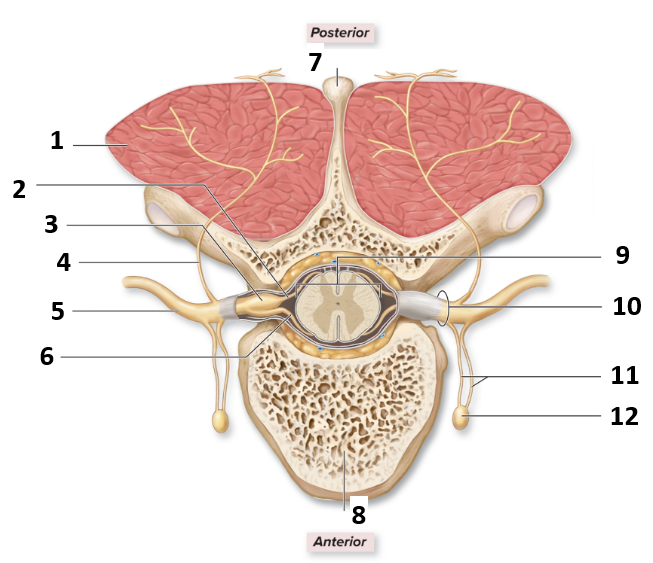
Spinal nerve branches (2): _________ ____
Posterior root

Spinal nerve branches (3): _________ ____ ________
Posterior root ganglion

Spinal nerve branches (4): _________ _____
Posterior ramus

Spinal nerve branches (5): ________ _____
Anterior ramus

Spinal nerve branches (6): ________ ____
Anterior root

Spinal nerve branches (7): _______ _______
Spinous process
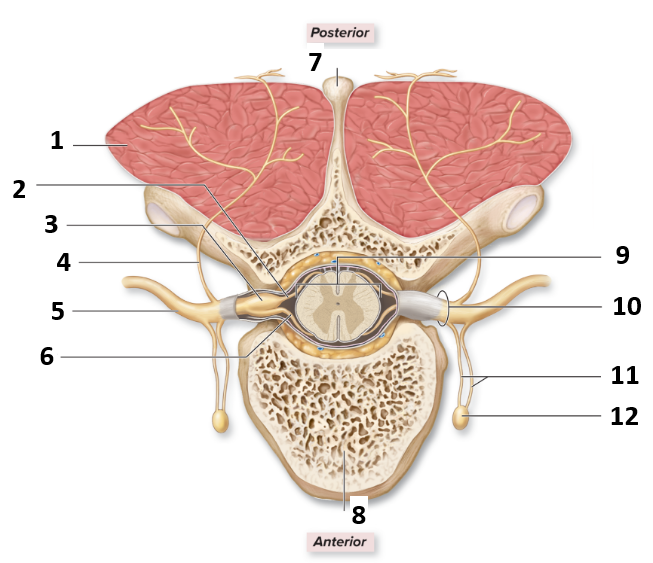
Spinal nerve branches (8): ____ __ ________
Body of vertebra

Spinal nerve branches (9)
Spinal cord

Spinal nerve branches (10): ______ _____
Spinal nerve

Spinal nerve branches (11): ____ _____________
Rami communicantes

Spinal nerve branches (12).
____________ _____ ________
Sympathetic trunk ganglion

Spinal nerve (1): _______ _____
Phrenic nerve

Spinal nerve (2): ________ _____
Axillary nerve

Spinal nerve (3): ________________ _____
Musculocutaneous nerve

Spinal nerve (4): ___________ ______
Intercostal nerves

Spinal nerve (5): ______ _____
Radial nerve
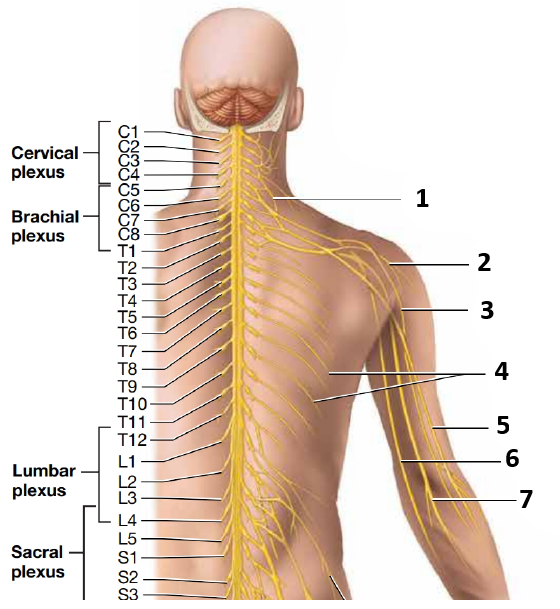
Spinal nerve (6)
Ulnar nerve
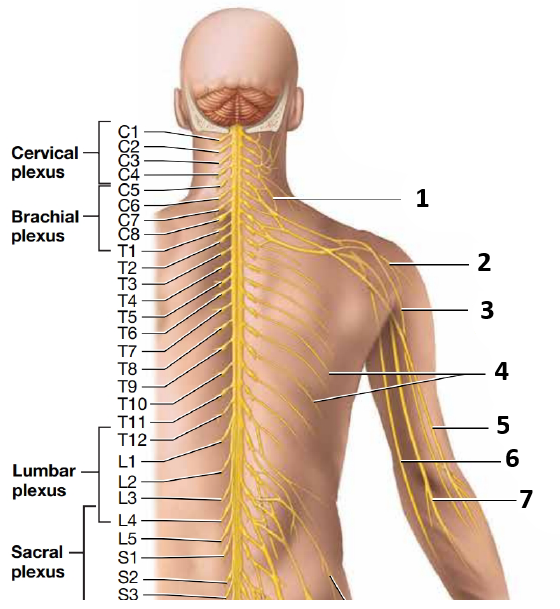
Spinal nerve (7)
Median nerve

Spinal nerve (8): medial. ______ _____
Tibial nerve

Spinal nerve (9): _______ _______ _________ _____
Lateral femoral cutaneous nerve

Spinal nerve (10): _______ _____
Femoral nerve

Spinal nerve (11): _______ _____
Sciatic nerve

Spinal nerve (12): lateral
______ _______ _____
Common fibular nerve
Formed by joining of ventral (anterior) rami of spinal nerves.
_____ ______
Nerve plexus
Plexus that serves head, neck, and shoulders.
________ ______
Cervical plexus
Plexus that serves chest, shoulders, arms and hands.
________ _____
Brachial plexus
Plexus that serves back, abdomen, medial thighs, knees, and calves.
______ ______
Lumbar plexus
Plexus that serves pelvis, buttocks, genitals, thighs, calves, and feet.
______ ______
Sacral plexus

Spinal plexus (1) (C1-C4)
Cervical plexus

Spinal plexus (2) C5-T1.
________ ______
Brachial plexus

Spinal plexus (3)
Lumbar plexus

Spinal plexus (4) (L4-S4): ______ ______
Sacral plexus
Formed by anterior rami of C1-C4, C5 contributes to some axons.
Innervates: anterior neck muscles, skin of neck, portions of head and shoulders.
________ ______
Cervical plexus
Formed from C3-C5
Innervates: diaphragm.
Cord damage above C3 = respiratory arrest
_______ _____
Phrenic nerve
Anterior rami (C5-T1)
Innervates shoulder and upper limb
Important nerves arising from it: axillary nerve, ulnar nerve, median nerve, radial nerve.
________ ______
Brachial plexus
Anterior rami (L1-L4)
Supplies abdominal wall, part of external genitals, anterior/medial thigh.
Femoral nerve → saphenous nerve, obturator nerve
______ ______
Lumbar plexus
Anterior rami (L4-L5 and S1-S4)
Supplies buttocks, external genitalia, anus, perineum, and most of the lower limb
Has sciatic nerve
______ ______
Sacral plexus
L4-S3
Long nerve that is part of sacral plexus.
_______ _____
Sciatic nerve

Nerves of lumbar plexus (1)
Medial thigh
_________ _____
Obturator nerve

Nerves sacral plexus (2)
Urogenital region
________ _____
Pudendal nerve

Nerves of lumbar plexus (3)
Close to femur
_______ _____
Femoral nerve

Nerves of sacral plexus (4)
Behind thigh. Splits into tibial and fibular.
____ ____
Sciatic nerve
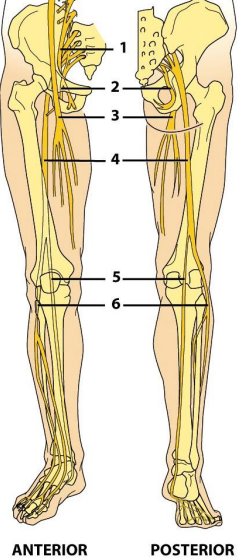
Nerves of sacral plexus (5)
Behind knee
Tibial nerve
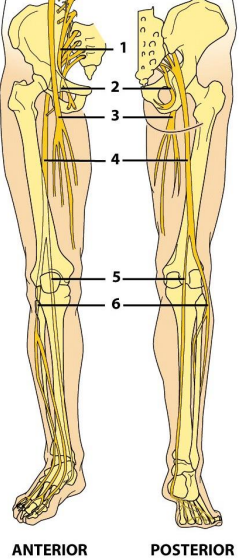
Nerves of sacral plexus (6)
Lateral leg
______ _______ _____
Common fibular nerve
Automatic response to change in environment.
______
Reflex
The integration center for spinal reflexes
____ ______
Gray matter
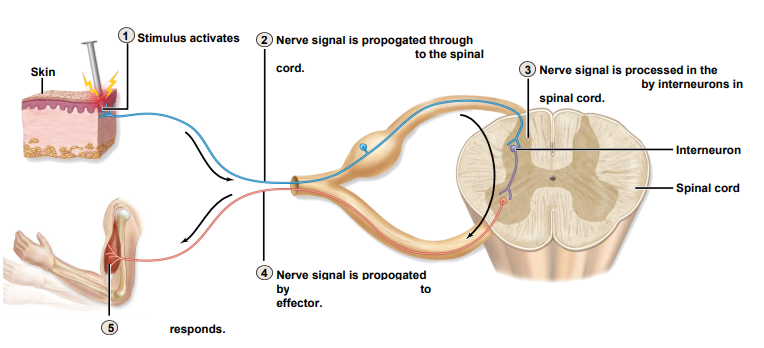
Components of reflex arc (1): Stimulus activates _______ ________ cell
Sensory receptor

Components of reflex arc (2):
Nerve signal is propogated through _______ ______ __ _____ to the spinal cord
Sensory neuron in nerve

Components of reflex arc (3): Nerve signal is processed in the ___________ ______ by interneurons in spinal cord
Integration center