R2-M3
 Call Kai
 Learn
 Practice Test
 Spaced Repetition
 Match
 Flashcards
 Knowt Play
1/16

There's no tags or description
Looks like no tags are added yet.
17 Terms


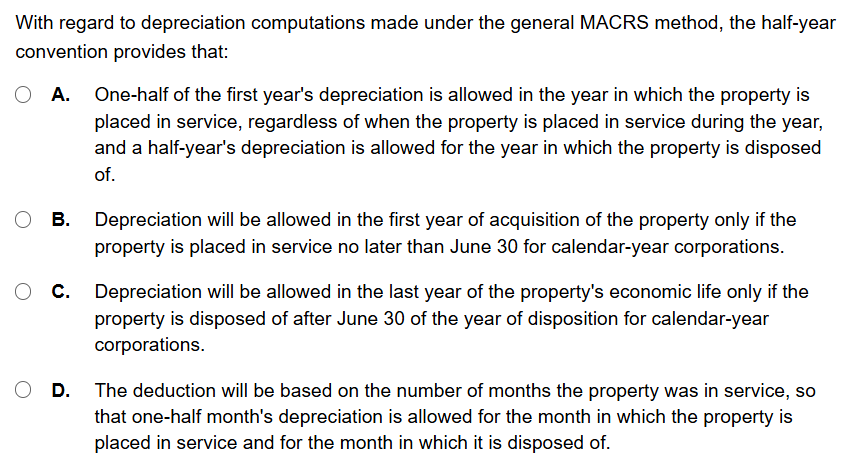


Choice "D" is correct. When a taxpayer places more than 40 percent of its property (other than certain qualifying real property) into service in the last quarter of the taxable year, the corporation must use the mid-quarter convention for MACRS depreciation purposes. With this method the acquisitions are segregated by quarter and treated as if placed in service in the middle of each respective quarter.

Choice "B" is correct. To qualify for the IRC Section 179 expense deduction, the property must be tangible personal property or qualified real property improvements acquired by purchase from an unrelated party for use in the active conduct of a trade or business.
Statements I and II are both correct statements concerning the criteria for property to qualify under IRC Section 179.

Choice "A" is correct. Under the Section 179 election to expense certain depreciable business assets, the taxpayer may expense the cost of qualifying depreciable property up to an annual limitation amount. Land is not depreciable property and does not qualify for Section 179, so only the cost of the depreciable personal property can be expensed ($100,000).
Choice "B" is incorrect. This answer choice only includes the land and not the depreciable personal property. Land is not a depreciable asset and is not eligible for the Section 179 expense deduction. Only the depreciable personal property is eligible for the Section 179 expense deduction.
Choice "C" is incorrect. This answer choice includes the land and the personal property; however, land is not a depreciable asset and is not eligible for the Section 179 expense deduction.
Choice "D" is incorrect. The taxpayer can only expense qualified business-use property which equals $100,000 in this scenario. Land does not qualify for the Section 179 deduction.


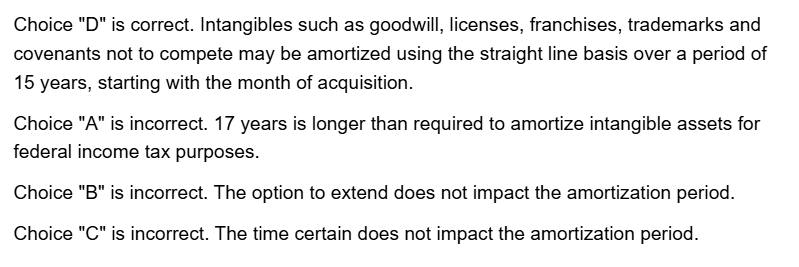


Choice "C" is correct. New Brands, Inc. is permitted to deduct $5,000 of organizational costs in Year 1 and is permitted to amortize the remaining organizational costs over 180 months, starting in September of Year 1. After the $5,000 is immediately deducted, New Brands, Inc. is left with $41,400 of organizational costs to be amortized. The portion that is amortized in Year 1 is $920: ($41,400 / 180 months) × 4 months. New Brands, Inc. will add this $920 to the $5,000 immediate deduction. Therefore, New Brands, Inc.'s total Year 1 organizational cost deduction is $5,920.
Choice "A" is incorrect. New Brands, Inc. is permitted to deduct $5,000 of organizational costs in Year 1 and will amortize the remaining amount ($41,400) over 180 months, starting in September of Year 1. It is important to note that New Brands will deduct a full month of amortization for the first month of business, even though the business did not start until the middle of the month (September 15). Therefore, New Brands, Inc. will deduct $920 [($41,400 / 180 months) × 4 months] in addition to the $5,000 immediate deduction. Accordingly, New Brands, Inc.'s total Year 1 organizational cost deduction is $5,920.
Choice "B" is incorrect. New Brands Inc. is permitted to deduct $5,000 of the organizational costs in Year 1 and will amortize the rest of the costs over 180 months, starting when business operations start. This answer choice disregards the immediate $5,000 deduction and calculates four months of amortization for the full organizational cost amount of $46,400: ($46,400 / 180 months) × 4 months = $1,031.
Choice "D" is incorrect. Not only is New Brands, Inc. permitted to deduct $5,000 of organizational costs in Year 1, but it must also amortize the remaining organizational costs over 180 months, starting in September of Year 1. After the $5,000 is immediately deducted, New Brands, Inc. is left with $41,400 of organizational costs to be amortized. The portion that is amortized in Year 1 is $920: ($41,400 / 180 months) × 4 months. New Brands, Inc. will add this $920 to the $5,000 immediate deduction, totaling $5,920.
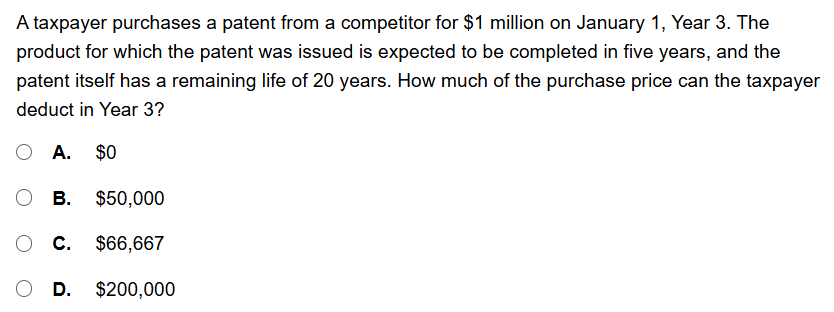

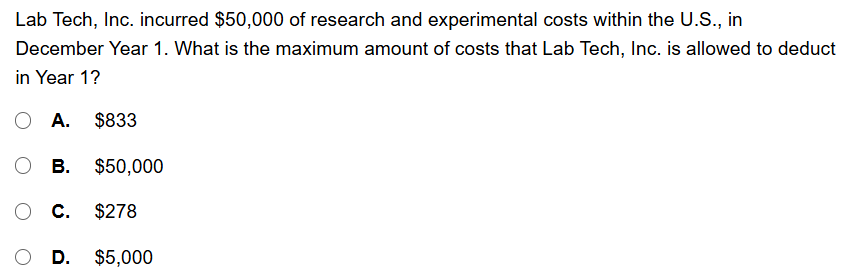

Choice "A" is correct. Up to $5,000 of organizational expenses may be deducted in the year business begins, with any remaining amount amortized over 180 months (15 years). The $5,000 allowance is reduced dollar-for-dollar when total costs exceed $50,000.
Total organizational expenses | $32,000 |
Less: amount immediately expensed in first year | (5,000) |
Remaining organizational expenses to be amortized | 27,000 |
Divided by total months of amortization | 180 |
Monthly amortization expense | 150 |
Multiplied by number of months of amortization in first year (July 1 to Dec. 31) | × 6 |
First year amortization | 900 |
Amount immediately expensed in first year | 5,000 |
Total first year deduction for organizational expenses | $5,900 |
Choice "B" is incorrect. The $3,200 amount appears to represent 10 percent of the total $32,000 for the first year deduction of organizational expenses, which is not the proper method for computing the deduction. The correct amount is an immediate expense of $5,000 plus $900 of amortization ($27,000 × 6 months / 180 months), for a total deduction in the first year of $5,900.
Choice "C" is incorrect. The $6,400 amount includes 10 months (March 1–December 31) of amortization in the first year, along with the $5,000 immediately expensed in the first year ($32,000 – $5,000 = $27,000 × 10 months / 180 months = $1,800 + $5,000 = $6,800). Amortization begins with the month business operations start (July 1), not the first month in which organizational expenses are incurred (March 1).
Choice "D" is incorrect. The $6,800 amount includes 12 months (January 1–December 31) of amortization in the first year, along with the $5,000 immediately expensed in the first year ($32,000 – $5,000 = $27,000 × 12 months / 180 months = $1,800 + $5,000 = $6,800). Amortization begins with the month business operations start (July 1), not the month of incorporation (January 1).