Baddeley and Hitch- Memory
 Call Kai
 Learn
 Practice Test
 Spaced Repetition
 Match
 Flashcards
 Knowt Play
1/7

Earn XP
8 Terms
What are the three main components of the model?
Central executive
The Phonological Loop
The Visio-Spatial Sketchpad
Diagram of the Working Memory Model (Baddeley and Hitch 1974)
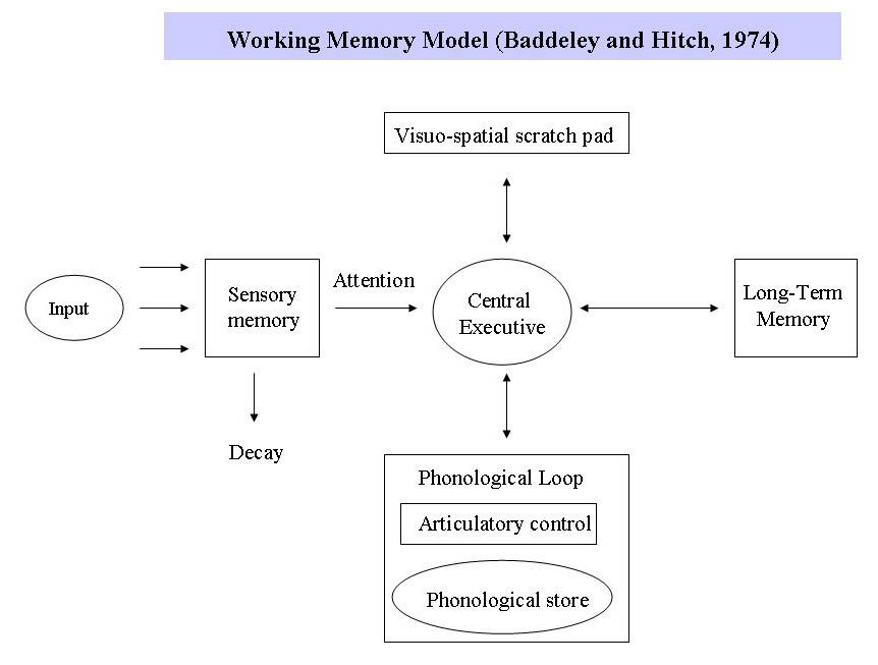
What two “slave systems” does the central executive rely on?
The Phonological Loop (inner ear)
The Visio-Spatial Sketchpad (inner eye)
Name a function (of the six) of the Central Executive.
-Filters essential from non-essential information.
-Selects, deletes and re-orders information.
-Adds information from LTM to guide mental processes and behaviour.
-When information is no longer needed it directs its flow to the LTM.
-Combines information from the other three components.
-Co-ordinates the flow of information between working and LTM.
What does the Visio-Spatial Sketchpad do?
Stores visual and spatial information for a brief time
What does the Phonological Loop do?
Stores a limited amount of verbal speech-like information for a brief time
Can store and repeat auditory STM
What are the two parts of the Phonological Loop?
Phonological Store
Articulatory Control Process
Compare the format of speech (perceived/produced), time stored and format of words of the Phonological Store and Articulatory Control Process
| Phonological Store | Articulatory Control Process |
Perceived/Produced | Speech perception | Speech production |
Time stored | Holds information in a speech-based form for 1-2s | Circulates information in a loop |
Format | Must be converted into an articulatory (spoken) code | Converts written material into an articulatory code |