BIOL 2140
 Call Kai
 Learn
 Practice Test
 Spaced Repetition
 Match
 Flashcards
 Knowt Play
1/120

There's no tags or description
Looks like no tags are added yet.
121 Terms
Life History
The schedule of an organism's life, including age of reproduction and survival.
Fecundity
The number of offspring produced per reproductive episode.
Parity
The number of reproductive episodes an organism experiences in its lifetime.
Parental Investment
The amount of time and energy devoted to caring for offspring.
Longevity
The expected lifespan of an organism.
r-Selected Species Traits
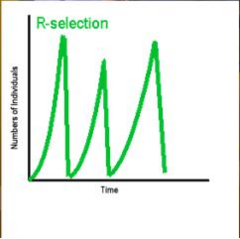
Rapid development, early reproduction, semelparity, large clutches, small offspring, short lifespan.
K-Selected Species Traits
Slow development, delayed reproduction, iteroparity, small clutches, high parental care, long lifespan.
Grime's Ruderals
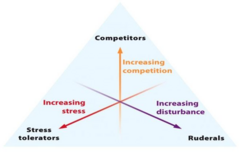
Plants adapted to high disturbance; they grow fast and devote energy to reproduction.

Grime's Stress Tolerators
Plants adapted to high stress; characterized by slow growth and vegetative reproduction.
Principle of Allocation
Energy devoted to one trait cannot be allocated to another trait.
Offspring Size vs. Number Trade-off
Producing more offspring generally results in smaller individual offspring size.
Determinate Growth
A growth pattern where an individual stops growing after initiating reproduction.
Indeterminate Growth
A growth pattern where an individual continues growing after reproduction begins.
Semelparity
A reproductive strategy where an organism breeds once and then dies.
Iteroparity
A reproductive strategy where an organism breeds multiple times throughout life.
Charnov and Schaffer Model
Semelparity is favored when adult survival is low relative to juvenile survival.
Senescence
A gradual decrease in fecundity accompanied by an increase in mortality probability.
Photoperiod
The daily amount of light that serves as an environmental cue.
Effects of predatiom
Has a strong affect many life history traits. (time to hatching, size at hatching, metamorphosis, sexual maturity)
Trade off
Hatch at a smaller size; more vulnerable to aquatic predators
Sexual Reproduction
Progeny inherit DNA from 2 parents
Gonads
Primary sexual Organs
Gametes produced through Meiosis
into haploid cells (a single set of chromosomes)
haploid Gametes fuse
diploid zygote
vegetative reproduction
An individual is produced from the nonsexual tissues of a parent
Clones
Individuals that descend asexually from the same parents (identical genotype)
Binary Fission
Duplication of genes followed by division of the cell into 2 identical cells
Parthenogenesis
Embryo is produced without fertilazation
Animals that undergo parthenogenesis are typically
all female
Clones result when germ cells
develop directly to egg cells
Genetically variable offspring result when germ cells undergo
partial meiosis
Cost pf Meiosis
50% reduction in the number of a parents genes passed in to the next generation
Hermaphroditism
A condition in which an individual has both female and male gonads and functions as both a male and female in sexual reproduction by producing both sperm and eggs.
Purging Mutations
Sexually reproducing organisms can lose deleterious mutations during meiosis
Random assortment
many gametes will not contain mutations
Red Queen Hypothesis
Sexual selection allows hosts to evolve at faster rate that counters the rapid evolution of parasites
Perfect flowers
Flowers that contain both male and female structures
simultaneous hermaphrodites
Possess Male and Female reproductive functions at the same time
Sequential hermaphrodites
Possess Male and Female reproductive functions and switch
Monoecious
Plants that have separate Male and Female flowers on the same individual
Dioecious
Plants that contain either only Male flowers or only Female flowers on a single individual
Comparing sexual strategy
Natural selection should favor the strategy with the highest fitness. If a Male can invest in a Female function while giving up only a little male fitness, or vice versa, selection should favor hermaphroditism
Self-fertilization
occurs when an individual's Male gametes fertilize its own female gametes
Costs
Inbreeding depression and less genetic diversity
Selection should favor individuals that occurs when possible
Sequential Hermaphroditism
Avoids selfing by separating sexual functions in time
Outcross
When mates are available
When mates are unavailable
Self-fertilize, not as many viable offspring, but it is better than nothing
Mixed mating can be in response to
a lack of resources in the environment
The ratio of Male to Female offspring
1:1
Female chromosomes
XX
Male chromosomes
XY
Environmental sex determination
Process in which sex is determined largely by the environment = Phenotypic plasticity
Temperature-dependent sex determination
sex of an individual is determined by the temperature
Fisher: sex ratio of clutch
Each individual had one mother and one father
-On average, producing one son should give her as
great a chance of leaving future descendants as
producing one daughter
- RV of average son = RV of average daughter
- Reproductive value = contribution in terms of # of
young that an individual animal will make to the
future population
- Specific prediction from Fisher: investment in sons
& daughters should be equal
- Fitness value of son or daughter depends on the population sex ration
Frequency dependent selection
When the rarer phenotype in a population is favored by natural
selection
In a population with an uneven sex ratio, the rarer sex will compete with fewer individuals for breeding
the rarer sex will gain higher fitness
Trivers and Willard (1973)
"Prediction" is not assumed to require conscious
thought or motivation
-How can the female "predict" that sons will be
more successful?
- Female in good condition ("fat") will result in
offspring in good condition (large, well-fed!)
- A healthy son will have a much better probability
to compete successfully for mates
A son in good condition will yield higher
fitness payoffs than a daughter in good
condition
- A daughter will always mate; whether in
good or poor condition
-A son will only mate if in good condition!
Offspring sex ratio
Females can influence the sex ratios of their offspring
Bednarz & Hayden 1991: Conclusions
Overall sex ratio biased toward males
- Consistent with Fisher's Equilibrium
hypothesis
- Suggest that female-male broods are
maladaptive
- Brood reduction: large females kill males
- Parents loose on 2 ways:
- Fledge fewer young
- Skew sex ratio in wrong direction: toward females
To avoid disadvantage of maladaptive
brood reduction
- Females might "purposely" skew the sex
ratio toward (~70%) in the first laid egg
- Results in overall skew in sex ratio toward Males 57%
- Adaptive following Fisher's Model
According to Fisher's equilibrium hypothesis
what is the primary factor that would cause a
skew in the sex ratio toward females at birth?
B.) When mature females are substantially larger
than males
According to the Trivers & Willard
hypothesis, when should females skew the
sex ratio of their offspring toward males?
E.) When a female's mate is dominant, healthy, &
likely to sire many offspring
Based on the research done by Bednarz &
Hayden, why do Harris's Hawks skew the sex
ratio of their 1 st -hatched young toward males?
B.) Because males grow slower than females & need a head
start
Mating systems
-Monogamy
-Polygyny
-Polygamy
-Polyandry
Promiscuity
Member of one sex has near equal opportunity of
mating with every individual of the opposite sex
-No mating system?
- Unlikely to occur in nature for almost all animals
- May occur with some outcrossing plants and
sedentary aquatic organisms that release
gametes in H2O
What do females need to fertilize all their eggs?
One or a few matings
What do males provide in most species?
Sperm
What limits females in mating systems?
Resources
How does the availability of resources affect female reproductive success?
The more resources a female can gather, the more offspring she can produce.
What do males tend to do in mating systems?
Initiate courtship, search for females, and fight with other males for access to females.
Monogamy
Social bond between a male & female persists
through the period that is required for them to
rear offspring
Extra-pair copulations
Females may use this strategy to obtain
1) Produce offspring with better genes
2) Increase the genetic diversity of brood
3) Fertility insurance
4) Induce sperm competition
Sexual Selection
Selection related to mating, Related to the advantage in which
certain individuals have over other individuals of the same sex and species. Related to reproduction
Female choice
individuals selecting
"attractive"
characters
Male-male competition
Characters that allow males to compete with other males for
mates
sexual dimorphism
Differences in physical characteristics between males and females of the same species.
Parental Investment
the time and energy parents expend for their offspring's benefit
runaway sexual selection
Sexual selection by female choice that results in elaborate and costly secondary sexual characteristics in males.
Zahavi handicap principle
states that only traits that are true and honest indicators of male genetic quality should be used by females when choosing mates
Good genes hypothesis
Females select males on basis of trait that indicates viability or beneficial adaptation
Good health hypothesis
Females select the healthiest males
Sexy son hypothesis (fashion icon
hypothesis)
Females only receive genes that will provide their male offspring with sexy trait favored by females.
-Trait provides no adaptive benefit
Social behaviors
interactions with members of one's own species
Dilution effect
Reduced probability of predation to a single animal when in a group
More individuals watching for predators
each individual spends less time watching & more time feeding
Group benefits
Many individuals searching for food may be able to find rare food more easily
-Probability of prey capture may increase in a group
Being social makes it easier to find potential mates
attract the attention of females
Lek
Location of an aggregation displaying males that attract the opposite sex
Group costs
Groups of animals are more conspicuous to predators
The risk of parasitic infection increases in groups
High densities can
Up the rate at which diseases spread
Larger the group
the more inter-individual agonistic interactions and larger groups are better able to locate food, but that food must be
shared
Territory
Area defended by one or more individuals against the intrusion of others and defending a high-quality territory often assures greater resources.
Territories
Can be temporary or relatively permanent
Examples
Migratory bird species will establish territories though out the breeding season (e.g., Swainson's Warbler)
Swainson's Warbler Territory & Home Range
defend small, localized breeding territories in dense wetland vegetation, with home ranges that can extend several hundred meters depending on habitat quality and food availability
Dominance hierarchy
Social ranking among individuals in a group, typically determined through contests such as fighting, displays, or contests over food and occurs when conspecific density is relatively high & not feasible to defend resources against all conspecifics
Types of social interactions
donor, recipient, cooperation, selfishness, spitefulness, altruism
Donor
Individual who directs a behavior toward another individual
Recipient
the individual who receives the behavior of a donor in a social interaction
Cooperation
Donor & recipient of a social behavior both experience increased fitness from interaction (e.g., pride of lions kills prey)
Selfishness
Donor experiences increased fitness & recipient experiences
decreased fitness (e.g., competition for food)