Introduction to Operative Exam 2 Review (short version)
 Call Kai
 Learn
 Practice Test
 Spaced Repetition
 Match
 Flashcards
 Knowt Play
1/82

There's no tags or description
Looks like no tags are added yet.
83 Terms
a dental dam keeps the operating field what
dry
"W" indicates that the retainer is
wingless
"A" as in W8A indicates the retainer's beaks / jaws are ____________ positioned
apically
T/F: the retainer should be ligated with floss for the patient's safety to aid in retrieval if necessary
true
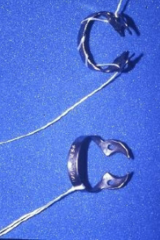
is this retainer winged or wingless
wingless

this retainer has _________ beaks
apical

is this retainer winged or wingless
winged
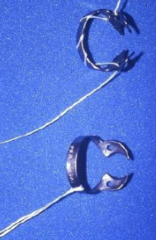
T/F: this is an example of a ligated retainer
true
a saliva ejector / auxiliary device uses _________ to remove saliva
suction
the main 2 limitations to using a saliva ejector / auxiliary device are
size of mouth, space to work

what is this
isolate device with suction
another method of isolation is using a tissue ____________ cord
retraction
T/F: an electrosurgery/surgical flap can NOT be used as an isolation method
false
the high sped evacuator isolation device is used with the highspeed handpiece and
water spray
"there will be gaps as the dental dam will have to be stretched too far" is an indication the dental dam holes are poked too (far/close)
close
"saliva will leak into the working field" is an indication the dental dam holes are poked too (far/close)
close
"there will be bunching of the dental dam" is an indication the dental dam holes are poked too (far/close)
far
"it may be hard to floss through proximal contacts" is an indication the dental dam holes are poked too (far/close)
far
in the order of operations for placing a dental dam, what step is "check shade for restoration prior to placing dental dam - resin"
step 1
in the order of operations for placing a dental dam, what step is "place the retainer (ligated)"
step 2
in the order of operations for placing a dental dam, what step is "anchor dental dam on retainer"
step 3
in the order of operations for placing a dental dam, what step is "secure dental dam on young's frame"
step 4
in the order of operations for placing a dental dam, what step is "floss dental dam between teeth"
step 5
a pit and fissure sealant is retained primarily through ___________ retention
micro-mechanical
a pit and fissure sealant is retained primarily by micro-mechanical retention that occurs after the 37% _____________ etchant is placed
phosphoric acid
adequate ________ is the key to retaining a sealant
etch
T/F: sealants must be evaluated after placement and at each visit to verify integrity of PFS
true
PFS is a low viscosity fluid __________ resin
BIS-GMA
we use 37% phosphoric acid to create micro-mechanical retention --> creates surface _____________ for resin to flow into
irregularities
we use 37% phosphoric acid to create micro-mechanical retention --> increases ____________ to provide mechanical retention
surface area
after performing an acid etch, the enamel should have a _________ look
frosty
"T/F: saliva contamination of an etched surface prior to placement of sealant has no effect on the bond of resin
false (decreases)
T/F: cotton rolls can be used as an isolation method to control moisture content
true
T/F: dry angles cannot be used as an isolation method to control moisture content
false
what step of placing a PFS is "clean tooth surface if necessary"
step 1
what step of placing a PFS is "place etchant for appropriate time/rinse/dry --> check for frosty appearance"
step 2
what step of placing a PFS is "place sealant material --> cure --> check for integrity"
step 3
what step of placing a PFS is "check sealants at every recall appointment"
step 4
the handle of the hand instrument can come in various (what 2 things)
shapes and sizes
the handle of the hand instrument can be rounded or
eight sided
we prefer the handle of the hand instrument to be (lightweight/heavyweight) which is conducive to delicate manipulation
lightweight
the shank of the hand instrument connects the handle to the
working end
T/F: the shank of a hand instrument can be a contra-angle
true
the blade of the hand instrument is also known as the __________ end
working
the blade of the hand instrument is called the ______ if it is for non-cutting purposes
nib
T/F: some instruments have a blade on both ends
true
the hand instrument formula consists of ___ numbers
3
the first number of the 3 number formula for hand instruments indicates what
width of the blade (in tenths of a millimeter)
the second number of the 3 number formula for hand instruments indicates what
blade length (in millimeters)
the third number of the 3 number formula for hand instruments indicates what
blade angle (relative to the long axis of the handle in clockwise centigrade)
if the first number in the 3 number formula for hand instruments is 20, this indicates the blade/cutting edge is ____ mm
2.0
if the second number in the 3 number formula for hand instruments is 5, this indicates the blade length is ____ mm
5.0
if the third number in the 3 number formula for hand instruments is 14, this indicates the blade angle relative to the long axis of the handle in clockwise centigrade is ___ degrees
14
"15-8-4" --> blade width is ____ mm, blade length is ____ mm, blade angle is ____ degrees
1.5, 8.0, 14
in the four number formula for hand instruments, the first number indicates the
width of the blade (in tenths of a millimeter)
in the four number formula for hand instruments, the second number indicates the
primary cutting edge angle (clockwise centigrade)
in the four number formula for hand instruments, the third number indicates the
blade length (in millimeters)
in the four number formula for hand instruments, the fourth number indicates the
blade angle (relative to the long axis of the handle in clockwise centigrade)
"10-95-7-14" --> the blade width is ___ mm
1.0
"10-95-7-14" --> the primary cutting edge angle is ___ degrees
95
"10-95-7-14" --> the blade length is ___ mm
7.0
"10-95-7-14" --> the blade angle relative to the handle is ___ degrees
14
periapical films are placed in which 2 rows of the film mount
top and bottom
periapical films show what 2 things of the selected teeth in the area
root and crown
bite wing films are placed in which row of the film mount
middle
bitewing films are taken of (posterior/anterior) teeth
posterior
when viewing full-mouth radiograph series --> the left side of the film mount = the patient's _______ side
right
caries typically appears as _____________ on radiographs
radiolucent/dark
caries has __________ borders on a radiograph
ill-defined
amalgam is (radiolucent/radiopaque) on radiographs
radiopaque
on a radiograph, an amalgam will have _______________ borders
well defined
T/F: resins will only show up as radiopaque on dental radiographs
false
T/F: resins can be both radiopaque or radiolucent on radiographs
true
on a dental radiograph, resins will have ___________ borders
well defined

these are what class amalgams
class 2

these are what class amalgams
class 2

this is what class of amalgam
class 1

these are both what class of amalgams
class 5
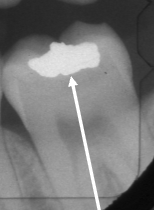
this is what class amalgam
class 1
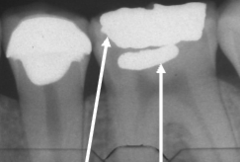
the bottom amalgam (left arrow) is what class
class 5

the top amalgam (right arrow) indicates what class of amalgam
class 1
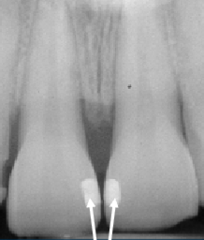
what class of resins
class 3

what class resin is this?
class 4