Biology Notes - Unit 1
 Call Kai
 Learn
Learn Practice Test
 Spaced Repetition
 Match
Match Flashcards
 Knowt Play
1/65

Earn XP
Description and Tags
coooooooooooooooooooked
Name | Mastery | Learn | Test | Matching | Spaced | Call with Kai | Chat |
|---|
No analytics yet
Send a link to your students to track their progress
66 Terms
Taxonomy
The science of classifying living things
Phylogney
The history of the evolution of species
What are the 7 levels of classification?
Domain, Kingdom, Phylum, Class, Order, Family, Genus, Species

What are the two main purposes of Taxonomy?
To identify organisms and represent relationships between organisms
What are the 6 Kingdom systems?
Eubacteria, Archaebacteria, Protista, Fungi, Plantae, Animalia
Binomial Nomenclature Naming System
Genus is the first part of the name, and species is the second part.
What does the “Genus” represent in the Binomial Nomenclature naming system?
refers to a group of organisms that are closely related and have similar characteristics.
What does the “Species” represent in the Binomial Nomenclature naming system?
refers to a group of organisms that look alike and can interbreed

What is a “Dichotomous Key”?
Two part key to identify an organism.
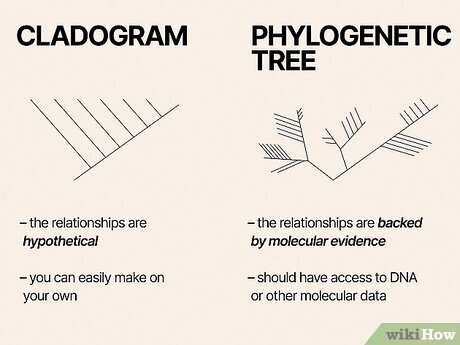
What is a Cladogram?
A tree shaped diagram that shows related characteristics between organisms.
What are the 4 different ways in which species are related? (Common Ancestry)
By similar stages of development, physiological functions, anatomical structure and similar DNA sequences.
Ancestor
An Organism from which other groups of organisms are descended.
Physiology
The study of the physical and chemical functions of an organism (example: its internal processes and the proteins it makes.)

What does a “Branch Point” represent in a phylogenetic tree?
A common ancestor
How can you tell which species are more closely related to each other on a phylogenetic key?
if they share a more recent common ancestor on an evolutionary tree
Common Ancestor
An ancestor 2 or more descendants have in common.
Most recent ancestor
most recent individual from which all organisms of the set descended
Derived Characteristic
A newer trait or feature that a group of animals or plants developed over time, which their ancient ancestors did not have.
Homology
Similarity in Anatomical Structures
Characteristics Of life
Homeostasis, Organization, Metabolism, Growth, Adaptation, Response, Reproduction
At the highest level of classification, what are the groups organisms are divided into?
Domains and Kingdoms
How do scientists decide which domain or kingdom an organism belongs to?
Based on their cell structure, how they obtain energy, and how they reproduce.
What are the 3 domains of life?
Bacteria, Archaea and Eukarya (humans)
What are the 3 types of domains generally separated by?
By their cell type.
What are the major cell types?
Prokaryotic and Eukaryotic.
What domain of life fall under the major cell type “Prokaryotic”
Bacteria and Archae
What domain of life fall under the major cell type “Eukaryotic”
Eukarya
Heterotrophs
An organism that cannot make its own food
Autotrophs
An organism that makes its own food
What is the primary difference between a prokaryote and a eukaryote?
The Nucleus. Eukaryotic cells have a membrane-bound nucleus and membrane-bound organelles, while prokaryotic cells do not
Prokaryotes characteristics
Has no nucleus (DNA floats freely), no complex organelles, and DNA from reproduction come in rings called plasmids.
Eukaryote Characteristics
Has a nucleus (DNA stored in a membrane bound nucleus), DNA from reproduction come in strands called “chromosomes”, and are 1000x larger than prokaryotes.
What Kingdom falls under the Domain of Life “Archaea”
Archaea
What Kingdom falls under the Domain of Life “Bacteria”
Eubacteria
What Kingdom falls under the Domain of Life “Eukarya”
Protista, Plantae, Fungi, Animalia
Kingdom Archaea Characteristics
Prokaryotic, Asexual, Extremophile
Extremophiles
can survive in harsh environments
Kingdom Bacteria Characteristics
Prokaryotic, Unicellular, Heterotrophs/Autotrophs, Asexual
Kingdom Protista Characteristics
Eukaryotic, Unicellular/Multicellular, Heterotrophs/Autotrophs, Sexual/Asexual
What are the 3 types of Protists?
There are plant-like protists (algae), fungi-like protists (slime mold), and animal-like protists (protozoans).
Protozoans Characteristics (Animal like Protists)
Heterotrophic and can move around w/ flagella (specialized parts)
Algae Characteristics (Plant like Protists)
Green algae live in shallow waters cause they need sunlight, red algae live in deeper waters, and brown algae are the largest and are the most complex of the multicellular algae (containing most seaweeds)
Slime Molds Characteristics (Fungi like protists)
Can move around, sometimes brightly coloured, can form fruiting bodies like mushrooms.
Kingdom Plantae Characteristics
Eukaryote, Multicellular, Autotrophs, Sexual, Cell wall (which is made up of cellulose)
Kingdom Fungi Characteristics
Eukaryotes, Unicellular/Multicellular, Heterotrophs, Sexual, Cell wall (made up of chitin)
Kingdom Animalia Characteristics
Eukaryotic, Multicellular, Heterotrophs, Sexual, Diploid
Diploid
two complete sets of chromosomes, with one set coming from each parent
Species Diversity
The variety and number of different species in a specific area
Genetic diversity
The variety of genes in a population. High diversity = better disease resistance.
Ecosystem diversity
The variety of different ecosystems across the Earth
Gene Pool
All the different genes present in a specific population
Population
A group of the same species living in the same area at the same time
Resilience
An ecosystems ability to bounce back and stay balanced after a major disturbance
Ecosystem services
The natural benefits ecosystems provide to us (i.e clean water, climate control, crop pollination)
Diversity vs Resilience
Ecosystems with greater species diversity are more resilient, produce more biomass, and better resist diseases and invasive species.
Human Actions
Interventions like introducing non-native species often alter natural food webs, leading to a decline in native species and ecosystem complexity.
What are the 3 species concepts?
Morphological, Biological, Phylogenetic
Morphological Description
Looking at the bodies shape, size and structural features
Morphological Advantages
Its simple, so its commonly used
Morphological Disadvantages
Deciding what is too much variation between individuals for them to not be species
Biological Description
Two organisms can produce fertile off spring
Biological Advantages
Widely used
Biological Disadvantages
When populations are physically separated, they cant reproduce, and cant apply it to asexual organisms or fossil species.
Phylogenetic Description
Looking at the evolutionary history of organisms
Phylogenetic Advantages
Can be applied to extinct species, uses DNA analysis so its more accurate
Phylogenetic disadvantages
Evolutionary histories arent known for all species