Health & wellbeing in society (public health)
 Call Kai
 Learn
Learn Practice Test
 Spaced Repetition
 Match
Match Flashcards
 Knowt Play
1/23

There's no tags or description
Looks like no tags are added yet.
Name | Mastery | Learn | Test | Matching | Spaced | Call with Kai | Chat |
|---|
No analytics yet
Send a link to your students to track their progress
24 Terms
What is the definition of public health?
All organised measures (whether public or private) to prevent disease, promote health, & prolong life among the population as a whole
Its activities aim to provide conditions in which people can be healthy & focus on entire populations, not on individual patients or diseases
What is the difference between public vs individual health?
Public health:
Interventions are designed to affect large populations (e.g. national vaccination campaigns, food safety regulations, air quality measures & public health education, such as anti-smoking campaigns)
Efforts target common risk factors & widespread health determinants (e.g. environment, behaviour & social conditions)
Individual health:
Focuses on diagnosing & treating specific health problems on individual patients (often after onset of symptoms)
Interventions are personalised, addressing the specific medical needs of each patients (e.g. surgeries, personalised medical consultations & prescription medications)
Why is the surveillance of diseases important?
Crucial for early detection of outbreaks (e.g. flu, COVID-19) → enables a timely response to prevent the spread of infectious diseases
Aids in understanding disease rates, population health trends & emerging health threats
Public health agencies (e.g. WHO) rely on surveillance data to inform public health policies, guide resource allocation & coordinate international response
Why are vaccination programmes important?
They protect against diseases (e.g. polio, measles, diphtheria, flue & COVID-19)
They target vulnerable groups & aim for herd immunity to safeguard communities
campaigns can be global (e.g. WHO’s global eradication) or national (e.g. flu vaccines)
What is the purpose of health promotion (e.g. public health campaigns) ?
Educate on disease prevention through healthy behaviours (e.g. exercise, diet, quitting smoking & safe sex)
Targets lifestyle factors causing chronic diseases (e.g. heart disease, diabetes & cancer) while advocating for policies that support healthy living (e.g. parks, safe workplaces & limiting harmful substances)
What are the 3 different types of disease prevention?
Primary prevention: prevents the onset of diseases (e.g. vaccination & healthy diets)
Secondary prevention: aims for early detection & prompt treatment of diseases to limit their impact (e.g. cancer & high blood pressure screenings)
Tertiary prevention: focusing on reducing the impact of already-established diseases through rehabilitation & long-term management (e.g. diabetes & heart disease)
Outline the sanitary movement (19th century)
Causes: overcrowding, poor living conditions & diseases (e.g. cholera & typhoid)
Key figures: Edwin Chadwick & John Snow
Interventions: sewage systems, clean water, waste management & public health authorities
Key law: Public Health Act 1848 → increased government involvement in public health
Outline the rise of bacteriology & germ theory (late 19th to early 20th century)
Germ theory: Louis Pasteur & Robert Koch showed that microorganisms cause disease
Public health shift: focus moved to controlling pathogens through vaccination, quarantine & hygiene
Key interventions: vaccination campaigns, hygiene education, laboratories & improved food safety (e.g. pasteurisation)
Outline public health expansion & social medicine (mid-20th century)
Post-WWII: public health expanded to chronic diseases & mental health, recognising social factors (e.g. housing, education & employment)
Health systems: the NHS (1948) combined public health with healthcare; WHO coordinated global health efforts
Prevention: focus shifted towards preventing chronic diseases through healthy lifestyles & education
Health promotion: campaigns targeted smoking, alcohol misuse & unhealthy diets
Outline the focus on healthy equity (late 20th century to present)
Public health now focuses on social, economic & environmental factors affecting health:
WHO Ottawa Charter (1986) promoted “Health for All” through addressing social determinants & empowering communities
SDOH: factors (e.g. poverty, education, gender, race, housing & healthcare access) influence health inequalities
public health aims to reduce these inequalities by addressing their underlying causes
WHO Commission on Social Determinants of Health (2005) highlighted how poverty & discrimination create health inequities
Goal: equitable access to healthcare, education & healthy living conditions
What are the key themes of modern public health?
Universal healthcare: ensure everyone can access essential health services without financial hardship
Global health: initiatives (e.g. Millennium & Sustainable Development Goals) aim to reduce inequalities, especially for marginalised groups
Mental health: recognised as essential to overall well-being, with efforts to reduce stigma & improve access to services
What are the key developments of modern public health?
Health as a human right: everyone should have access to healthcare & healthy living conditions
Community involvement: communities actively help identify & address their own health needs
Environmental health: public health addresses pollution, climate change & their impacts on health
What is the definition of social determinants of health?
The non-medical factors that influence health outcomes…the conditions in which people are born, grow, work, live, age & the wider set of forces & systems shaping the conditions of daily life (WHO, 2023)
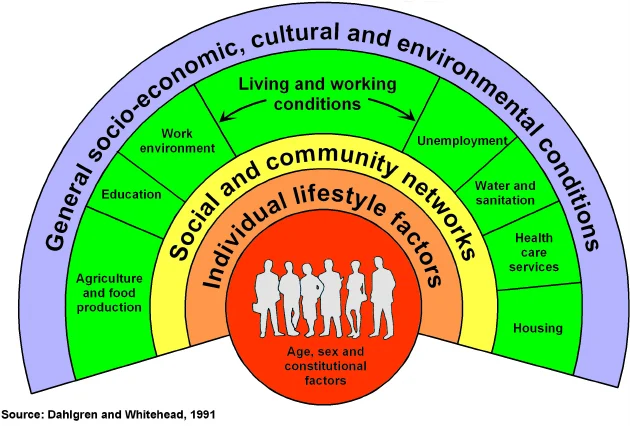
What is the socioecological rainbow model?
Shows how different levels influence health & behaviour:
individual - knowledge, beliefs, genetics
interpersonal - family & friends
community - schools, workplaces, neighbourhoods
societal - policies, culture, economy
Key idea: health is shaped by both individual & wider social/environmental factors
What is the definition of inequality, equality, equity & justice?
Inequality: differences in health, resources or opportunities between people or groups
Equality: everyone receives the same resources, opportunities or treatment
Equity: resources & support are distributed according to individual needs to achieve fair outcomes
Justice: ensuring fairness & equal rights, while addressing unfair disadvantages & discrimination

What is the definition of health inequalities?
Systemic differences in the health status of different population groups…that have significant social & economic costs both to individual & societies (WHO, 2018)
What is the difference between health inequalities & health disparities?
Health inequalities: the underlying structural & systemic factors that create avoidable & unjust differences in health outcomes within a population → SDOH
Health disparities: the observable differences in health outcomes between specific groups (e.g. racial or ethnic groups) without always addressing the systemic root causes → historical injustices, discrimination or bias
What are some causes of health inequalities?
Physiological impacts: high blood pressure, high cholesterol & anxiety/depression
Health behaviours: smoking, diet & alcohol
Psycho-social factors: isolation, social support/networks & self-esteem/worth
Wider determinants of health: income/debt, employment/quality of work, housing & education/skills
What are the 3 different types of public health interventions?
Policy-based interventions:
legislation (e.g. tobacco control & mandatory seatbelt use)
health promotion policies aimed at influencing behaviour (e.g. sugary drink taxes & smoke-free zones)
Community engagement:
grassroots efforts, community-led initiatives & participatory models of health promotion
empowerment & capacity building in communities
Preventive health programs:
vaccination campaigns, screening programs & public awareness initiatives (e.g. HIV/AIDS awareness & cancer screenings)
What is the role of policy in public health interventions?
The policy introduces laws, regulations or programmes to improve health:
immediate effects: changes behaviour, access or the environment
short-term health outcomes: reduces risk factors or prevents illness
medium-term outcomes: improves overall health & reduces health inequalities
long-term outcomes: reduces disease, disability & premature death
broader social impact: improves quality of life, productivity, communities & reduces healthcare costs

What does the process of community engagement & participation involve?
Community represents the central focus, which is the group or population involved in engagement efforts:
informing: providing relevant information to the community
consulting: gathering feedback from the community
involving: collaborating with the community on activities or decisions
collaborating: partnering with the community on projects & decision-making
empowering: giving control to the community to make key decisions

How is the effectiveness of interventions evaluated?
Through the use of assessment parameters:
reach: how many people were affected by the intervention?
efficacy: did the intervention achieve the desired health outcomes?
adoption: was the intervention implemented widely across communities?
sustainability: can the intervention be maintained over time?
What are the 3 barriers to effective public health interventions?
Political:
lack of political will, government issues, conflict of interests can delay or prevent public health measures
vaccine hesitancy
Social:
cultural resistance, religious beliefs or lack of awareness can impede health interventions
resistance to family planning programmes in certain communities
Economic:
lack of funding or resources limits the reach & effectiveness of interventions
underfunded healthcare systems struggling to implement large-scale health campaigns
How does sustainability & scalability play a role in public health interventions?
Sustainability:
long-term success depends on continuous funding, community engagement & adaptive strategies
HIV/AIDS programmes require long-term support to maintain access to anti-retroviral therapy
Scalability:
expanding successful local programmes to national or global levels prevents logistical & financial challenges
scaling up nutrition programmes for food security across diverse regions