Muscles system/Muscle Tissue
 Call Kai
 Learn
Learn Practice Test
 Spaced Repetition
 Match
Match Flashcards
 Knowt Play
1/199

There's no tags or description
Looks like no tags are added yet.
Name | Mastery | Learn | Test | Matching | Spaced | Call with Kai | Chat |
|---|
No analytics yet
Send a link to your students to track their progress
200 Terms
About the muscular system
– consist only of skeletal muscles
– Muscle organization/attachment affects power, range, & speed of movement
(appearance dictates function)
What are fascicles?
Bundles of skeletal muscle fibers
What are the 4 major fascicle arrangements?
Parallel
convergent
pennate
circular
What is a parallel muscle?
Fascicles run parallel to long axis of the muscle
some are flat
Cylindrical muscles have a central body (belly)
• ex: biceps brachii
What are the types of Parallel muscles?
Parallel muscle; Biceps brachii
Parallel muscle with tendinous bands (tendons inscription); Rectus abdominis
Wrapping Muscle; supinator (posterior & wraps anteriorly)

What is a convergent muscle?
Fascicles spread like a fan & converge on an attachment site (wide→narrow)
ex.pectoralis muscle
fibers pull in different directions depending on activity

What can a convergent muscle pull on?
(where muscle attaches to bone)
tendon
aponeurosis (sheet of tendon; areas in head & lower back)
raphe (slender band of collagen fibers)
What is a pennate muscle?
Muscle fibers attach to tendon at an angle, like shape of a feather
How do pennate muscles compare with parallel muscles?
contain more myofibrils (muscle fibers; more contraction power)
move their tendons less far
develop more tension
What is a unipennate muscle?
pennate muscle type
All fascicles are on same side of tendon
ex. Extensor digitorum.

What is a bipennate muscle?
pennate muscle type
Fascicles are on both sides of a central tendon
ex. Rectus femoris

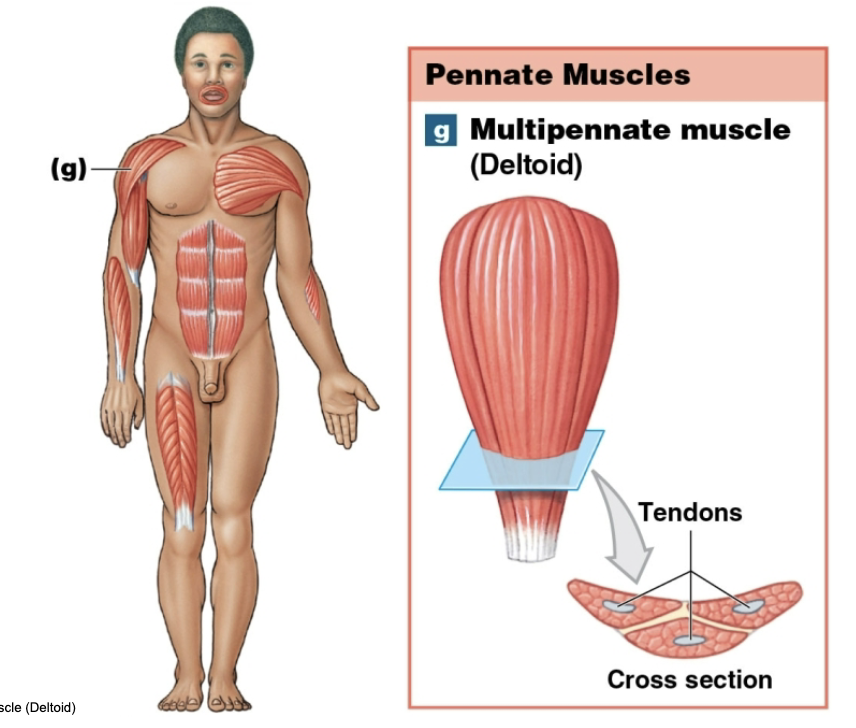
What is a multipennate muscle?
pennate muscle type
The tendon branches inside the muscle
(large and in charge; muscle surrounds)
ex. Deltoid
What are circular muscles?
Sphincters, to close & open areas
Act as valves in digestive & urinary tracts
Surround body openings & hollow organs
• Contraction makes diameter of opening smaller (O→o)
Ex. orbicularis oris of mouth

What is a lever in the body?
A bone acting as a rigid, moving structure
all muscle attach to bone
What is the fulcrum?
fixed point around which a lever moves; in the body, each joint is a fulcrum
(like seesaw)
bones move on fulcrum when muscles give AF to overcome load
Levers can change
levers=bones
– Direction of applied force (AF)
– Distance & speed made by AF
– Effective strength of AF
What is the load?
The resistance the applied force must overcome
(like weight at other end of seesaw)
What is applied force (AF)?
The force provided to move the load
(like kid on left side of seesaw trying to lift kid on right side)
How are the 3 classes of levers determined?
By the relative positions of the applied force, fulcrum, & load
What is a first-class lever?
The fulcrum lies between the applied force & the load
ex. Extension of the neck to lift head
(like using crow bar)(overworks muscle)

What is a second-class lever?
The load lies between applied force & fulcrum
advantage: small force moves large weight
ex. Ankle extension (plantar flexion) by the calf muscles
(wheelbarrow)

What is a third-class lever?
The applied force lies between the load & the fulcrum
most common lever in the body
Increases/maximizes speed & distance, but decreases force
ex. A pair of tongs (ONLY TILL HERE

What is the origin of a muscle?
The fixed point of attachment of a muscle to a bone
-Origin usually proximal to insertion
What is the insertion of a muscle?
The movable point of attachment of a muscle to a bone
distal
What is a muscle action?
Movements caused by muscle contraction
Described by effect on bone/joint
Ex. flexion, adduction, elevation, pronation
Ex. flexion of the forearm at the elbow
Muscle interactions
Muscles work together for efficient movement.
Smaller muscles activate first (tension 1st), then larger primary muscles
4 types of muscle interactions
– Agonist
– Antagonist
– Synergist
– Fixator
What is an agonist?
The prime mover; the muscle mostly responsible for a particular movement
What is an antagonist?
A muscle that opposes the movement of an agonist
What is a synergist?
A smaller muscle that assists a larger agonist
What is a fixator?
A synergist that helps an agonist by preventing movement at another joint;stabalizer
-holds bone/body/joint part so other muscles can move efficiently
How do agonists & antagonists work together?
When one contracts, the other stretches
ex. of opposing muscle pairs: Flexors–extensors & abductors–adductors
(shorten & lengthen)

What 4 types of information can muscle names describe?
Body region
position/direction/fascicle arrangement
structural characteristics
action
What does abdominal indicate?
Abdomen
What does ancon indicate?
Elbow
What does auricular indicate?
Ear
What does brachial indicate?
Arm
What does capitis indicate?
Head
What does carpi indicate?
Wrist
What does cervicis indicate?
neck
What does costal indicate?
Rib
What does coccygeal indicate?
coccyx
What does cutaneous indicate?
skin
What does femoris indicate?
Thigh
What does glossal indicate?
Tongue
What does hallux indicate?
Great toe.
What does ilium/inguinal indicate?
groin
What does lumbar indicate?
Lumbar region.
What does nasalis indicate?
Nose
What does ocular indicate?
Eye
What does oris indicate?
Mouth
What does palpebra indicate?
Eyelid
What does pollex indicate?
thumb
What does popliteal indicate?
Posterior to the knee.
what does Psoas indicate?
Loin
What does radial indicate?
Forearm
What does scapular indicate?
Scapula
What does temporal indicate?
Temple
What does thoracic indicate?
Thorax
What does tibial indicate?
Tibia/shin.
What does ulnar indicate?
Ulna
What does externus (superficialis) mean?
Muscles visible at the body surface.
What does internus (profundus) mean?
Deeper muscles.
What is an extrinsic muscle?
A muscle outside a structure that positions/stabilizes an organ.
What is an intrinsic muscle?
A muscle located entirely within an organ.
What does transversus mean?
Runs perpendicular to body’s long axis.
What does oblique mean?
Runs at a slant to the long axis.
What does rectus mean?
Straight; runs along the long axis
ex.rectus abdominis
What does anterior mean?
Front
What does external mean?
on the outside
What does extrinsic mean?
outside the structure
What does inferior mean?
Below
What does internal mean?
away from the surface
What does intrinsic mean?
within the structure
What does lateral mean?
on the side
what does medial mean?
middle
oblique
slanting
posterior
back
profundus
deep
rectus
straight
superficial
towards the surface
superior
towards the head
transverse
crosswise
Structural characteristics of muscles
Origin & insertion: First name = origin; second = insertion
# of tendons: Biceps = 2 tendons
Shape: Names can describe shape → trapezius, deltoid, rhomboid
Size: Names can indicate muscle size
What does biceps mean?
Two heads.
What does triceps mean?
Three heads.
What does quadriceps mean?
Four heads.
What does deltoid indicate about shape?
Triangle
What does orbicularis indicate about shape?
Circle.
What does rhomboid indicate about shape?
Parallelogram
What does serratus indicate about shape?
Serrated;notched (like saw)
What does pectinate indicate about shape?
comblike
What does piriformis indicate about shape?
pear shaped
What does platysma indicate about shape?
flat plate
What does pyramidal indicate about shape?
pyramid
What does splenius indicate about shape?
bandage
What does teres indicate about shape?
round & long
What does trapezius indicate about shape?
Trapezoid
What does alba mean?
white
What does brevis mean?
short