Nervous system - neural structure and organisation
 Call Kai
 Learn
 Practice Test
 Spaced Repetition
 Match
 Flashcards
 Knowt Play
1/53

There's no tags or description
Looks like no tags are added yet.
54 Terms
What is the nervous system?
An organisms control centre
What is the nervous system responsible for?
Sensory input : monitoring the internal and external world vi millions of receptor cells
Integration : processing and interpreting sensory no non sensory information, deciding what to do
Motor output : activating effector organs (muscles, g,ands)
What is the order if these 3 responsibilities?
Sensory input → integration → motor output (refkex arc)
What are the 2 principal divisions if the nervous system?
CNS
brain, including retina
Spinal cord
PNS
motor nerves (efferent or motor system, have an effect on world)
Sensory nerves (afferent or sensory system, affected by the world)
What can the efferent (or motor) system be further subdivided into?
Somatic (voluntary)
Autonomic (involuntary)
Which muscles are under the voluntary ir somatic system?
Skeletal,
located inside skeletal muscles,
attach bone to skin
Which muscles are under the involuntary or somatic system?
cardiac, located in the heart
Smooth, located in the walls of hollow organs
What an the autonomic pathway be further subdivided into?
sympathetic , fight or flight
Parasympathetic , rest and digest
What are the signs of sympathetic vs parasympathetic systems?

How many pairs of nerves connect the CNS to the rest of the body, and why in pairs?
43
Pairs as all animals are bilateral symmetric (have a left and right side)
Of the 43, how many are cranial nerves exit the brain, and what type are they?
12 pairs of cranial nerves
3 sensory (efferent) only
5 mainly motor (afferent) but some efferent too
4 mixed
How many nerves remain, what type are they, and and where do they exit?
31 pairs remaining
Exit various parts of the spinal cord
All mixed
What is the nervous system primarily made if ?
Nervous tissue
What were the 2 competing theories for what is nervous tissue?
reticular theory - network if interconnected structure
Cell theory - composed of discrete cells with gaps in between
Which theory was right and how was it proven?
Golgis silver staining technique, stains a limited number if cells at random in their entirety
Showing many discrete cells with different shores and sizes, in CNS tissue
CELL THEORY CORRECT
Cajal used Golgi staining and saw lots of different types of cells, founding modern neuroscience
describe the morphology of the neurone

What is the function of the neuron?
Transmission and processing if information, via electrical impulse
What is the role of the dendirites?
neuritis that receive incoming signals (neurones input regions)
How are dendrites adapted to their functions?
large surface area
Due to lots if branching (bifurcation)
Spines in the dendrite
What is the role of the soma (cell bidy)?
Sums incoming electrical signals from the dendrites ,, considered part of the input region
What is the diameter of the soma?
5 to 40 um
What is included inside the soma?
usual cell organelles
Also key organelles included in o rite in synthesis (which are not present in neuritis):
rough endoplasmic reticulum (produces proteins)
Nucleus , contai)img nucleolus , (processes rRNA, instructions on how to assemble new proteins)
How are soma cowards?
most cell bodies like to hide in the CNS , protected by the bones of the skull and spinal column
What are clusters of cell bodies in the CNS called?
Nuclei
What are clusters of cell bodies lying along the nerves of the PNS called?
Ganglia
What is the role of the axon?
Neurone that genetertes and transmits electrical impulses (action potentials) away from the soma, conducting region if the neuron
How long are axons?
Vary in length from virtually non existent to over a meter long
Describe the features if the axon within the neuron
Jojns soma at the axon hillock, a cone shaped area where signal is generated
Ends in axon terminals (synapses) that contact other neurones
Coated in between with myelin sheath (insulating layer if fat and protein )
What dies the axon contain?
phospholipid bilayer → embedded with proteins that act as ion channels
Cytoplasm (axoplasm) → containing essential element manufactured by nucleus e Golgi, vesicles, proteins etc)
What is a problem that can arise in the axon and how can it be solved?
Axons are very long so it may take a long time to rely on passive diffusion to get elements where they need to be
Instead they rely on axonal transport
What is involved in axonal transport?
various cytoskeleton components(neurofilaments, microtubules, microfilaments) form a series of train tracks
Motor proteins (kinesin, dynein) act as locomotives pulling essential elements down the tracks

In axonal transport, what is transport away from the nucleus called?
Anterograde
In axonal transport, what is transport back towards from nucleus called?
Retrograde

What us the speed of axonal transport?
40 cm a day
Describe axon terminals
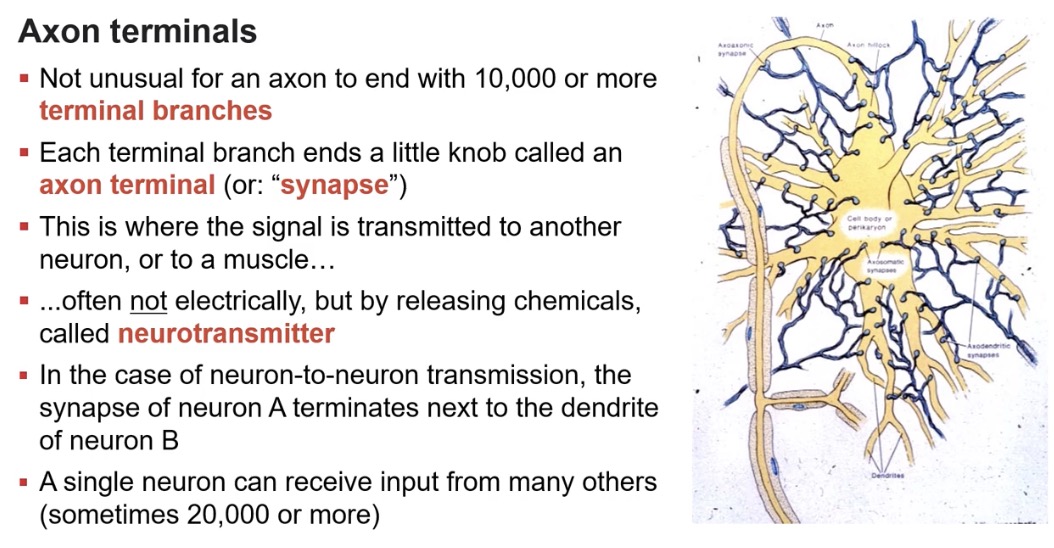
Describe the morphology and physiology of neurons
Highly polar, meaning;
their structure , morphology, is not symmetrical
They transmit signals (physiology) in one direction
What is the difference between a neuron and a nerve (in the PNS)?
Nerve is a collection of neurones
Dies a single nerve contain efferent ir afferent fibres?
can contain both
Describe the morphology if neurones and eventually nerves

Are all inputs mediated through the dendrites?
no
Most are from axon to dendrites (axodendritic)
But some are form axon to soma (axosomatic)
Or to the axon (axonaxoic)
What are axon collaterals?
when the axon occasionally branches
Usually around 90 degrees
> 10 um in length
They can regulate nerve activity, branch back onto other cells
Do all neurons have multiple dendrites, no have an axon?
No
What are the 5 morphological types if nerve cell?

What are the neural support cells called and how much if the nervous system do they make up?
called glia ( means glue)
Make up 50% of the nervous system

What are the functions if the glia?
Helpjngnto hold neurons in place
Supplying oxygen and nutrients to neuron
Electrically insulating nueron
Removing pathogens and dead neurones
Aiding neurotransmission
What are the glia in the CNS?
oligodendrocytes
Microglia
Ependymal cells
Astrocytes

What are the glia in the PNS?
Schwann cells
Satellite cells

Describe Schwann cells

Are small axons myelinated?
sometimes they are non myelinated
rather than being wrapped in Shawn cell membrane , they lie in a groove on the surface of such a cell
A single Schwann cell can partially enclosed 15 or more axons this way

D3cribe oligodendricytes
Equivilent to Schwann cells (that exist in the PNS) , but in the CNS
Unlike Schwann cells, a single oligo can myelinate multiple axons, wg 50-60

Describe astrocytes

Describe satellite cells

Describe microglia

Describe ependymal cells
