chem c15 acid base equilibria
 Call Kai
 Learn
 Practice Test
 Spaced Repetition
 Match
 Flashcards
 Knowt Play
1/16

There's no tags or description
Looks like no tags are added yet.
17 Terms
How does the \( CO_3^{2-}/HCO_3^- \) buffer system maintain ocean pH?
When \( [H^+] \) increases (more ( CO_2 ) dissolves): \( CO_3^{2-}(aq) + H^+(aq) \rightarrow HCO_3^-(aq) \)
When ( [OH^-] ) increases: \( HCO_3^-(aq) + OH^-(aq) \rightarrow CO_3^{2-}(aq) + H_2O(l) \)
Rapid increase in atmospheric \( CO_2 \) overwhelms this buffer → ocean acidification → lower \( [CO_3^{2-}] \) → harder for marine organisms to form \( CaCO_3 \) shells. 🌊

What is the ionic product of water Kw?
\( K_w = [H^+][OH^-] \)
At 25°C: \( K_w = 1.0 \times 10^{-14}\ \text{mol}^2\ \text{dm}^{-6} \)
\( pK_w = pH + pOH = 14 \) (at 25°C)
\( K_w \) increases with temperature because self-ionisation of water is endothermic (\( \Delta H > 0 \))

Define pH and pOH
\( pH = -\lg[H^+] \) and \( [H^+] = 10^{-pH} \)
\( pOH = -\lg[OH^-] \) and \( [OH^-] = 10^{-pOH} \)
At 25°C:
Neutral: \( [H^+] = [OH^-] ), ( pH = 7 )\)
Acidic: \( [H^+] > [OH^-] ), ( pH < 7 )\)
Alkaline: \( [H^+] < [OH^-] ), ( pH > 7 )\)

What is the relationship between ( K_a ), ( K_b ) and ( K_w ) for a conjugate acid-base pair?
\( K_a \times K_b = K_w = 1.0 \times 10^{-14}\ \text{mol}^2\ \text{dm}^{-6} \) (at 25°C)
\( pK_a + pK_b = pK_w = 14 \) (at 25°C)
Stronger acid → weaker conjugate base, and vice versa.

How does a \( CH_3COOH / CH_3COO^- \) buffer resist pH changes?
When ( H^+ ) added: \( CH_3COO^-(aq) + H^+(aq) \rightarrow CH_3COOH(aq) \)
When ( OH^- ) added: \( CH_3COOH(aq) + OH^-(aq) \rightarrow CH_3COO^-(aq) + H_2O(l) \)
Both reactions consume the added species, causing only a small change in pH

How do you choose a suitable indicator for an acid-base titration?
Back: A suitable indicator has its pH range falling on the vertical portion (region of rapid pH change) of the titration curve.
Strong acid + strong base: methyl orange or thymolphthalein
Strong acid + weak base: methyl orange (pH range 3.2–4.4)
Weak acid + strong base: thymolphthalein (pH range 9.4–10.6)
Weak acid + weak base: no suitable indicator
What determines the nature of a salt solution?
Strong acid + strong base → neutral salt, ( pH = 7 ) (e.g. NaCl)
Strong acid + weak base → acidic salt, ( pH < 7 ) (e.g. \( NH_4Cl )\)
Weak acid + strong base → basic salt, ( pH > 7 ) (e.g. \( CH_3COONa )\)
Weak acid + weak base → depends on relative ( K_a ) and ( K_b )
What is a buffer solution and what must it contain?
A buffer solution resists pH changes when small amounts of acid or base are added.
It must contain both a weak acid and its conjugate base (or weak base and its conjugate acid) in relatively large amounts.
Acidic buffer: ( pH < 7 ) (e.g. \( CH_3COOH / CH_3COO^- )\)
Alkaline buffer: ( pH > 7 ) (e.g. \( NH_3 / NH_4^+ )\)
How do you calculate the pH of a weak acid?
For \( HA \rightleftharpoons H^+ + A^- \), assume \( x \ll [HA]_{initial} \):
\( K_a = \dfrac{x^2}{[HA]_{initial}} \)
\( [H^+] = x = \sqrt{K_a[HA]_{initial}} \)
\( pH = -\lg[H^+] \)

How do you calculate the pH of a weak base?
For \( B + H_2O \rightleftharpoons BH^+ + OH^- \), assume \( y \ll [B]_{initial} \):
\( K_b = \dfrac{y^2}{[B]_{initial}} \)
\( [OH^-] = y = \sqrt{K_b[B]_{initial}} \)
\( pOH = -\lg[OH^-] \)
\( pH = pK_w - pOH = 14 - pOH \) (at 25°C)

What are the characteristics of the four titration curves?
Strong acid + strong base: sharp pH change at ( pH = 7 ) equivalence point
Strong acid + weak base: equivalence point ( pH < 7 ); buffer region present
Weak acid + strong base: equivalence point ( pH > 7 ); buffer region present; ( pH = pK_a ) at half-equivalence point
Weak acid + weak base: no sharp pH change; no suitable indicator
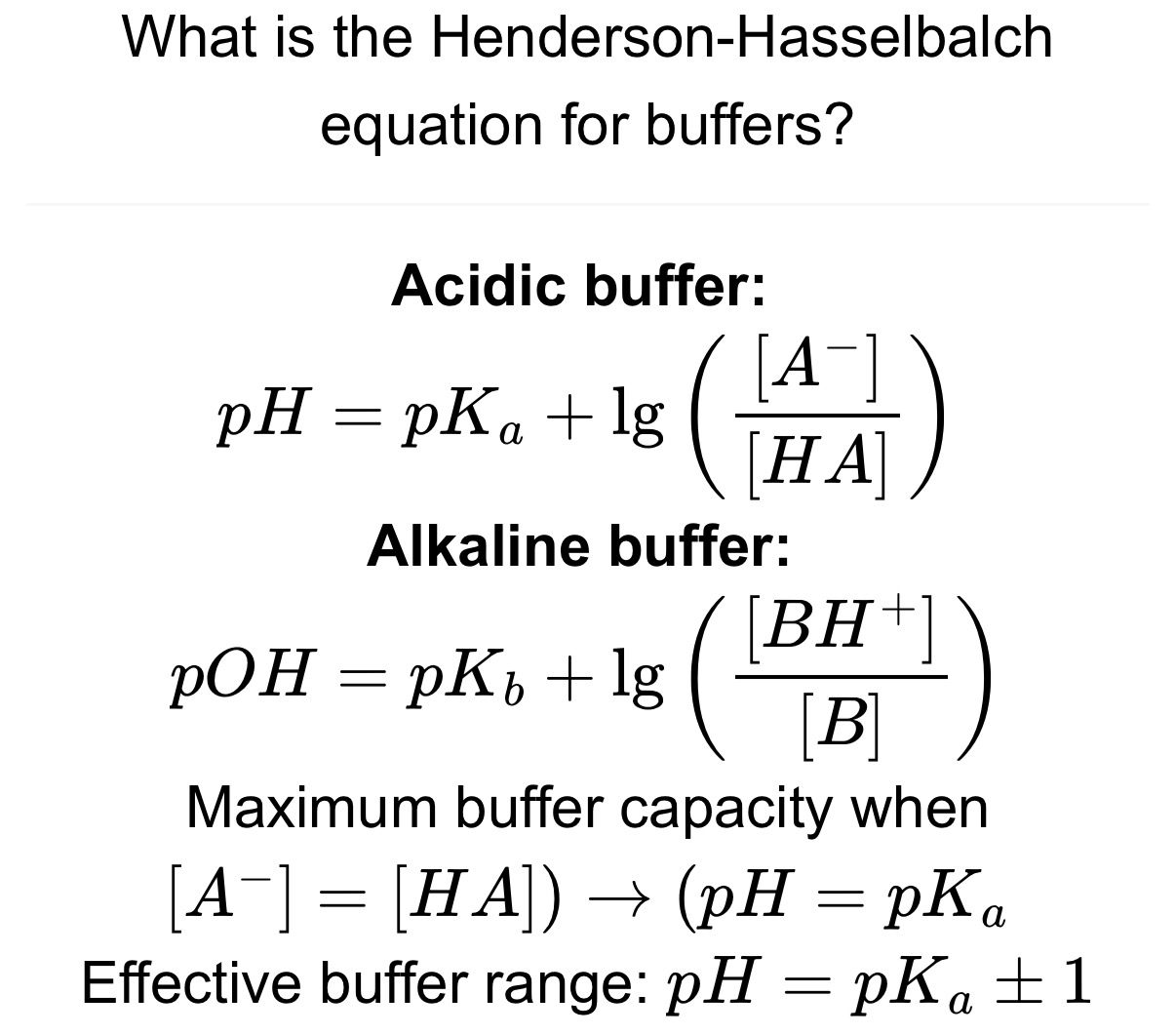
What is the Henderson-Hasselbalch equation for buffers?
Acidic buffer: \( pH = pK_a + \lg\left(\dfrac{[A^-]}{[HA]}\right) \)
Alkaline buffer: \( pOH = pK_b + \lg\left(\dfrac{[BH^+]}{[B]}\right) \)
Maximum buffer capacity when \( [A^-] = [HA] ) → ( pH = pK_a \)
Effective buffer range: \( pH = pK_a \pm 1 \)
Define the acid dissociation constant \( K_a \) and \( pK_a \)
For \( HA(aq) \rightleftharpoons H^+(aq) + A^-(aq) \):
\( K_a = \dfrac{[H^+][A^-]}{[HA]} \) units: mol dm\(^{-3}\)
\( pK_a = -\lg K_a \)
Larger \( K_a \) → stronger acid
Larger \( pK_a \) → weaker acid

Define the base dissociation constant \( K_b \) and \( pK_b \)
For \( B(aq) + H_2O(l) \rightleftharpoons BH^+(aq) + OH^-(aq) \):
\( K_b = \dfrac{[BH^+][OH^-]}{[B]} \) units: mol dm\(^{-3}\)
\( pK_b = -\lg K_b \)
Larger \( K_b \) → stronger base
Larger \( pK_b \) → weaker base

What is a conjugate acid-base pair?
A pair of species that differ by one proton \( H^+ \): \( HA + B \rightleftharpoons A^- + HB^+ \)
\( HA / A^- \) are a conjugate acid-base pair
\( HB^+ / B \) are a conjugate acid-base pair
The acid loses \( H^+ \) to form its conjugate base; the base gains \( H^+ \) to form its conjugate acid.

What is the difference between strong and weak acids?
Strong acid: complete dissociation in aqueous solution (\( \alpha = 1 )\) e.g. \( HCl(aq) \rightarrow H^+(aq) + Cl^-(aq) \)
Weak acid: partial dissociation in aqueous solution (\( 0 < \alpha < 1 \)) e.g. \( CH_3COOH(aq) \rightleftharpoons CH_3COO^-(aq) + H^+(aq) \)

State the three theories of acids and bases
Arrhenius: acid releases ( H^+ ); base releases ( OH^- ) in aqueous solution
Brønsted-Lowry: acid is a proton donor; base is a proton acceptor
Lewis: acid is an electron pair acceptor; base is an electron pair donor