recrystallization/arenes
 Call Kai
 Learn
Learn Practice Test
 Spaced Repetition
 Match
Match Flashcards
 Knowt Play
1/14

There's no tags or description
Looks like no tags are added yet.
Name | Mastery | Learn | Test | Matching | Spaced | Call with Kai | Chat |
|---|
No analytics yet
Send a link to your students to track their progress
15 Terms
Pure Compounds
homogeneous sample consisting only of molecules having the same structure
Supersaturated Solution
a chemical solution that contains more dissolved solute than the solvent can normally hold at a given temperature
one of the reasons you could have no crystals after recrystallization, either add a crystal of original or take a stir rod/spatula, get solvent, allow it to cool + form crystals, and use that
another reason no crystals = too much solvent used
Rules of a recrystallization solvent
Compound is insoluble in cold solvent (meaning room temperature)
Compound is soluble in hot solvent (meaning near/at boiling point)
Impurities solubility is temperature independent (either completely soluble or completely insoluble)
Process of a recrystallization
Add solvent slowly until just dissolves
Filter
Cool down slowly (why: Rapid cooling by immersing the flask in water or an ice-water bath tends to lead to the formation of very small crystals that may adsorb impurities from solution)
Filtration
Melting Point
temperature at which the liquid and solid phases exist in equilibrium with one another without change of temperature
Physical Constant
numerical values associated with measurable properties of these substances
useful only in the identification of previously known compounds
Recrystallization Solvent for base
solvent for neutral
base: h2o
neutral: MeOH (methanol)
Taking a melting point
Heat increase ramp at 1 to 2 degrees per minute (Thermal Equilibrium: Heat takes time to transfer evenly from the heating block or bath through the capillary tube to the solid sample. If heated too quickly, the temperature of the thermometer/sensor rises faster than the sample can absorb the heat, causing the sample to melt at a thermometer reading higher than its actual melting point.)
Report temperature as a range
Melting point data analysis
What does melting point data tell you
Purity - A narrow melting-point range ordinarily signals that the sample is pure
Identity
bromine safety
always wear gloves
rinse skin with water for 15 min if exposed
if spill, must rinse with sodium thiosulfate solution
Reaction Control
Statistical Factor
Energy Factor
statistical factor - determined by the number of hydrogen atoms whose replacement will give a specific constitutional isomer
energy factor - related to the strength of the type of C–H bond being broken and is called the relative reactivity (primary, secondary, tertiary, aka substitution)
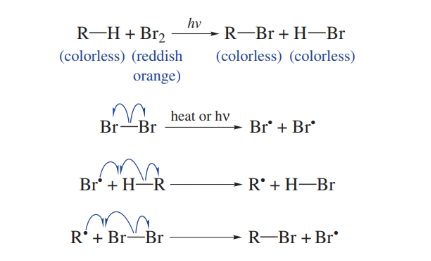
Free Radical Substitution of C-H to C-X (X=halogen)
Hydrogen Types
Aromatic
Aliphatic
Benzylic
aromatic - hydrogens bound directly to an aromatic ring
aliphatic - hydrogens bound to sp3-hybridized carbons
benzylic - An aliphatic hydrogen atom attached to an sp3-hybridized carbon atom that in turn is bound to an aromatic carbon atom
Free Radical Mechanism
Initiation
Propagation
Termination
Initiation - Radicals are formed in low concentration from neutral molecules, resulting in a net increase in the concentration of free radicals within the system
Propagation - Radicals produced in the first step react with molecules to yield new molecules and new radicals; there is no net change in the concentration of radicals
Termination - Various radicals combine to give molecules, resulting in a net decrease in radical concentration and a decrease in the rate of the reaction
Relative reactivities of each type of hydrogen
Aromatic vs Aliphatic vs Benzylic
Primary vs Secondary vs Tertiary
What is determining factor as to why some hydrogens are more reactive than others (radical stability)
hyperconjugation for determining factor: tertiary more stable than primary b/c orbitals can spread electron charge
