Sociology Final: Social Class, Race and Ethnicity, and 13TH
 Call Kai
 Learn
 Practice Test
 Spaced Repetition
 Match
 Flashcards
 Knowt Play
1/97

There's no tags or description
Looks like no tags are added yet.
98 Terms
What is meant by the term social class?
Most sociologists have adopted Max Weber’s definition of social class as a large group of people who rank close to one another in terms of property, power, and prestige.
Property
Material possessions- buildings, bank accounts, bonds, businesses, cars, jewelry, land, etc
Power
is the ability to get one’s way even though others resist. C. Wright Mills coined the term power elite to refer to the small group that holds the reins of power in business, government, and the military.
Prestige
is often linked to occupational status
Occupations and Prestige
People’s rankings of occupational prestige have changed little over the
decades and are similar from country to country.
Globally, the occupations that bring greater prestige pay more, require more education and abstract thought, and offer greater autonomy.
Physician: Occupational Prestige: How Occupations Stack Up
76
Astronaut
74
College president
71
Biologist
69
College professor
69
Architect
67
Dentist
67
Electrical engineer
67
Pharmacist
67
Waiter or waitress
36
Housekeeper
35
Used car salesperson
35
Bill collector
30
Janitor
30
Telephone solicitor
25
What is meant by the term status inconsistency?
People who rank higher on some dimensions than on others are status
inconsistent. The frustrations of status inconsistency tend to produce political radicalism
Status is social ranking.
Most people are status consistent; that is, they rank high or low on all three
dimensions of social class, wealth, power and prestige.
Income: Dimensions of Social Inequality
• Money received or earnings, usually from job, business, or assets (salary/wages)
• U.S. society is highly stratified.
• During recent decades, income
inequality has increased.
• The very richest people now receive a much larger share of all income.
• This woman’s life is not the same as the social world of the people who hire these women.
Wealth: Dimensions of Social Inequality
Total value of everything someone owns, minus outstanding debts
• Distributed more unequally than income
• The distribution of wealth in the United States has changed little since World War
II, but the changes that have occurred have been toward greater inequality.
• Data for 2014 suggests median wealth for U.S. families was about $90,000.
• The lowest-ranking 40% of U.S. families have little or no wealth at all.
The wealthiest 1 percent of Americans…
owns 40 percent of the nations wealth
The wealthies 10 percent of Americans…
owns 84 percent of the nations wealth
Marx View of Social Class
Capitalists (Bourgeoisie, those who own the means of production), Workers (Proletariat, those who work for the capitalists), Inconsequential Others (beggars, etc.)
Updating Marx: Erik Wright
Some people are members of more than one class at the same time
Contradictory ckass locations
Four social classes: Capitalists, Petty bourgeoisie, Managers, and Workers
Weber’s View of Social Class
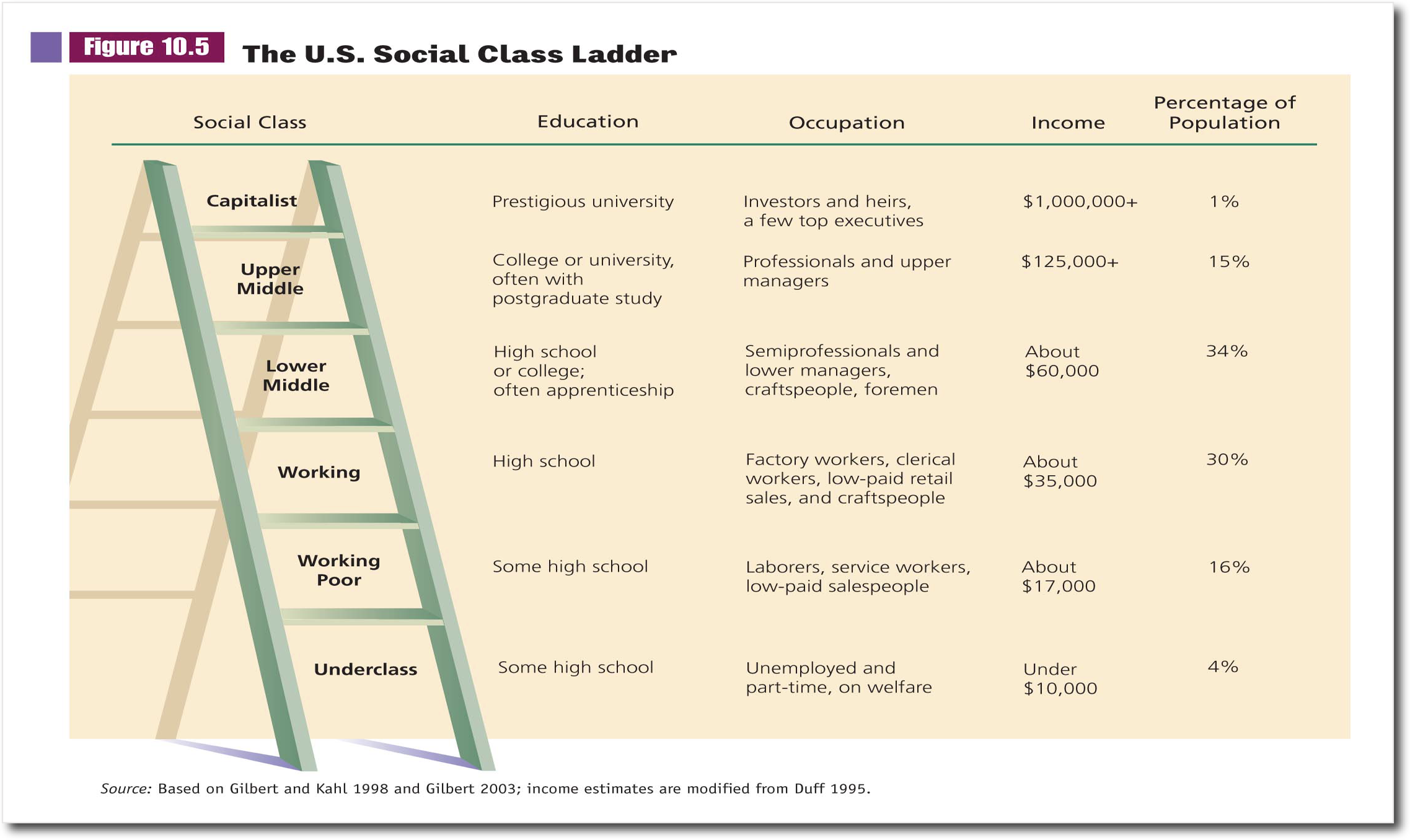
The term Intergenerational Mobility: Social Mobility
refers to changes in social class from one generation to the next.
Upward Social Mobility
Movement up the social ladder
Downward Social Mobility
Movement down the social class ladder
Structural Mobility
refers to changes in society that lead large numbers of people to change their social class.
Exchange Mobility
is the movement of large numbers of people from one class to another, with the net result that the relative proportions of the population in the classes remain about the same
Consequences of Social Class
Social class leaves no aspect of life untouched.
It affects our chances of benefiting from the new technology, dying early, becoming ill, receiving good health care, and getting divorced.
Social class membership also affects child rearing, educational attainment, religious affiliation, political participation, and contact with the criminal justice system.
Problems Linked to Poverty
Poor health, substandard housing, homelessness, limiting schooling, crime and punishment, political alienation.
Poor Health
Strong link between income and health
“Food insecurity” or lack of access or ability to afford nutritious foods
Stress leads to use of tobacco, alcohol, and drugs
Lack of health insurance
The infant mortality rate among the poor is twice the rate among affluent people
Longevity gap between the rich and poor
More likely to die earlier from infectious diseases, violence, and accidents
Substandard Housing
Decline in availability of low-rent apartments
High housing costs leave less money for other needs
Homelessness
it is the plight of poor people who lack shelter and live primarily on the streets
About 554,000 people are homeless on a given night and 1.6 million at some point during the year
Limited Schooling
30% of economically disadvantages children do not graduate from high school
Fewer poor children enter college; they have less chance of completing an advanced degree
tracking often defines poor children as less able
Privileged children are seen as more talented
Crime and Punishment
A focus on “street crime” means the poor are more likely to face arrest, trial, conviction, and prison
The poor depend more on public defenders and court-appointed attorneys
Conviction of a crime increases difficulty of finding a good job
Political Alienation
80% of people earning at least $100,000 per year voted in recent presidential elections
About half of people earning less than $40,000 per year voted
How do we know how many people are poor?
The Poverty Line
Poverty line: income level set by the government for the purpose of counting the poor
Roughly three times what a family needs to eat a basic, nutritious diet
In 2025, 10 percent of the U.S. population fell below the poverty line
Several issues with poverty line measurement
U.S. Government Poverty Threshold, by Family Type, 2021

Myths About Poverty
1. Poor people are lazy: They are poor because they don’t want to work.
2. Poor people are trapped in a cycle of Poverty that few escape.
3. Most of the poor are African American or Latino.
4. Most of the poor live in the inner city.
5. The poor live on welfare.
Structural-Functional Analysis: Theories of Poverty
Some Poverty is Inevitable
Social Pathology Theories: Personal Deficiency
Poverty is the result of personal flaws
Culture of poverty, patterns that encourage poverty as a way of life
Meritocracy; social standing corresponds to personal ability and effort
Symbolic-Interaction Analysis: Theories of Poverty
Defining the Problem
Highlights the social construction of problems and solutions
Blaming the victim is a process of finding the cause of a social problem in the behavior of people who suffer from it (character traits/behaviors)
If we view the poor as no different than the wealthy, we see the cause of poverty in society
Blaming the victim
is a process of finding the cause of a social problem in the behavior of people who suffer from it (character traits/behaviors)
Social-Conflict Analysis: Poverty Can Be Eliminated: Theories of Poverty
Marxist Theory: Poverty and Capitalism
Industrial-capitalist economy places wealth in the hands of a few
More Than Money: Cultural Capital
Cultural capital is the skills, values, attitudes, and schooling that increase a person’s chances of success
Cultural capital
is the skills, values, attitudes, and schooling that increase a person’s chances of success
The Horatio Alger Myth: How is the Horatio Alger myth functional for society?
the belief that anyone can get ahead if only he or she tries hard enough—encourages people to strive to get ahead.
It also deflects blame for failure from society to the individual.
Financial Accounts: Dr. Dovil: Quick Financial Literacy “Where The Cash At?”
Checking/Savings Account
Credit
High-Yield Savings Accounts
Certificate of Deposit (CD) Accounts
Investment Accounts (Tithe, 401ks, Roth IRAs, FSA/HSA, Life Insurance, Trust, etc)
Companies/Corporations: Dr. Dovil: Quick Financial Literacy “Where The Cash At?”
*Marcus by Goldman Sachs
*Fidelity
*Chase, American Express, Airline Credit Cards, etc
How many people are on this world? Race: Myth and Reality
With more than 7 billion people, the world offers a variety of human shapes and colors
Where and when did the first humans emerge? Why do races have different features? Race: Myth and Reality
Humans first emerged in Africa some 250,000 years ago. As humans spread throughout the world, their adaptations to diverse climates and other living conditions resulted in this profusion of colors, hair textures, and other physical variations
Is there such thing as a pure race? Race: Myth and Reality
No, There is no such thing as a “pure” races
Is there a “superior” race?
Although, people do divide one another into races. There is no such thing as a “superior” race
The Truth About Race and Ethnicity
Race and ethnicity are social constructions.
They are defined and maintained through interaction.
They do not exist biologically.
Race is so arbitrary that biologists and anthropologists cannot agree on how many “races” exist
The myth of racial superiority
Race: Race and Ethnicity
A socially constructed category of people who share physical characteristics that distinguish them from other groups
For hundreds of years, people in most societies have divided humanity into categories based on skin color, hair texture, facial features, and body shape.
Ethnicity: Race and Ethnicity
A shared cultural heritage or characteristics, which typically involves common language, religion, nationality, history, or another cultural factor.
How do Sociologist see race and ethnicity?
Sociologists see race and ethnicity as social constructions because they are not rooted in biological differences, they change over time, and they never have firm boundaries.
•Ex: White, Black, Asian, Hispanic
Defining Race and Ethnicity
The distinction between race and ethnicity is important because ethnicity can be displayed or hidden, depending on individual preferences, while racial identities are always on display.
Consequences of Race and Ethnicity
Genocide
The annihilation or attempted annihilation of a people because of their presumed race or ethnicity
Minority Group: Minority and Dominant Groups
People who are singled out for unequal treatment and who regard themselves as objects of collective discrimination
Expansion through political boundaries
By migration
Dominant Group: Minority and Dominant Groups
The group with the most power, greatest privileges, and highest social status
Racism
Prejudice and discrimination on the basis of race
A set of beliefs about the superiority of one racial or ethnic group.
Used to justify inequality
Often rooted in the assumption that differences between groups are genetic
Rooted in white supremacy
Combined with structural and systemic power
It is an ideology.
Prejudice
(a thought process) An attitude or prejudging, usually in a negative way
An idea about the characteristics of a group
Applied to all members of that group
Unlikely to change regardless of the evidence against it.
Can be positive but typically negative
Discrimination
(an action) An act of unfair treatment directed against an individual or a group
Unequal treatment of individuals because of their social group
Usually motivated by prejudice
Can be based on many characteristics (age, sex, weight, skin color, sexual orientation, disability, etc)
Contact Theory: Learning Prejudice
The idea that prejudice and negative stereotypes decrease and racial-ethnic relations improve when people from different racial-ethnic backgrounds, who are equal status, interact frequently
Individual discrimination (or racism)
Discrimination carried out by one person against another.
Institutional discrimination (or racism)
Discrimination carried out systematically by social institutions (political, economic, educational, and others) that affect all members of a group who come into contact with it.
*Home Mortgages (bank loans)
*Health Care
*Employment
Racism, Prejudice, and Discrimination
Institutional racism is pervasive.
If all racist people went away racism would still exist because it is in our institutions.
It does not reside in any one person but is in the fabric and patterned interactions (social structure).
White Privilege
Refers to the fact that white people, relative to those in minority categories, enjoy social advantages
Most non-minorities do not understand the disadvantages faced by minorities
The Flipside to Disadvantage
Racism and discrimination disadvantages some but benefits others in the form of an invisible unseen privilege.
Invisible knapsack refers to the unearned resources (carried in the Invisible Knapsack) that are not in broad view or intended to be seen.
“White privilege is like an invisible weightless knapsack of special provisions, maps, passports, codebooks, visas, clothes, tools and blank checks.
Invisible knapsack
refers to the unearned resources (carried in the Invisible Knapsack) that are not in broad view or intended to be seen.
Psychological Perspectives: Theories of Prejudice
Frustration and Scapegoats
People are unable to strike out at the real source (unfairly blamed)
The Authoritarian Personality
Rank high on conformity, intolerance, insecurity, submissiveness (older, less educated, less intelligent, and lower social class)
Sociological Perspectives: Theories of Prejudice
Functionalism
Conflict Theory (Split labor force and Reserve labor force)
Symbolic Interactionism (Labels and Stereotypes)
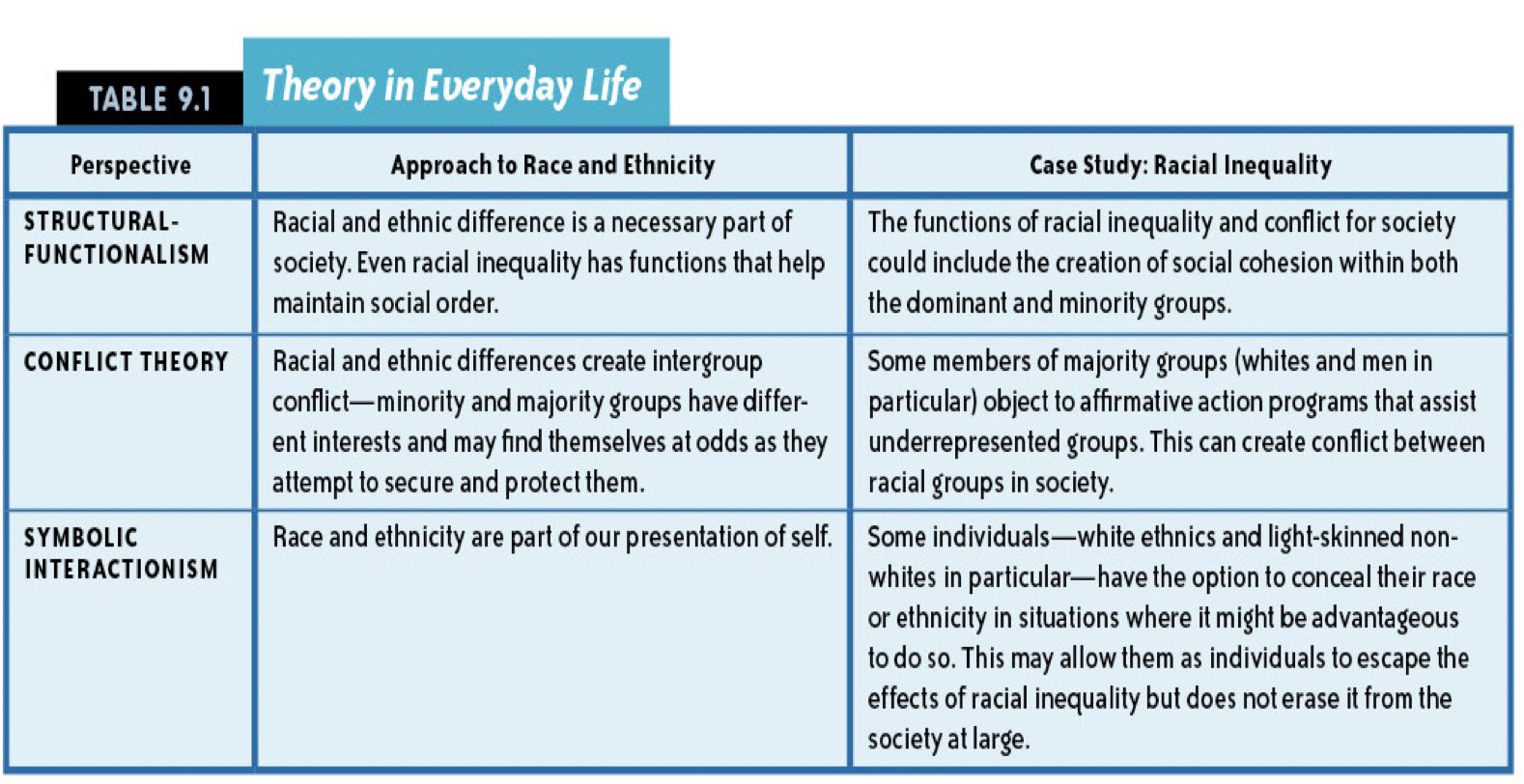
Theories of Race in Review
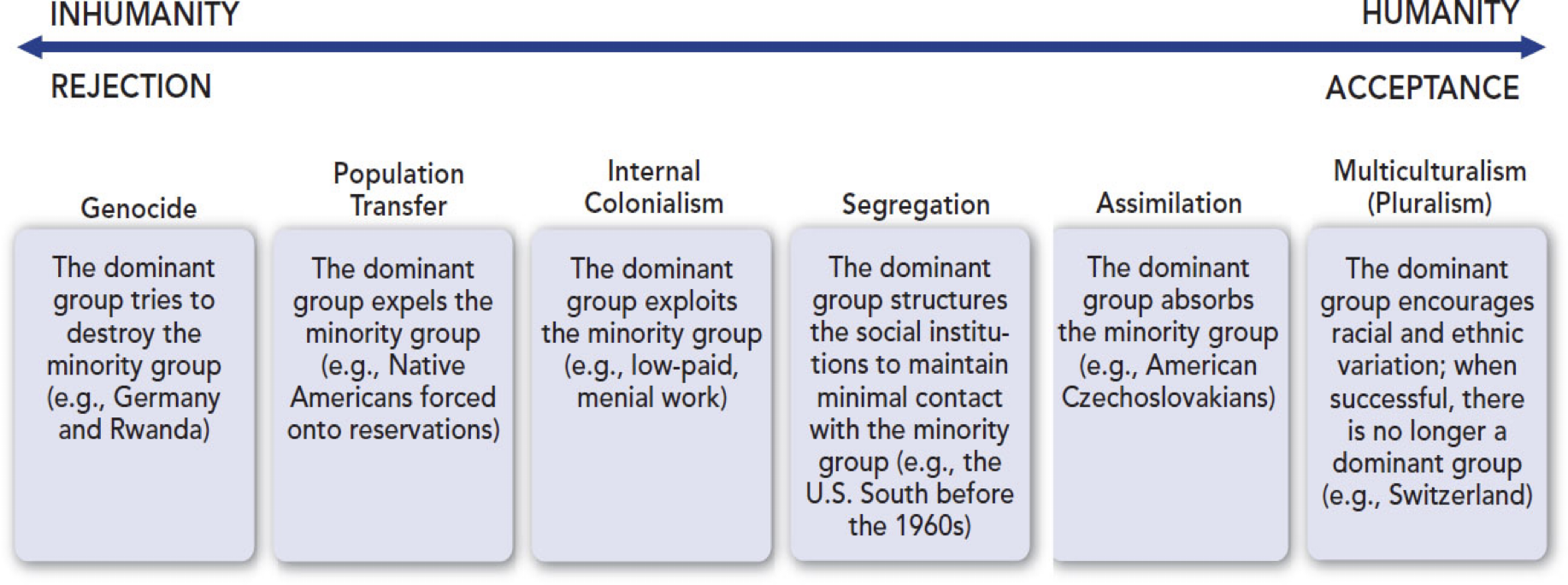
Global Patterns of Intergroup Relations: A Continuum
Racial Breakup

WASPs and White Ethnics

Race and Ethnicity
European Americans, Latinos (Hispanics) Americans, African Americans, Asian Americans, Native Americans
Native Americans
“Indigenous People”
Conflict between American Indians and Europeans led to the destruction of the Native American civilization
Soldiers forcibly removed Natives from their homelands causing thousands of deaths known as The Trail of Tears
Endured forced Assimilation and moved them to reservations
Many American Indians still live on reservations with very high rates of poverty, abuse, depression and suicide
Did not gain full citizenship until 1924
African Americans
Up to 1808: slave traders brought 500,000 Africans to the United States as slaves
1857: Dred Scott case affirmed that slaves were not citizens entitled to rights
1863: Emancipation Proclamation
1865: Thirteenth Amendment banning slavery
1868: Fourteenth Amendment granting citizenship to everyone born in the United States
After the Civil War: “Jim Crow laws” passed by states
African Americans prt 2
After World War I: “Great Migration” brought thousands to the North; Harlem Renaissance
1954: Brown versus Board of Education ended school segregation
1960s: Civil Rights Acts and Voting Rights Act brought an end to most legal discrimination
Today, people of African descent are still disadvantaged:
Below-average income
Poverty rate nearly three times that of white poverty rate
Issues around inequitable education
Asian Americans
Asian Americans include people with historical ties to dozens of Asian nations
The largest number have roots in China, the Philippines, India, South Korea, and Japan
Immigration from China and Japan began with the California Gold Rush of 1849
•Once the economy slowed, whites pressured legislatures and courts to bar Asians from certain works
•World War II: President Roosevelt’s Executive Order 9066 relocated 100,000 Japanese Americans to military camps
•Citizenship granted to Chinese Americans in 1943 and to Japanese Americans in 1952
•By the 1980s, called the “model minority,” based on their cultural commitment to study and hard work
Hispanic Americans/Latinos
•The largest U.S. minority group: 55.2 million people; 17.3% of the total population
•Latinos are so numerous and their cultural contributions so great that Spanish has become the unofficial second language of the United States
•Overall standing is below U.S. average:
Mexican Americans have lowest relative ranking with the language barrier leading to limited job opportunities
Hispanic Americans, now the largest ethnic category in the U.S. population, are a hugely important segment of our society
Race, Ethnicity, and Life Chances
Race and ethnicity influence all aspects of our lives:
❖Health
❖Education
❖Work
❖Family
❖Interactions with the criminal justice system
Race and Ethnicity Take Away Points
Race and ethnicity are social constructions
They do not exist in the natural world but only in the social world.
They have real consequences and are used as the basis for inequality.
Like social class, they have effects on life chances.
How does the 13th Amendment directly enable the modern system of mass incarceration as described in the documentary?
it contains a loophole allowing involuntary servitude as a punishment for a crime
The amendment explicitly abolishes slavery except as a punishment for a crime whereof thr party shall hav been duly convicted, effectively rendering convicted individuals slaves of the state.
What historical progression of racial control systems followed the collapse of chattel slavery in the United States?
Convict leasing, followed by Jim CRow laws, and eventually mass incarceration.
After slavery ended, convict leasing was used to rebuild the economy followed by Jim Crow segregation, and finally the modern system of mass incarceration
What was the primary cultural impact of the film The Birth of a Nation
It reinforced animalistic stereotypes of Black people and romanticized the KKK
The film confirmed the racist narratives white audiences wanted to elieve, portraying Black people as dangerous while depicting the Klu Klux Klan as heroic
How did political strategies during the Nixon, Reagan, and George H.W. Bush eras link race and crime?
They used coded rhetoric and media fear to associate Black men with criminality
From Nixon’s War on Drugs to Reagan’s sentencing disparities and Bush’s Willie Horton ad, politicians leverages racialized fears of crime for political gain
What was a major consequence of the 1994 Federal Crime Bill signed by President Bill Clinton?
It dramatically expanded the prison system thrhough funding and three-strikes laws.
How did J. Edgar Hoover and the FBI respond to Black leaders and movements during the 1960s and 1970s?
They targeted activists like Dr. King and Angela Davis to neutralize Black movements.
Hoover ordered the destruction of progressive Black movements, labeling dr. King dangerous and placing figures like Angela Davis on the Ten Most Wanted List
How does the American Legislative Exchange Council (ALEC) influence the criminal justice system?
It allows corporations and lawmakers to privately draft laws that benefit their business and eventually lead to the increase of incarceration.
through ALEC task forces, cooperate lobbyists like CCA and Walmart vote alongside lawmakers to advance bills like Stand Your Ground ( stating that you could kill someone if you feel threatened.and was pleaded as self defense), SB1070 (the law that gave police the right to stop anyone they thought looked like an immigrant, which benefitted CCA), and mandatory minimums.
What does the 'prison industrial complex' encompass beyond the operation of private prisons?
A vast network of vendors profiting from telecom, food, healthcare, and inmate labor
Companies like Securus Technologies, Aramark, and Verizon, along with corporations using inmate labor, heavily monetize the incarceration systems.
What systemic flaws in the justice system are illustrated by the tragic case of Kalief Browder?
The inability to afford bail and coercive plea bargains can destroy innocent lives
Browder was held for three years without conviction because he couldnt pay $10,000 bail and refused to plead guilty to a crime he didn’t commit, suffering severe trauma.
According to the documentary, why is visual documentation critical to advancing civil rights and humanization?
It forces society to confront state brutality and recognize the humanity if victim.
From photos of Emmitt Till and televised marches to modern social media videos of police violence, visual proof shocks the public and counters criminalization.