NEW Cerebral application
 Call Kai
 Learn
 Practice Test
 Spaced Repetition
 Match
 Flashcards
 Knowt Play
1/72

There's no tags or description
Looks like no tags are added yet.
73 Terms
- Retention of learned information
- Lifelong adaptations of brain circuitry in response to environment
Memory
Facts, events, concepts, and locations
Results from conscious effort
Declarative, explicit
skills, habits, and behaviors (procedural)
results from experience
Nondeclarative/implicit
Recollections that can be accessed on demand and easily verbalized
Declarative/conscious/explicit memory
Which memory requires attention?
Declarative
Working memory is a common subtype of?
Declarative - short term
Working memory
- __ storage and __ of information
- Maintains __-relevant information for a short time.
- Temporary storage and manipulation of information
- Maintains goal-relevant information for a short time.
Working memory is essential for?
language, problem-solving, mental navigation, and reasoning.
Complex mental multitasking requires? central to?
working memory
cognition
What area of the brain maintain, manipulate, and update information in working memory.
PFC & Parietotemporal association cortex
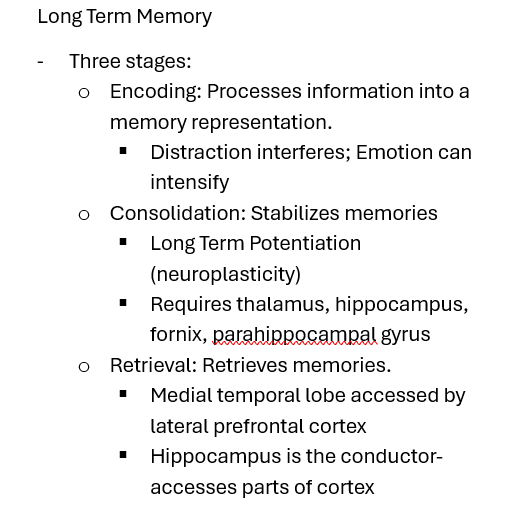
Processes information into a memory representation.
Encoding
Stabilizes memories
Consolidation
Retrieves memories
Retrieval
Long term memory
What interferes? what intensifies?
Long term potentiation from?
Consolidation requires what areas of the brain?
Medial temporal lobe is accessed by?
What is the conductor- assesses parts of cortex?
Memory, Consciousness, Intellect, Personality, Behavior, Emotion, and Decision Making
Cerebrum
Non-declarative/Procedural Memory - parts of the brain?
Motor & parietal cortices
Striatum
Cerebellum
Amygdala
SCAM
Non-declarative/Procedural Memory
Recall of?
__ skills
Perceptual skills:
Cognitive skills?
- Recall of skills and habits.
- Motor skills
- Perceptual skills including object, pattern, and face recognition
- Cognitive skills including reason and logic
What is required to store procedural memories? this is called?
- Practice is required to store procedural memories (motor learning).
- Slow to acquire but relatively permanent
Consciousness functions
- Waking and sleeping, paying attention, and the initiation of action are under the consciousness system.
- Aspects of consciousness include:
- Generalized arousal level
- Attention
- Selection of object of attention, based on goals
- Motivation and initiation for motor activity and cognition
What drives consciousness?
- RF delivers neuromodulators to cerebrum (thalamus and cortex) to drive consciousness
Limits of attention
Limits of Attention
- Our amount of attention is limited; information that is not attended to is not processed.
- As tasks become more automatic, less attention is required.
- Attention requires orienting from many stimuli available, dividing, selecting, sustaining, and switching (different cortical areas for each)
Loss of consciousness
Torque of brainstem
Abrupt increase in intracranial pressure
Space occupying lesions of cerebrum located in the diencephalon
Exerting pressure on the brainstem.
Impaired attention
Brain injury or other neuro dx may impair ability to orient, divide (dual tasking), select, switch, or sustain attention.
ADHA
Affects what aspects of attention
Abnormal __ from: PFC to ?
Also connection between what lobes?
Every aspect of attention
Abnormal circuity: PFC - striatum, parietal cortex, cerebellum
Parietal cortex connection to temporal cortex
Is the ability to form concepts and reason
Intellect
Intellect requires integration of?
Verbal
Visuo-spatial
Working memory
Goal-directed behavior
Intellect integration is achieved by connections between?
PFC & posterior parietal lobes/parietotemporal cortices
Intellect disorders due to?
genetic abnormalities
Dementia
Dementia
- Defined by generalized mental deterioration
- A number of different causes and types: typically a neurodegenerative or neurovascular issue
- Can cause issues with memory, visuospatial perception, attention, reasoning, judgement, goal-directed behaviors (as well as motor, emotional, and behavioral)
Any area called “association” is not directly involved with?
sensation or movement
Function of association areas of cerebral cortex
- Personality, integration and interpretation of sensations, processing of memory, and generation of emotion
Lateral PFC function
- Goal Directed Behavior
- Executive functions- deciding on goal, planning, executing, monitoring
- Includes processes of working memory, judgment, planning, abstract r reasoning, dividing attention and sequencing activity.
- Also inhibits socially inappropriate behaviors
- Responsible for divergent thinking (different possibilities)
What inhibit socially inappropriate behaviors
Lateral PFC
Damage to lateral PFC
- apathy, lack of goal-directed behavior, lack of divergent thinking
- Difficulty with executive functions: choosing goals, planning, executing plans, monitoring the execution of a plan
Pt not uncooperative- has lost neural capacity to initiate goal-oriented action
- Can have huge effect on compliance and outcomes in PT
Does lateral PFC damage affect performance on standard intelligence tests?
NO
Typically does not affect performance on standard intelligence tests which require convergent thinking- problem comes with divergent thinking
Medial PFC function
- Emotions, self-awareness, and motivation
- Includes awareness of one’s own emotions as well as perception of others’
EMS
Lesion to Medial PFC
- Lesions cause apathy, lack of emotions, and lack of insight
Can cause paranoia, delusions, incorrect assumptions about emotions and intent (schizophrenia)
Is a short-term subjective experience.
Emotion
Six structures recognize emotional stimuli and generate and perceive emotions:
o Medial Prefrontal Association Cortex
o Amygdala
o Broadman’s area 25
o Mediodorsal nucleus of the thalamus
o Ventral striatum
o Anterior insula
Amygdala location
- Almond shaped collection of nuclei deep in the anterior temporal lobe
What structure
- Generates feelings of fear and disgust
- Interprets facial expressions, body language, and social signals
- Essential for social behavior, emotional learning, and decision making
Amygdala
Area 25 includes
the cingulate cortex inferior to genu of the corpus callosum
What generates sad mood and depression?
Area 25 & Mediodorsal thalamus
provides awareness of emotions and stimuli inside the body (awareness of the present moment)
Anterior insula
Ventral striatum includes?
- Caudate and putamen
What structure
- Determines reward-oriented behavior and responses to conditioned stimuli
Ventral Striatum
What structure plays a big role in Motivation
Ventral striatum (and medial PFC)
Lesion where
causes apathy, loss of initiative
Ventral striatum
Excessive activity of what structure causes OCD?
Ventral striatum
What connects with areas that regulate mood (subjective feelings) and affect (observable demeanor).
Ventral PFC
What structure
Uses reward and emotional info to guide behavior and inhibit undesirable behavior
Ventral PFC
Ventral PFC includes?
- Includes orbital cortex (ventrolateral) as well as ventromedial PFC.
What is apart of the Social Behavior Loop
Ventral PFC
Making decisions depends on a(n):
o Stimulus coding system (ventral prefrontal cortex)
o Action selection system (ant cingulate, lateral prefrontal, parietal cortices)
o Expected reward system (ventral striatum , amygdala, insula)
What is active when making a decision where the outcome is uncertain
Limbic loop
What is concerned with seeking pleasure.
Limbic loop
Good decisions depend on balance between
Amygdala (gut reaction)
Lateral PFC (rational part)
What lesion
doesn’t sense personal fear or others’ fear
Amygdala
What integrates emotional and rational info to guide behavior
Somatic Marker Circuitry
What lesion
Impair social intelligence
People don’t learn from their mistakes
Somatic marker circuitry
Emotional intelligence requires?
ventral PFC, amygdala, and anterior insula
VAA
Prefrontal Association Cortices includes
- Includes lateral prefrontal, medial, and ventral prefrontal cortex.
Damage to Prefrontal Association Cortices causes?
- Damage interferes with emotional response to inferred emotional events i.e. empathy, embarrassment, guilt, and regret
- Can lead to inappropriate and risky behavior.
- Causes poor judgement, impulsivity, difficulty with social norms
- May cause personality changes
This lesion impairs perception of others’ emotions, beliefs, and intentions is impaired
causes paranoia
Medial dorsal PFC lesion
Emotional liability is caused by?
Emotional Lability
- Caused by brain lesions (common in ALS, MS, TBI, Alzheimer’s and to a smaller effect, CVA and PD)
- Is abnormal, uncontrolled expression of emotions
- Marked by abrupt mood shifts (anger, depression anxiety); involuntary, inappropriate emotional expression in absence of subjective emotion; emotion is triggered by nonspecific stimuli unrelated to emotional expression
Reward pathway steps
Dopamine nuerons from VTA (in midbrain)
Project to Ventral striatum - specifically nucleus accumbens
Project to PFC
What promote the release of dopamine and norepinephrine
Amphetamines
What blocks the reuptake of dopamine
cocaine
What block the release of inhibitory transmitters (therefore increasing dopamine)
Heroin and morphine
What activates Ach receptors that depolarize dopamine neurons
nicotine
Individual’s reaction to experiences can disrupt homeostasis, which is called?
stress response
Stress response
What kind of interaction?
Thoughts and emotions influence function of?
What regulated by brain modulate immune sx cells?
What regulate neuroendocrine system?
Stress Response
o Psychologic and somatic interaction
o Thoughts and emotions influence the functions of all organs.
o Neurotransmitters and hormones regulated by the brain modulate immune system cells, and cytokines regulate the neuroendocrine system.
o Somatic nervous system: Motor neuron activity increases __
o Autonomic nervous system: Sympathetic activity increases blood flow to __ and decreases it to skin, kidneys, and digestive tract.
o Neuroendocrine system: Sympathetic stimulation of the __ releases __ into the bloodstream.
Increases?
Relaxes?
