Ch. 12 Module 1: Sections 12.01-12.02 Dynamic Study Module
 Call Kai
 Learn
 Practice Test
 Spaced Repetition
 Match
 Flashcards
 Knowt Play
1/32

There's no tags or description
Looks like no tags are added yet.
33 Terms
Identify the area associated with Parkinson's disease.
C
B
A
D
B

In the lateralization of cortical function, the left hemisphere of most people dominates during which of the following tasks?
Visual-spatial skills
Intuition
Language
Emotion
Musical skills
Language
What is the function of the outlined structure?
Receives information from the general (somatic) sensory receptors in the skin and from proprioceptors
Directs the muscles involved in speech production
Integrates sensory inputs to produce an understanding of an object being felt: its size, texture, and the relationship of its parts
Consciously controls the precise or skilled voluntary movements of our skeletal muscles
Receives information from the general (somatic) sensory receptors in the skin and from proprioceptors
__________ is a division of labor in which each cerebral hemisphere has unique abilities not completely shared by its partner.
Lateralization
Hemispherication
Cortical association
Hemispherical association
Lateralization
Damage to the circled area may lead to what behavioral symptom?
Errors in judgment
Unable to interpret visual stimuli
Hearing loss
Paralysis
Unable to interpret visual stimuli

Match the cerebral structure with the appropriate function: Basal nuclei.
Connect corresponding gray areas of the two hemispheres, enabling them to function as a coordinated whole (includes the corpus callosum)
Important in starting, stopping, and monitoring the intensity of movements executed by the cortex
Enter the cerebral hemispheres from lower brain or cord centers; those that leave the cortex to travel to lower areas
Important in starting, stopping, and monitoring the intensity of movements executed by the cortex
Match the term with its definition: Gyrus.
Group of axons in the CNS
Elevated ridge of tissue
Hollow fluid-filled space
Deep groove
Furrow
Elevated ridge of tissue
Which cortical region is involved with intellect, complex learning abilities (called cognition), recall, and personality?
Anterior association area
Posterior association area
Visual association area
Limbic association area
Anterior association area
Aqueductal stenosis is a condition where the cerebral aquaduct is blocked. Aqueductal stenosis would prevent the flow of cerebrospinal fluid between __________.
the third ventricle and the fourth ventricle
the lateral ventricles
the lateral ventricles and the third ventricle
the fourth ventricle and the spinal cord
the third ventricle and the fourth ventricle
Match the cerebral structure with the appropriate function: Association fibers.
a) Connect different parts of the same hemisphere
b) The "executive suite" of the nervous system where our conscious mind is found
c) Important in starting, stopping, and monitoring the intensity of movements executed by the cortex
d) Connect corresponding gray areas of the two hemispheres, enabling them to function as a coordinated whole (includes the corpus callosum)
a) Connect different parts of the same hemisphere
Match the following area of the cerebrum with its function: Occipital lobe.
Smell
Visual sensation
Sensory functions
Motor functions
Speech
Visual sensation
Damage to the circled area may cause what symptoms?
Loss of programmed or planned motor skills
Reflexive contraction of muscle
Paralysis of voluntary muscle control on the left side of the body
Paralysis of voluntary muscle control on the right side of the body
Paralysis of voluntary muscle control on the right side of the body

Name the outlined structure.
Broca's area
Which of the following is not a feature of the cerebral cortex?
It is arranged in six layers.
It accounts for roughly 40% of the total brain mass.
Its convolutions effectively triple its surface area.
It is composed of white matter.
It is composed of white matter.
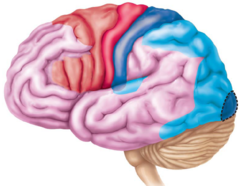
Damage to the circled area may lead to what behavioral symptom?
The ability to interpret visual stimuli
The ability to recognize faces
The ability to see but not comprehend
Functional blindness
Functional blindness
Which landmark separates the cerebral hemispheres?
The septum pellucidum
The central sulcus
The longitudinal fissure
The transverse cerebral fissure
The longitudinal fissure
Match the following area of the cerebrum with its function: Postcentral gyrus of the parietal lobe.
Sensory functions
Motor functions
Speech
Smell
Visual sensation
Sensory functions
Match the cerebral structure with the appropriate function: Cerebral cortex.
The "executive suite" of the nervous system where our conscious mind is found
Connects different parts of the same hemisphere
Important in starting, stopping, and monitoring the intensity of voluntary movements
The "executive suite" of the nervous system where our conscious mind is found
Match the following area of the cerebrum with its function: Broca's area.
Sensory functions
Motor functions
Visual sensation
Taste
Speech
Speech
Match the cerebral structure with the appropriate function: Projection fibers.
Connect different parts of the same hemisphere
Enter the cerebral hemispheres from lower brain or cord centers and leave the cortex to travel to lower areas
The "executive suite" of the nervous system where our conscious mind is found
Important in starting, stopping, and monitoring the intensity of movements executed by the cortex
Enter the cerebral hemispheres from lower brain or cord centers and leave the cortex to travel to lower areas
Match the term with its definition: Sulcus.
Shallow groove
Match the sensory area with the appropriate description/function: Gustatory cortex.
a) Integrates sensory inputs (temperature, pressure, etc.) relayed to it to produce an understanding of an object being felt
b) Involved in the perception of taste stimuli
c) Receives information from the general sensory receptors in the skin and from proprioceptors in skeletal muscles
d) Responsible for conscious awareness of balance (position of the head in space)
e) Responsible for permitting the perception of the sound stimulus
Involved in the perception of taste stimuli
Damage to the posterior association area could result in which of the following?
Carelessness with personal appearance
Lack of inhibition
Feeling that a part of the body "doesn't belong to me"
Rashly attacking a 7-foot opponent rather than running
Feeling that a part of the body "doesn't belong to me"
All of the structures of the CNS originate from the __________.
neural tube
In which part of the cerebral cortex do sensations, emotions, and thoughts come together and make us who we are?
The multimodal association cortex
Match the cerebral structure with the appropriate function: Commissural fibers.
Connect corresponding gray areas of the two hemispheres, enabling them to function as a coordinated whole (includes the corpus callosum)
Important in starting, stopping, and monitoring the intensity of movements executed by the cortex
Connect different parts of the same hemisphere
Enter the cerebral hemispheres from lower brain or cord centers and leave the cortex to travel to lower areas
The "executive suite" of the nervous system where our conscious mind is found
Connect corresponding gray areas of the two hemispheres, enabling them to function as a coordinated whole (includes the corpus callosum)
Because of the buoyancy provided by the ventricles and cerebrospinal fluid, a traumatic blow to one side of the head may cause the brain to "float" back and cause injury when the opposite side of the brain impacts the inside of the skull (a contrecoup injury).
Thus, a blow to the frontal lobe may also cause damage to what other lobe?
Occipital lobe
Right parietal lobe
Temporal lobe
Left parietal lobe
Occipital lobe
The visceral sensory area of the cerebral cortex is involved in the conscious perception of all the following except __________.
the feeling that your lungs will burst when you hold your breath
full bladder
upset stomach
taste
taste
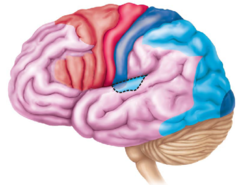
The circled area is involved with which of the following?
Perception of sound
Match the term with its definition: White matter.
Ridges
Furrows
Mostly myelinated axons
Mostly neuron cell bodies
Mostly myelinated axons
Match the term with its definition: Gray matter.
Furrows
Groups of axons in the CNS
Hollow space filled with fluid inside the CNS tissue
Neuron cell bodies
Neuron cell bodies
Match the term with its definition: Ventricle.
Furrow
Elevated ridge of tissue
Group of axons in the CNS
Hollow fluid-filled space
Deep groove
Hollow fluid-filled space
Match the following area of the cerebrum with its function: Precentral gyrus of the frontal lobe.
Motor functions
Smell
Sensory functions
Speech
Visual sensation
Motor functions