Kohlberg
 Call Kai
 Learn
 Practice Test
 Spaced Repetition
 Match
 Flashcards
 Knowt Play
1/22

Earn XP
Description and Tags
Dev. area
23 Terms
define morality
a person’s sense of understanding to differentiate between and do good / wrong - morals develop as you get older and grow and you add to them - everyone has the same idea of morality but different morals
define amoral
a person who does not have morals
why study moral development?
understanding the process of moral development and the age at which children can establish what is right and wrong had important applications for criminal responsibility. The age of criminal responsibility refers to the age at which a person can be arrested or charged with a crime. In theory, the age of criminal responsibility should not be set lower than the age at which children have an ability to understand “right” and “wrong”, in practice, however, many countries have laws which allow children to be prosecuted for criminal offences at very young ages
what was the Heinz dilemma?
“Heinz’s wife is dying of cancer. Doctors said a new drug may save her life. The drug had been discovered by a local chemist and Heinz tried to buy some, but the chemistry was charging 10 times the money it cost to make the drug and Heinz could only raise half of the money. He explained to the chemist that his wife was dying and asked if he could have the drug cheaper or pay the rest of the money later. The chemist refused, saying that he discovered the drug and was going to make money from it. The husband was desperate to save his wife, so later that night, he broke into the chemist’s and stole the drug."
outline Kohlberg’s stages of moral devlopment
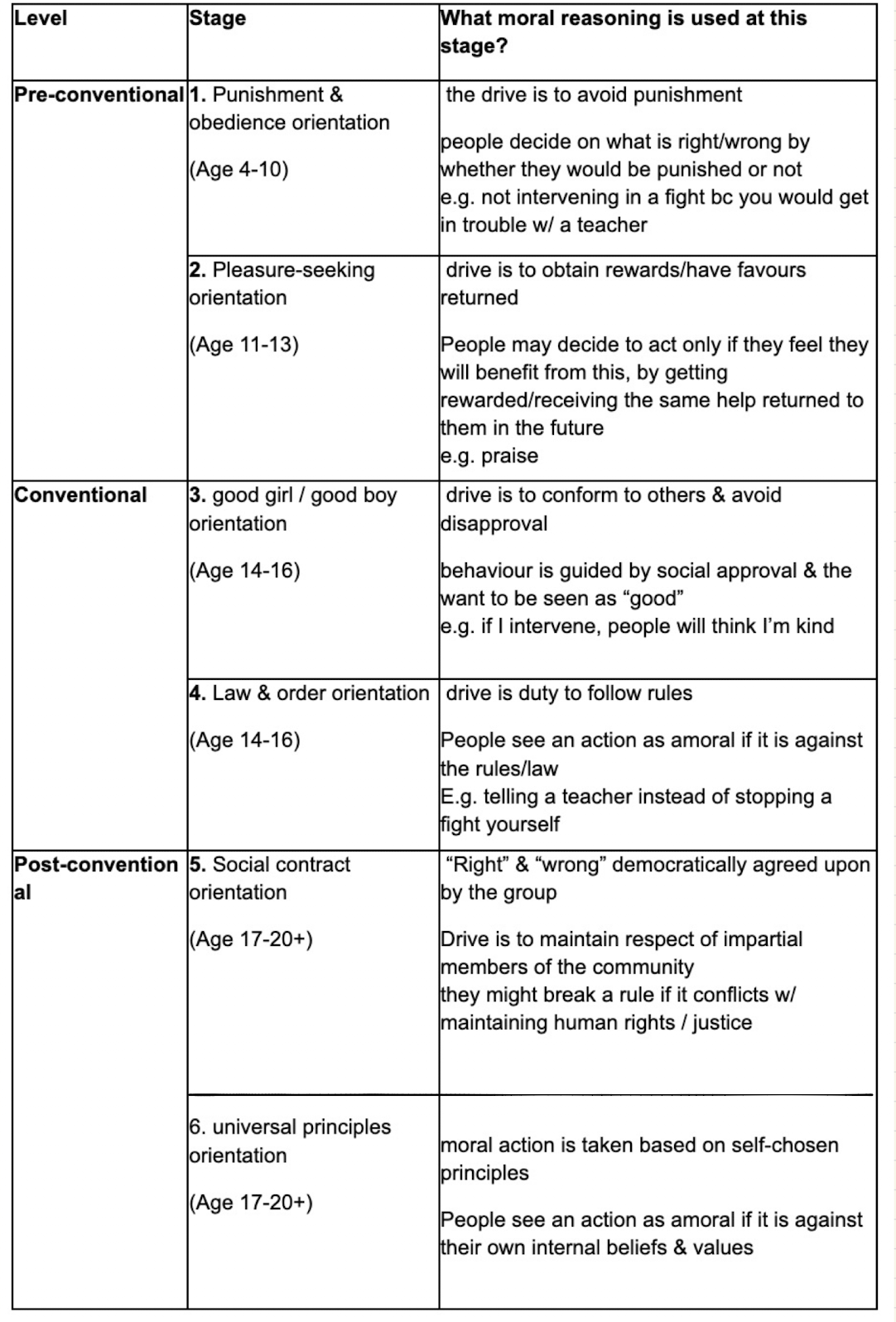
what was Kohlberg’s stage theory of moral development?
Kohlberg developed a systematic, three-level, six-stage, sequence of development, which reflected changes in moral judgement throughout the lifespan. Kohlberg argued that development proceeds from a selfish desire to avoid punishment (personal), to a concern for group functioning (societal), to a concern for the consistent application of universal ethical principles
what was the aim of the study?
to show how, as young adolescents develop into young manhood, they move through the distinct levels and stages of moral development proposed by Kohlberg in his theory of moral development
what was an issue of Kohlberg himself investigating to find evidence of his theory
researcher bias - lowers internal validity
what method was used?
longitudinal study (positive: gives multiple pieces of data - shows changes in development + reduces individual differences) following the development of the same group of boys for 12 yrs by presenting them with hypothetical moral dilemmas
Data collected through the use of interviews, each one of the American boys was, at 3 yearly interviews, presented with hypothetical moral dilemmas, all deliberately open to interpretation
Kohlberg also studied moral development in other cultures using hypothetical moral dilemmas. This study therefore has a cross-cultural element
outline the sample
sample 1: 75 American boys who were aged 10-15 at the start of the study were followed at 3-yr intervals through to ages 22-28
sample 2: moral development was also studied in boys of other cultures including; Great Britain, Canada, Taiwan, Mexico, and Turkey
evaluate the sample
no girls: gender bias, lowers pop val
good age range
decent sample size, lowers individual diffs
wide range of countries & cultures - not ethnocentric, less culture bias - however, not every country & culture so still ethnocentric elements
what was the IV?
age of boys
outline the procedure
for the 75 American boys
ps were presented w/ hypothetical, deliberately philosophical moral dilemmas in the form of short stories to solve. Kohlberg analysed the answers that the children gave in the moral dilemmas & used them to determine a child’s level of morality
the stories were to determine ps’s stage of moral reasoning for 25 diff moral concepts/apsects, including:
- motive given for rule obedience or moral action
- the value of human life: tested by asking the ps: aged 10: “Is it better to save the life of one important person or a lot of unimportant people?” Aged 13, 16, 20, 24: “Should the doctor “mercy kill” a fatally ill woman requesting death bc of her pain?” The Heinz dilemma was used.
Taiwanese boys, aged 10-13 were asked about a story involving theft of food: “A man’s wife is starving to death but the store owner won’t give the man any food unless he can pay, which he can’t. Should he break in and steal some food? Why?”
Young boys in Great Britain, Canada, Mexico, and Turkey were tested in a similar way
evaluate the procedure - are there any issues?
ps were presented with moral dilemmas - open to social desirability bias: ps may lie to seem like a better person according to society standards
Kohlberg himself analyses ps & determines their level of morality - researcher bias - everyone has diff opinions on what is right / wrong: open to analysis, not consistent- he wants to prove his theory right.
diff ages were asked slightly diff q’s
Non-Americans were tested slightly differently - reduces standardisation, reducing internal validity
task is very artificial - lowers ecological val
high ethnocentrism - lowers reliability
evaluate the type of data collected
Qualitative data was collected (ps responses to q’s)
difficult to compare, but more valid & accurately represents sample’s responses
culturally appropriate moral dilemmas were used for each culture studied, limiting ethnocentrism
outline the key findings
results showed that about 50% of each of the six stages a ps’s thinking was at a single stage, regardless of the moral dilemma involved & ps showed progress through the stages with increased age
not all ps over the period of the study progressed through all the stages & reached stage 6
ps progressed through the stages one at a time & always in the same order
once a ps had reached a particular stage, they neither stopped or continued to move upward. No adults in stage 4 had been through stage 6, but all stage 6 adults had gone through at least stage 4
a child at an earlier stage of development tends to move forward when confronted with/ the views of a child one stage further along & they seem to prefer this next stage (this relates to social learning theory)
outline the cross-cultural findings
Taiwanese boys aged 10-13 tended to give “classic” stage 2 responses
in the US, by age 16, stage 6 was rarely used. At age 13, the “good-boy” middle stage (3) was not used. Mexico & Taiwan showed the same results except that their development was a little slower
at the age of 16, stage 5 thinking was much more noticeable in the US than either Mexico or Taiwan
In the US, Mexico & Taiwan, middle-class children were found to be more advanced in moral judgement than matched lower-class children
No important differences were found in the development of moral thinking among Muslims, Catholics, Protestants, Jews, Buddhists, or Atheists
outline the issues with the cross-cultural findings
SOCIAL SENSITIVITY ISSUES: Changes across cultures. All progress through stages, but US ps were faster.
Could lead to discrimination against certain cultures and/or lower class - lowers self-esteem
financial diffs had an impact
really open to bias - may not have valid conclusions
differences in role of progression through stages of moral development differences (relates to how non-Americans were tested slightly differently)
what were the findings at each stage for obeying rules/following moral actions?

what were the findings at each stage, in relation to the “value of human life”

outline the conclusions drawn from all the findings of the study
moral development fits w/ Kohlberg’s stage-pattern theory; each stage of moral development comes one at a time & always in the same order
an individual may stop at any given stage & at any age
there is cultural universality of sequence of stages
middle-class & working-class children move through the same sequence but middle-class children move faster & further
this 6-stage theory of moral development is not significantly affected by widely ranging social, cultural, or religious conditions. The only thing that is affected is the rate at which individuals progress through the sequence.
Evaluate Kohlberg’s use of a longitudinal study
ps variables are controlled (e.g. personality differences would not affect differences in devleopment of moral reasoning between boys)
ps often drop out (Attrition) (in the og study, there were 84 boys, 9 dropped out - this may bias sample)
evaluate sampling bias
research is biased towards men; androcentric