proteins
 Call Kai
 Learn
 Practice Test
 Spaced Repetition
 Match
 Flashcards
 Knowt Play
1/21

There's no tags or description
Looks like no tags are added yet.
22 Terms
structure of amino acids
Amino acids have 2 reactive groups attached to a central carbon atom:
An amino group (NH2)
A carboxyl group (COOH)

The R group is different in different amino acids (some positively charged, some negatively charged, some have no charge).
What part of an amino acid varies between different types, and how many standard amino acids exist?
The R group (side chain) varies (can be positively charged, negatively charged, or uncharged).
There are 20 standard amino acids.
What type of reaction joins amino acids together, and what bond is formed?
Reaction: Condensation reaction
Bond: Peptide bond
What is the primary structure of a protein, and why is it important?
basic sequence of amino acids in the polypeptide chain - dictates how the whole chain folds up into its final 3D shape, which controls everything else the protein does.
How does secondary structure form, and what are its two main types?
Hydrogen bonding between the C=O group of one amino acid and the N-H group of another.
Alpha helix
Beta pleated sheet
What is tertiary structure, and what causes the polypeptide chain to fold?
Definition: The specific 3D shape of a protein.
Cause: Folding caused by interactions and bond formation between R groups.
What are the four types of bonds that stabilize tertiary structure?
Disulfide bridges: Form between sulfur-containing R groups (strong).
Ionic bonds: Form between oppositely charged R groups (strong).
Hydrogen bonds: Form between H and either O or N atoms.
Van der Waals' forces: Weak attractive forces between non-polar R groups.
What is quaternary structure, and do all proteins have it?
the structure formed by the association of two or more polypeptide chains.
no, only multi-subunit proteins do
what are the 2 types of protein
Globular
Fibrous
what are globular proteins
Globular proteins typically have metabolic functions, for example acting as enzymes, antibodies, transport proteins or hormones.
They are usually:
Soluble in water
Rounded in shape
Sensitive to extreme temperature or pH
Their amino acid sequences are usually variable and non-repeating.
what are fibrous proteins
Fibrous proteins typically have structural and support functions. For example, keratin is found in nails and horns, and collagen in tendons.
They are usually:
Insoluble in water
Long and narrow in shape
Less sensitive to extreme temperatures or pH
Their amino acid sequences have certain sections repeated many times.
how to have a chemical reaction
reactant particles must collide with sufficient energy to break bonds in the reactant molecules.
properties of enzymes
proteins
catalysts that lower the activation energy
less energy is needed for reactions to occur - can take place at lower temperatures
unchanged in the chemical reactions so can be used over and over again.
Enzyme Structure
protein tertiary structure gives the enzyme a specific 3D shape.
active site is the part of the enzyme to which the substrate binds if complementary
when it binds an enzyme-substrate complex is formed.
lock a key process model
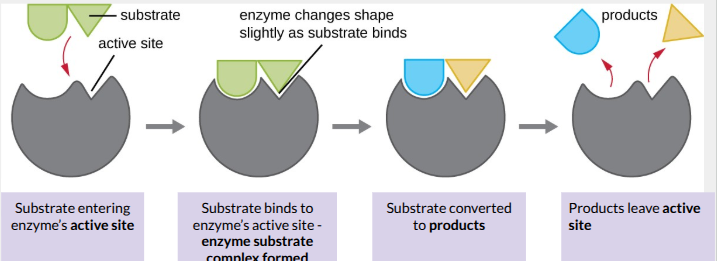
Factors Affecting Enzyme Activity
Temperature
pH
Enzyme Concentration
Substrate Concentration
what is denaturing
A change in the shape of the active site of the enzyme, resulting in it no longer being complementary to the substrate.
how can temperature affect enzyme activity below optimum temp
Increasing the temperature increases enzyme activity because it increasing the kinetic energy of the molecules.
Therefore the rate of collisions between the enzyme and substrate increases.
Therefore there are more chances of successful collisions resulting in enzyme-substrate complexes forming.
how can temperature affect enzyme activity above optimum temp
Increasing temperature decreases the rate of enzyme activity as the enzyme becomes denatured.
This is as the increased temperature causes bonds in the tertiary structure of the enzyme to break.
This changes the shape of the active site meaning it is no longer complementary to the substrate.
Enzyme-substrate complexes can no longer form
how can pH affect enzyme activity
Changing the pH away from the optimum pH reduces enzyme activity. If the change in pH is significant then the enzyme becomes denatured.
pH affects enzyme activity by:
Changing the charges on amino acids making up the active site so substrate can no longer attach - enzyme-substrate complexes cannot form.
Breaking the bonds in the tertiary structure of the enzyme, changing the shape of the active site and so preventing enzyme-substrate complexes from forming
pH fluctuations in organisms are rare and so changes in pH rarely denature enzymes in real life.
how can enzyme concentration affect enzyme activity
Increasing enzyme concentration increases the rate of an enzymatic reaction as long as there is an abundant supply of substrate.
how can substrate concentration affect enzyme activity
If the concentration of enzyme is fixed and the concentration of substrate increases the rate of the reaction increases.
This is because there is an increased rate of collision between the enzyme and substrate. This increases the chances of successful collisions resulting in enzyme-substrate complex formation.
Above a certain point, increasing substrate concentration has no effect on the rate of the reaction. This is as all the active sites are occupied with substrate and so enzyme concentration is limiting.