p-chem quiz 4
 Call Kai
 Learn
 Practice Test
 Spaced Repetition
 Match
 Flashcards
 Knowt Play
1/54

There's no tags or description
Looks like no tags are added yet.
55 Terms
Dosage dissolves
Drug enters GI tract as solution —> absorbed
Enters general circulation (blood)
Distributed to site of action or storage sites
OR immediately metabolized or excreted (“first pass metabolism”)
Overview of Oral Administration
can re-enter bloodstream
as a metabolite (pro-drug)
after it reaches site of action
Why are all but excretion reversible?
different absorption site, bypasses first-pass metabolism
Parenteral Administration: IM and SQ
NOT ABSORBED, travels directly into bloodstream
Parenteral Administration: IV
water solubility
degree of dissociation (pKa)
partition coefficient (K): oil to water solubility
resonance
hydrogen bonding
chelation
stereochemistry
interatomic distance between groups
isosterism
Physio-chemical properties related to drug action
kind, number, and arrangement of atoms in a drug molecule
What determines physico-chemical properties?
Structurally Non-Specific Drugs
Drugs that do not require any specific site of action
Biological effect relies on physico-chemical properties
Osmotic diuretics, Gastric antacids, general anesthetics
Examples of structurally non-specific drugs
Structurally Specific Drugs
interact with a specific receptor/enzyme to initiate/block signal transduction (ligands, agonists, antagonists, inhibitors)
rely on certain structural features
biological response
result of the interaction of a drug with a functional or organized group of molecules
Covalent (STRONGEST)
Reinforced Ionic
Ionic / charge-charge
Charge-dipole
Hydrogen bond
Dipole-dipole
Hydrophobic
Van der Waals (WEAKEST)
Bond strength ranking of chemical bonding interactions
Optical and geometric isomerism (R VS S, cis VS trans)
Conformational isomerism (sigma bond can rotate)
Isosterism: change in atom/functional groups
3 major types of steric factors that influence pharmacological activity
Fluorides and iodides
Medicinal agents for the control of pH: Gastric Antacids
Oxidating Germicides
Examples of Inorganic Substances as Medicinal Agents
Fluorides
prevent tooth decay by:
promoting tooth remineralizatiob
make teeth more decay resistant (better resistant to acid dissolutin)
inhibit plaque bacteria
Hydroxyapatite in teeth gets replaced with F to become fluoroapatite, which is more resistant to acid dissolution
How does fluoride help prevent tooth decay?
H2SiF6 and Na2SiF6: found in municipal water
NaF and Na2FPO3: found in toothpaste
Examples/sources of fluorine
Iodine is needed to produce thyroid hormones T3 and T4
Iodine deficiency can lead to
goiter: enlargement of thyroid gland
mental retaradation
Why is it important to prevent iodine deficiency?
NaI and NaIO3
Where is Iodine found?
antacids and acid reducers
OTC relief for heartburn and acid reflux (usually weak bases that neutralize HCl in stomach)
heartburn: acid reflux disease or GERD
Dyspepsia: pain/discomfort in upper middle part of stomach
Ulcers: cells are exposed/irritated by stomach acid
3 conditions antacids help with
Al(OH)3, MgCO3, CaCO3, Mg(OH)2
Examples of Antacids (weak bases)
composed of NaHCO3 and citric acid
In tablet, 2 separate forms
Reaction forms when dissolved: in H2O, forms CO2 bubbles
What is unique about Alka-Seltzer?
has both anti-bacterial and anti-inflammatory activity
dyed pink for branding purposes
What is unique about Bismuth Subsalicylate?

H2 blockers and PPIs
Examples of Organic drugs that work better for GERD, but take longer to produce effects
H2 blockers
inhibit stomach acid production
proton pump inhibitors
blocking proton pump to prevent acid production
oxidizing germicide
a substance that can kill a wide variety of organisms by oxidation, which irreversibly alters microbial proteins
Peroxides
Ozone
Halogens and their Oxo Compounds
General categories of oxidating germicides
hydrogen peroxide
used to clean wounds
Catalase converts H2O2 —> H2O + O2
Catalases on skin catalyzes decomposition of H2O2, releasing O2 bubbles
Wound is cleaned and bacteria is healed
can also sterilize heat-labile medical equipment
Metal Peroxides
peroxides used in pharmaceutical products, disinfectants, detergents, toothpaste
SLOWER decompositon than H2O2 —> better at producing oxidizing effects
CaO2, MgO2, Na2O2
Examples of metal peroxides
Organic Peroxides
peroxides that are used as antiseptics/disinfectants
can also initiate free radical chain reactions
Peroxyacetic acid, Benzoyl Peroxide, Cumyl and tert-butyl peroxides
Examples of organic peroxides
Ozone
powerful oxidizing agent, far better than dioxygen
decomposes and is unstable at high concentrations
used to bleach surface and kill microorganisms in air/water
Sodium hypochlorite
Hypochlorous Acid
Iodine
Permanganates
Examples of Halogen Germicides
Sodium hypochlorite (NaOCl)
Bleach: used as a disinfectant in hospitals/dentistry
can destroy standard steel because can be corrosive, must wash off and finish with alcohol
hypochlorous acid (HOCl)
Cl2 gas + H2O → H2O and HOCl
Cl2 used to disinfect air and municipal water
Keep at low concentration in pipes to kill bacteria
Iodine
WEAKEST of all oxidizing germicides, One of only halogens that is relatively safe
not soluble enough in water, must increase using different techniques
pink color
used in antiseptics

I2
Tincture of iodine: 2% I2 + 2.4% KI —> I3-
KI/I2: 5% I2 + 10% KI (Lugol’s solution)
Novel Iodine Antiseptics: Povidone-Iodine —> Polyvinyl pyrrolidone (PVPI)
used in organic polymers
dissolve in H2O
OTC Betadine solution/surgical scrub —> 1% I2
Forms of iodine
permanganates (KMnO4)
must dilute to 0.01% for use
will stain skin/clothes (magenta)
can be reduced to lower oxidation states
used as antiseptic
Fluorine (STRONGEST)
OH radical
Ozone
H2O2
Permanganate
HOCl
Cl2
HOBr
ClO2
Iodine (WEAKEST)
Ranking of Oxidation Potential from strongest to weakest
synthesis and storage in presynaptic neuron
released into synapse due to stimulus
produce response in postsynaptic cell
elimination mechanism: deactive neurotransmitter
receptor at post-synaptic cell
5 criteria of neurotransmitters
Reuptake: taken back to presynaptic cell for storage in vesicle
Metabolism: enzymes break down
Diffusion: decreased concentration where receptors are
Types of elimination mechanisms for neurotransmitters
located in CNS and PNS
cholinergic neurons
sympathetic and parasympathetic
can be inhibitory or excitatory
associated with Alzheimer’s (decreased ACh into CNS)
Function of Acetylcholine
Acetyl CoA + Choline —> Acetylcholine
by choline acetyltransferase
Synthesis of Acetylcholine
Acetylcholine —> Acetic Acid and Choline
by acetylcholine esterase (AChE)
choline: taken back to presynaptic neuron to be reused
Elimination of Acetylcholine (metabolism)
nicotinic cholinergic receptors (nAChR)
muscarinic cholinergic receptors (mAChR)
2 main classes of acetylcholine receptors
nicotinic cholinergic receptors (nAChR)
ion channels that bind nicotine
muscarinic cholinergic receptors (mAChR)
GPCRs that bind muscarine
prevent metabolism of acetylcholine in presynaptic cleft
build up acetylcholine —> muscle spasms
If reaching synapse, will phosphorylate acetylcholine esterase, causing the increase in ACh and overactivation of postsynaptic cells
How do organophosphates and nerve gases work on Acetylcholine?

Parathion: Insecticide
Example of organophosphate
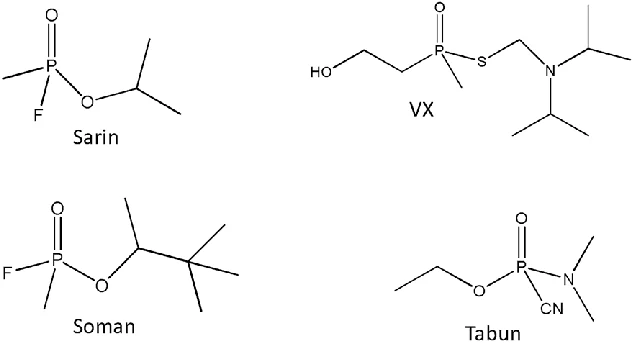
VX, Soman, Sarin
Examples of Nerve Gases
Atropine and 2-PAM
2 antidotes of organophosphates and nerve gases
atropine
bind to muscarinic receptor, preventing acetylcholine from binding —> STOP muscle spasms
2-PAM
recover unphosphorylated enzyme to remove phosphate from acetylcholine
must be done within 24 hours of exposure