Human Physiology: The Immune System Overview and Key Components
 Call Kai
 Learn
 Practice Test
 Spaced Repetition
 Match
 Flashcards
 Knowt Play
1/101

There's no tags or description
Looks like no tags are added yet.
102 Terms
What is immunity?
The body's ability to protect itself, provided by the immune system.
What are leukocytes?
White blood cells that are the primary cells of the immune system.
What is a pathogen?
Anything that causes a disease; short for 'pathology generator'.
What is the first line of defense against pathogens?
Barriers that prevent pathogens from entering the body.

What are the types of barriers in the immune system?
Physical barriers, mechanical barriers, and chemical barriers.
Give an example of a physical barrier.
Skin or other epithelial tissues.
What are mechanical barriers?
Processes that help push pathogens out of the body, such as coughing and sneezing.
What do chemical barriers do?
Destroy or neutralize pathogens with protective chemicals, like stomach acid.
What triggers an immune response?
The entry of a pathogen into the body.
What are the four steps of a typical immune response?
1. Detection & identification of the pathogen 2. Communication between leukocytes 3. Recruiting assistance 4. Destruction or suppression of the pathogen.
What is an antigen?
Any substance that can trigger an immune response; short for 'antibody generator'.
What are self-antigens?
Antigens produced by the body that do not trigger an immune response in the person they come from.
What are the two kinds of immunity?
Innate immunity and adaptive immunity.
What is innate immunity?
Immunity present from birth that reacts the same to any antigen without memory.
How quickly does innate immunity respond to antigens?
Within minutes or hours of exposure.
What is adaptive immunity?
Immunity gained over time from exposure to different antigens, which 'remembers' previous exposures.
What cells are responsible for adaptive immunity?
T cells and B cells.
Where do leukocytes begin their development?
In the red bone marrow.
What is hematopoiesis?
The process that creates leukocytes, erythrocytes, and platelets.

What do basophils and mast cells do?
Cause inflammation by releasing histamine and heparin.
What is the role of eosinophils?
Fight off multicellular parasites and are active during allergic reactions.
What are neutrophils?
Small, short-lived phagocytic cells that are the most common type of leukocyte.
What are monocytes and macrophages?
Larger, longer-lived phagocytic cells; monocytes travel through blood and can differentiate into macrophages.
What are dendritic cells?
Phagocytic cells with long processes that detect pathogens in epithelial tissue.
What types of lymphocytes are there?
T cells, B cells, and NK cells.
What is the function of NK cells?
Part of innate immunity, responsible for recognizing and destroying infected or cancerous cells.
What are chemotaxins?
Chemicals that attract leukocytes to an infected area.
What role do opsonins play in the immune response?
They bind to foreign substances, making them easier for leukocytes to find and destroy.
What is a common type of opsonin?
Antibodies.
What are pyrogens?
Chemicals that trigger an increase in body temperature, causing a fever.
How do higher temperatures affect pathogens?
They inhibit the growth of many pathogens in humans.
What is the function of histamine in the immune response?
It causes inflammation by dilating blood vessels, increasing blood flow to an area.
Which cells primarily release histamine?
Basophils and mast cells.
What are complement proteins?
A group of over 25 proteins that work together to damage and destroy pathogens.
What do complement proteins create in the membranes of some pathogens?
Membrane attack complexes that form large holes, causing the pathogen to swell and burst.

What is antigen presentation?
The process where cells take antigens from a pathogen and place them on their plasma membranes.

What is the role of major histocompatibility complex (MHC) proteins?
They present antigens on the surface of cells to activate T cells and B cells.
What type of MHC protein is found on nearly every cell in the body?
MHC class I (MHC-I).
What does MHC-I signal to the immune system?
It signals if a pathogen has infected the cell.
Where is MHC-II found?
On the surface of macrophages and dendritic cells.
What happens when lymphocytes encounter antigens presented by MHC-II?
They become activated.
How do T cells and B cells detect antigens?
Using special receptor proteins on their plasma membranes.
What is self-tolerance in the immune system?
The ability to filter out lymphocytes that would attack healthy cells.
What can cause autoimmunity?
Receptors that bind to self-antigens can lead to the destruction of healthy cells.
What is clonal expansion?
The process of replicating lymphocytes that bind to the same antigen after activation.
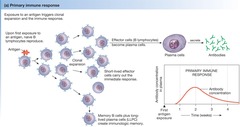
What is the primary immune response?
The body's first encounter with an antigen, characterized by slow clonal expansion.
What are memory T cells and memory B cells?
Lymphocytes created during the primary immune response that live in the body after the pathogen is gone.
What triggers the secondary immune response?
The re-encounter with an antigen, which activates memory cells for a faster response.

How long does clonal expansion take during the secondary immune response?
Only a few hours.
What is the significance of having billions of different receptor proteins in the immune system?
To recognize billions of potential antigens the body might encounter.
What is the process by which lymphocytes mature and are exposed to self-antigens?
A maturation process that ensures self-tolerance.
What is the potential benefit of early exposure to a variety of antigens?
It can help train the immune system to ignore harmless antigens, reducing allergic reactions.
What do B cells become when activated?
Plasma cells that produce large numbers of antibodies.
What are antibodies?
Small, Y-shaped proteins that make up 20% of plasma proteins and bind to specific antigens.
How many antigen-binding sites does each antibody have?
Two antigen-binding sites.
What is the function of antibodies in relation to pathogens?
They can bind to two separate pathogens at the same time, making them easier for leukocytes to find and destroy.

What is one way antibodies neutralize toxins?
By binding to the toxins, inactivating them so they cannot bind to and damage cells.
What is an example of a therapeutic use of antibodies?
Antivenin used to treat snakebites, which binds to toxins in snake venom.
What is the most common type of antibody?
IgG (immunoglobulin G), which makes up about 75% of all antibodies.
Where is IgA (immunoglobulin A) found?
In external secretions like saliva, milk, and mucus.
What is the role of IgE (immunoglobulin E)?
Produced to fight multicellular parasites and during allergic reactions.
What is the function of IgM (immunoglobulin M)?
Associated with the earliest parts of immune responses and helps activate complement proteins.
What is the role of IgD (immunoglobulin D)?
Found on the surface of B cells; it is the receptor that recognizes antigens and activates B cells.
What is passive immunity?
When the body receives antibodies made by someone else, such as from a mother through the placenta or breast milk.
What is active immunity?
When the body produces its own antibodies after being exposed to an antigen.
How can active immunity be artificially induced?
Through vaccination by exposing a person to antigens from a pathogen.
What do cytotoxic T cells do?
They kill cells with antigens presented on their MHC-I proteins by triggering apoptosis.

What is the function of helper T cells?
They secrete chemicals that stimulate other immune cells after recognizing antigens on macrophages and dendritic cells.
What do regulatory T cells do?
They suppress immune cell function to prevent an overactive immune response.
What is the role of memory T cells?
They speed up secondary immune responses without directly attacking pathogens.
What are the five types of pathogens that can infect humans?
Bacteria, viruses, parasites, fungi, and prions.

What is an example of a pathogenic bacterium?
Methicillin-resistant Staphylococcus aureus (MRSA), an antibiotic-resistant bacterium.
What are viruses composed of?
Small packets of genetic material (DNA or RNA) wrapped in a capsule of viral proteins.
What is the significance of the influenza virus?
It rapidly changes its genetic code to evade the immune system.
What are parasites?
Organisms that require a host to survive, causing health issues.
Name two types of multicellular parasites.
Hookworms and tapeworms.
What is an example of a single-celled parasite?
Plasmodium.
What are fungi?
Organisms that can cause disease under certain circumstances, e.g., Valley fever.
What are prions?
Misfolded proteins that cause other proteins to misfold, leading to loss of function.
What disease is caused by a prion?
Bovine spongiform encephalopathy (mad cow disease).
What distinguishes bacteria from viruses?
Bacteria are cells; viruses are not cells but bits of genetic material with a protein capsule.
How do antibiotics affect bacteria?
They target bacterial cell membranes, killing or inhibiting their growth.
Why are antibiotics ineffective against viruses?
Viruses are not cells and do not have structures that antibiotics can target.
What is the role of phagocytic cells in a bacterial infection?
They engulf and kill bacteria.

What triggers the activation of memory T and B cells?
The presence of previously encountered pathogens.
What is the role of cytotoxic T cells in viral infections?
They find and trigger apoptosis in infected cells displaying viral antigens.
What do NK cells do in response to viral infections?
They trigger apoptosis in infected cells lacking MHC-I proteins.
What is an allergen?
An antigen that triggers an immune response without harming the body.
What is anaphylaxis?
A severe allergic reaction that can lead to death if untreated.

What causes anaphylaxis?
IgE antibodies triggering a massive release of histamine.
What are MHC proteins?
Proteins that help the immune system recognize foreign tissues.
What happens if MHC proteins are 'wrong'?
Cytotoxic T cells will kill those cells, causing tissue rejection.
What is an autoimmune disease?
A condition where the immune system attacks self-antigens on healthy cells.
Give an example of an autoimmune disease.
Type 1 diabetes mellitus.

What is the effect of drugs used to treat autoimmune diseases?
They suppress the immune system, increasing susceptibility to infections.
What is the difference between immediate and delayed hypersensitivity reactions?
Immediate reactions occur within minutes, while delayed reactions take days to develop.
What triggers inflammation during an allergic reaction?
The release of histamine.
What is the role of complement proteins in bacterial infections?
They bind to bacteria, trigger mast cells to release histamine, and form membrane attack complexes.
What is the primary difference in survival between bacteria and viruses outside a host?
Bacteria can live and reproduce outside a host, while viruses cannot.
What is the function of dendritic cells in the immune response?
They present pieces of pathogens to lymphocytes for activation.