AUTOTECH 3AV3-Electric and Hybrid Vehicles Midterm 1
 Call Kai
 Learn
 Practice Test
 Spaced Repetition
 Match
 Flashcards
 Knowt Play
 Podcast
1/116

There's no tags or description
Looks like no tags are added yet.
Name | Mastery | Learn | Test | Matching | Spaced | Call with Kai | Chat |
|---|
No analytics yet
Send a link to your students to track their progress
117 Terms
Describe the greenhouse effect
CO2 (0.04% of the atmosphere) is the result of the combustion of HCs and coal. The
transportation sector is the major contributor to CO 2 emissions.The large amounts of CO2 released into the atmosphere by human activities are believed to
be largely responsible for the increase in the global Earth temperatureGlobal warming is a result of the “greenhouse effect” induced by the excess of CO 2 and
other gases, such as methane, in the atmosphere.Greenhouse effect:
greenhouse gases let sunlight (shortwave radiation) pass through the atmosphere.
the earth absorbs sunlight, warms, and reradiates heat (infrared or longwave radiation)
the outgoing longwave radiation is absorbed by greenhouse gases in the atmosphere.
this heats the atmosphere which in turn re-radiates longwave radiation in all directions.
some of it makes its way back to the surface of the earth
Without CO2, Earth's natural greenhouse effect would be too weak to keep the average
global surface temperature above freezingBy adding more CO2 to the atmosphere, people are supercharging the natural greenhouse effect, causing global temperature to rise
CO2 level have increased with 33% in the last 60 years (421 ppm = 0.04% of atmosphere
An increased Earth’s temperature results in major ecological damages to its ecosystems
disappearance of some endangered species
migration of some species from warm seas to previously colder seas, where they can
potentially destroy indigenous species and the economies that live off those species
Consider a regular residential house in a Canadian city. Can an electrical vehicle be charged with DC fast charging at home? Explain.
No
Supply type
DC fast charging (Level 3) needs a three-phase supply of 480 V or more (Mode 4).
Houses only get single-phase 120 V / 240 V AC.
Three-phase power isn’t supplied to residential homes.
Power available
Level 3 typically needs 50 kW, up to 350 kW.
Level 4 is 800 V, up to 500 kW.
A typical house has a 100 A main breaker: 240 V × 100 A = 24 kW total.
That’s less than half of even the smallest fast charger.
Even Level 2 (40 A breaker, 9.6 kW max) may need a panel upgrade.
It could trip the main breaker if used at the same time as the stove or dryer.
Grid capacity is listed as a home charging issue (Lecture 1).
Hardware
AC charging (Levels 1 and 2): the charger is inside the EV.
The onboard charger converts AC to the DC bus voltage, about 300–400 V.
DC fast charging bypasses the onboard charger.
It needs a large external AC-to-DC converter.
That’s public station equipment and very expensive ($50,000–$100,000 for ultra-fast).
What’s used at home instead
Level 1: 120 V, about 1.5–1.8 kW (15 A circuit)
Level 2: 240 V, about 7–9.6 kW (40 A breaker)
Conclusion
DC fast charging is only practical at public stations, for highway and long-distance travel.
Homes use Level 1 or Level 2 AC charging.
The Earth atmosphere contains approximately _________ cardbon dioxide
a) 0.4%
b) 40%
c) 0.04%
d) 0.004%
e) 4%
c) 0.04%
Carbon dioxide in Earth’s atmosphere is about 420–430 ppm (parts per million). Converting to a percentage:
430 ppm ÷ 10,000 ≈ 0.043%, which is roughly 0.04%
List the advantages and disadvantages of switched reluctance motors.
Advantages:
low cost
rugged structure
reliable converter topology
high effieciency over a wide speed range
simplicity in control
Disadvanatges:
Needs rotor position feedback to run
Either a shaft sensor (optical or Hall-effect) or sensorless techniques
More complex drive system
Needs a power inverter, voltage, current, and position sensors, and a DSP controller
Limits on power density
Copper packing factor
Lamination stacking factor
Saturation flux density of the steel
Heat removal from the stator
Phase inductance depends on both rotor position and current (because of saturation), which makes control harder
The combustion of an HC in an internal combustion engine yields ony carbon dioxide and water, which do not harm the environment?
False
ideally the combustion only yields CO2 and H2O but in reality, the combustion of HC in engines is never ideal
carbon dioxide and water, the combustion products contain a certain amount of
nitrogen oxides (NOx), carbon monoxides (CO), unburned HCs, and particles, all of which
are toxic to human health.CO₂ also harms the environment:
It’s the main greenhouse gas behind global warming (Lecture 1, greenhouse effect slides).
It’s only harmless to breathe: animals aren’t affected unless the CO₂ concentration is high enough that there’s almost no oxygen
Explain the C-rate of a battery: what it represents, what does 2 C means, what power is needed to charge a 20 kWh battery at 2C, what charging mode and charging level are required?
Discharge rate
Represents the speed of charge or discharge of a battery of any capacity
The C–Rate is the current at which a battery is charged or discharged.
The C–rate is a quantity of current. It allows us to compare different sized batteries
1C – full charge/discharge in 1 hour
2C – full charge/discharge in 1/2 hour (30 minutes)
0.5C – full charge/discharge in 2 hours
the power needed to charge a 20 kWh battery at 2C
P = C-rate × E = 2 × 20 kWh/h = 40 kW
Or, using P = E / t: P = 20 kWh / 0.5 h = 40 kW
what charging mode and charging level are required
Mode 4, Level 3 (DC fast charging)
Why it isn’t Level 1 or Level 2:
Level 1 is 120 V AC, about 1.5–1.8 kW. That’s far too low for 40 kW.
Level 2 is 240 V AC, typically 7–8 kW and at most 9.6 kW on a 40 A breaker. That’s still far below 40 kW.
AC charging goes through the car’s onboard charger, which the lecture describes as designed for slow rates of 0.5C to 0.125C. 2C is well above that.
Why it is Level 3, Mode 4:
40 kW is more than any AC level can supply, so it needs Level 3 DC fast charging: three-phase, 480 V or more, typically 50 kW and up to 350 kW.
Level 3 corresponds to Mode 4 (High-Speed DC charging), which bypasses the onboard charger and supplies DC directly to the battery.
2C is above 1C, which the lecture defines as fast charging.
In a separetely excited DC motor, the field and armature voltage
a) are the same
b) cannot be controlled
c) can be controlled independently of one another
d) are not needed for motor traction needs
c) can be controlled independently of one another
In a separately excited DC motor, the field winding and the armature each have their own power supply. This gives two ways to control speed:
Armature voltage control sets speed below base speed, with constant torque capability.
Field weakening (reducing field current) raises speed above base speed, with constant power.
Which battery parameter indicates its loading capability?
a) capacity
b) state of charge
c) specific power
d) specific energy
c) specific power
Specific power (W/kg) tells you how quickly a battery can deliver energy, meaning how much load it can supply at once. That’s what determines acceleration and peak performance in an EV.
The battery known as NMC is a
a) lead acid battery
b) nickel metal hydride battery
c) zinc-air battery
d) Li-ion battery
d) Li-ion battery
Li–ion batteries uses cathodes (positive electrodes) that include metals such as nickel,
manganese, cobalt, aluminium, lithium, iron, titanium
NMC – lithium Nickel Manganese Cobalt oxide (Li(NixMnyCo1/x/yO2): high capacity,
high performance, expensive – the most used in EV applications
The electrolyte of a battery can be a (select all the correct answers)
a) gel
b) solid
c) paste
d) resin
e) plasma
f) liquid
a) gel, b) solid, c) paste, d) resin, f) liquid
- medium that permits ionic conduction between positive and negative electrodes of a cell
- must have high conductivity for the ions that take part in electrode reactions, but it must
be a non–conductor for electrons in order to avoid self– discharge of batteries.
- most are liquid; some batteries use gel, paste, resin, or solid
Examples of each:
Liquid: flooded lead-acid batteries, and most Li-ion cells, which use an organic solvent electrolyte.
Gel: gel lead-acid batteries, where the acid is immobilized with silica, and gel-polymer Li-ion cells.
Paste: dry cells such as zinc-carbon and alkaline batteries, where the electrolyte is a moist paste.
Solid: solid-state batteries, which use ceramic or solid polymer electrolytes.
List 3 disadvantage of induction motors
The speed control of induction motors is difficult, whereas it is easier to control the speed of
DC motors by turning the supply voltage up or down. Due to advance in power electronics,
variable frequency drivers are used in industries for speed controlInduction motors have poor starting torque and thus, they may not widely be used for
applications with high starting torques such as traction systems. Moreover, induction motors
have high inrush currents that produces a large momentary voltage during startingUnlike DC motors, they can’t be driven from batteries or any other source of DC power without using an inverter. That is because thy need a changing magnetic field to turn the rotor.
Which combustion products are partially responsible for smog?
a) Unburned HC
b) NO2
c) CO
d) sulphur
e) CO2
a) Unburned HC and b) NO₂
From Lecture 1 (Environmental Impact):
NO₂ (slide 5): “NO₂ is partly responsible for smog; air becomes brownish, hazy and difficult to see through”
Unburned HCs (slide 7): “Unburned HCs are also responsible for photochemical smog: unburned HCs, NO and volatile organic compounds… react… with high ultraviolet radiation from the Sun to form ozone”
List 4 advantages of BLDC motors
Advantages of BLDC motors
• High efficiency: BLDC motors are the most efficient of all electric motors
• compactness: high-energy density magnets allows very high flux densities - high torques
• Ease of control: the BLDC motor can be controlled as easily as a DC motor
• Ease of cooling: the only heat production is on the stator, which is easier to cool than
• Low maintenance, great longevity, reliability: no brushes and mechanical commutators
• Low noise emissions: commutation is electronic at high frequency and not mechanical
Match the order of the countries with the largest oil reserves
Iran, Saudi Arabia, Venezuela, Canada, Iraq
Venezuela, 303.22 billion barrels
Saudi Arabia, 267.19 billion barrels
Iran, 208.60 billion barrels
Canada, 163.63 billion barrels
Iraq, 145.02 billion barrels
Motors used in EV applications should have (select all that apply)
a) high power density
b) high torque
c) high maintenance requirements
d) high acoustic noise
a) high power density, b) high torque
• Frequent starts, stops and acceleration
• High torque density and power density
• High speed range to eliminate need for multiple gears
• High reliability with no need for maintenance for >200,000 km
• High robustness in all temperatures and vibrational conditions common in vehicles
• Low acoustic noise
• Reasonable cost
An induction motor (select all that apply):
a) is also called AC Synchronous motor
b) is also called AC Asynchronous motor
c) are used in some EV and HEV vehichles
d) are best controlled with field-oriented control or vector control
b, c, and d are correct:
b) “AC Asynchronous (Induction) motors are commutator-less motor type”
c) “EV and HEV propulsion: Tesla Model S, 3, X, Y; Audi e-Tron SUV, Merc. Benz EQC”
d) “variable-voltage variable-frequency control cannot provide the desired performance”, while “field-oriented control (FOC) or vector control of induction motors are better.” The lecture adds that FOC still has low efficiency at light loads and a limited constant-power range.
a) is wrong. Induction motors are asynchronous, because the rotor slips behind the rotating magnetic field.
List 3 advantages of induction motors
• Simple in construction with only one moving part (rotor). This makes induction motors
low-cost, quiet, long lasting, and relatively trouble free
• Have a self-starting torque. However, single-phase induction motors does not have the
self-starting torque, and need to have some auxiliary mechanisms
• DC motors need a commutator and carbon brushes that wear out and need replacing
occasionally. The friction between brushes and commutator makes DC motors
relatively noisy and smelly. In contrast, induction motors are cheaper due to the
absence of these elements, and they can operate in polluted and explosive
environments without producing sparks
Consider a single coil in an electric motor. At what position of the coil no torque will be produced? Explain
No torque is produced when the coil plane is perpendicular to the magnetic field (α = 90°).
From Lecture 3 (Electric Motors), slide 6:
A current-carrying wire in a magnetic field feels a force F = BIL.
When the wire is shaped into a coil of diameter D, the forces on its two sides produce a torque:
T = B·I·L·D·cos α, where α is the angle between the coil plane and the field B.
Why torque is zero at α = 90°:
cos 90° = 0, so T = 0.
In this position, the forces on the two sides of the coil are still there (F = BIL), but they point in opposite directions along the same line, passing through the axis of rotation.
With no lever arm, they only stretch the coil instead of turning it.
Maximum torque is at α = 0°:
That’s when the coil plane is parallel to B: cos 0° = 1, so T = BILD (the maximum).
The two forces are then perpendicular to the coil plane, giving the largest lever arm.
Why this matters:
The lecture says slip rings and brushes (the commutator) are used “to conduct each coil at the position of α = 0”.
Switching current to each coil near α = 0 avoids the zero-torque position and gives continuous, maximum torque.
Real armatures use many coils at different angles, so some coils are always near α = 0.
Describe the Ozone layer (layer of the atmosphere where it is located, altitude above the earth’s surface, main role for the Earth, variation of its temperature with altitude reason for this variation)
• Near the ground, is an air pollutant that causes lung damage and asthma attacks.
• The ozone layer is found at about 15 to 35 km above the earth's surface
• The ozone layer accounts to about 90% of all the ozone (O 3) found in the atmosphere.
• O3 molecules protect life on Earth. They help shield the planet from harmful solar radiation
• Ozone makes up only one to ten out of every million molecules in the ozone layer. The rest
of the molecules are mostly nitrogen and oxygen
• Together, ozone and oxygen molecules are able to absorb 95 to 99.9% of the ultraviolet radiation that gets to our planet.
• When UV light is absorbed by oxygen and ozone, heat is generated, which is why the
stratosphere gets warmer with altitude
The advantages of lead-acid batteries are (select all the correct answers)
a) low cost
b) safe recycling
c) availbility of raw materials
d) low specific energy
a) low cost, b) safe recycling, c) availability of raw materials
Low cost: lead-acid is the cheapest rechargeable battery technology per kWh.
Recycling: lead-acid batteries are among the most recycled products in the world, with recycling rates around 99% in North America, and the recycling process is well established.
Raw materials: lead and sulphuric acid are abundant and widely available.
d) is a disadvantage, not an advantage. Lead-acid batteries have low specific energy, about 30–40 Wh/kg compared with 150–250+ Wh/kg for Li-ion. Low specific energy means they’re heavy for the energy they store.
What are the differences between a capacitor and an ultracapacitor (construction, capacitance)?
Capacitor | Ultracapacitor | |
|---|---|---|
Construction | Two charged plates separated by an insulating medium | Porous electrodes (such as activated carbon) in an electrolyte |
Plate separation | Micrometre range | Tenths of nanometres (0.3–0.8 nm) |
Surface area | Small, flat plates | Much larger, because the electrodes are porous |
How charge is stored | Static charges on the plates create an electric field | A double layer: when voltage is applied, ions in the electrolyte move to the surfaces of the porous electrodes |
Electrolyte | None (insulating medium) | Wet (liquid, the majority) or dry (solid or gel, a significant recent shift) |
Voltage | High breakdown voltage | Low breakdown voltage (1–3 V) |
Capacitance | Low | Much larger |
Why ultracapacitors have far more capacitance:
Capacitance is C = εA/d.
The ultracapacitor’s much larger area (A), from the porous electrodes, and its much smaller separation (d), at nanometres instead of micrometres, both increase C by orders of magnitude.
The trade-off is that the tiny separation only withstands 1–3 V.
Ultracapacitor advantages (same slide):
Extremely fast charging and discharging
Very long cycle life
Excellent reliability
Used for regenerative braking in electrified vehicles and power backup for electronic devices
In an AC Asynchronous motor, the angular speed of s Rotating Magnetic Field RMF) and the angular speed of the rotor are?
a) not needed for traction in an EV with such a motor
b) the same
c) different
c) different
“When the angular velocity of the rotor ωm is equal to the angular velocity of rotating stator mmf ωms, there will be no induced current in the rotor, and then no torque is produced. Therefore, there must exist a difference between them.”
The difference is called the slip speed: ω_sl = ω_ms − ω_m = s·ω_ms
And the slip is: s = (ω_ms − ω_m) / ω_ms
That’s why it’s called asynchronous: the rotor always turns slightly slower than the rotating magnetic field.
Match each specific energy, measure in Wh/kg, with the corresponding energy source
a) 13000, 100-265, 39500, 8500
b) Lithium battery, gasoline, hydrogen, ethanol
Lithium battery: 100–265 Wh/kg
Hydrogen: 39,500 Wh/kg
Ethanol: 8,500 Wh/kg
Gasoline: 13,000 Wh/kg

at ground level, ozone…
a) is an air pollutant that harms peoplend plants
b) protects the Earth from the sun’s harmful radiation
c) attacks the membranes of living cells
d) is needed for human life
a) and c)
a) Ground-level ozone is a major component of smog. It irritates the lungs, worsens asthma, and damages crops and vegetation.
c) Ozone is a strong oxidant, which is why it attacks cell membranes. It damages lung tissue and plant leaves.
b) is wrong. Protection from UV radiation is the job of the stratospheric ozone layer, about 15–35 km up, not ground-level ozone.
d) is wrong. Humans don’t need ozone to live. Breathing it is harmful.
The electrolyte of a battery must have a high conductivity for electrons, true or false
False
The electrolyte “must have high conductivity for the ions that take part in electrode reactions, but it must be a non-conductor for electrons in order to avoid self-discharge of batteries.”
Are permanent magents installed in large DC motors? Explain
No, not usually. Large DC motors use field windings (electromagnets) in the stator instead of permanent magnets.
From Lecture 3 (Electric Motors), slide 7, “Types of DC Motors”:
In a DC machine, the stator magnetic field is kept constant, and currents in the rotor (armature) produce torque through the Lorentz force.
“For small motors, permanent magnets are used to create the constant stator field.” The slide’s example is small wheelchair motors, which use ferrite magnets in the stator.
“For larger motors, such as traction motors for vehicles, permanent magnets are too expensive to use, so instead we use an electromagnet.” This stator electromagnet is called the field winding.
The slide’s large-motor example is the NetGain Warp9 series-wound motor, which “would need enormous magnets in the stator if field windings weren’t used.”
Why large motors use field windings:
Cost: a magnet strong enough for a large motor would be very big and expensive.
Size: the magnets needed would be enormous.
Control: a field winding lets you adjust the field current. With permanent magnets the field is fixed. Wound-field motors can be separately excited, shunt, series, or compound. A separately excited motor lets you control the field and armature independently, which allows field weakening above base speed.
The ozone layer that protects from UV radiation…
a) is found at about 15 to 35km
b) completly filters the UVA radiation
c) completely filters the UVC radiation
d) is located in the stratsphere
e) completely filters the UVB radiation
f) is located in the troposhere
a), c), and d)
From Lecture 1 (Environmental Impact):
a) Slide 12, “Ozone Layer”: “The ozone layer is found at about 15 to 35 km above the earth’s surface.”
c) Slide 11, “UV radiation”: UVC is “completely filtered by the atmosphere and does not reach the earth’s surface.”
d) The stratosphere runs from about 10 km to 50 km (slide 9), so the ozone layer sits inside it. Slide 12 adds that UV absorption by ozone is “why the stratosphere gets warmer with altitude.”
Why the others are wrong:
b) UVA is not filtered. It makes up “95% of the UV radiation reaching the Earth’s surface” (slide 11).
e) UVB is only partly filtered: “most solar UVB is filtered by the atmosphere” (slide 11). That’s not completely.
f) The troposphere is the first layer, below the ozone layer. Ozone “near the ground” is described as a pollutant (slide 12).
How can CO lead to death (effect on human body, what does the person feels, reason or being a poison, treatment). Explain.
What CO is
It comes from incomplete combustion of HCs because of a lack of oxygen.
It’s a colourless, odourless, and tasteless gas, so a person can’t sense it.
The lecture calls it “the most toxic gas”, because of its high affinity for hemoglobin.
Effect on the body
Normally, hemoglobin in the red blood cells carries oxygen to the organs.
When CO reaches the blood, it binds to the hemoglobin in place of oxygen and forms carboxyhemoglobin.
This greatly reduces the oxygen reaching the organs, which lowers physical and mental abilities.
Why it’s a poison
CO binds more strongly to hemoglobin than oxygen does.
The bond is so strong that normal body functions cannot break it.
So once CO attaches, that hemoglobin can’t carry oxygen any more. With enough exposure, the organs, especially the brain and heart, are starved of oxygen.
What the person feels
At low levels: flu-like symptoms such as dizziness, headache, nausea, and fatigue.
At higher concentrations: confusion and loss of consciousness, which can rapidly lead to death.
It’s especially dangerous because the gas can’t be detected, and the early symptoms are easy to mistake for the flu.
Treatment
Remove the person from the CO source.
Oxygen therapy is the primary treatment: give high-flow oxygen.
Hyperbaric oxygen is used in severe cases: the person breathes pure oxygen in a pressurized chamber, which removes CO from the blood faster.
How it leads to death, step by step:
CO is inhaled.
It binds to hemoglobin in place of O₂ and forms carboxyhemoglobin.
Less oxygen reaches the organs.
The person feels headache, dizziness, and nausea, then confusion.
They lose consciousness.
Without treatment, they die.
Select all the effects that are true for the nitrogen oxides pollutants produced by an internal combustion engine
a) nitrogen oxides are formed in the engine at low temperatures
b) NO released by the engine reacts with Oxygen to form NO2
c) The NO attaches to hemoglobin and can lead to death
d) The NO2 is decomposed by the Sun’s radiation to NO and highly reactive oxygen atoms
b) and d)
From Lecture 1 (Environmental Impact), slide 5, “Nitrogen Oxides”:
b) “Once released into the atmosphere, NO reacts with the oxygen to form NO₂.”
d) “The NO₂ can be decomposed by the Sun’s ultraviolet radiation back to NO and highly reactive oxygen atoms that attack the membranes of living cells.”
a) is wrong. NOx forms at high temperatures. The lecture says “high temperatures (above 1300 °C) and the high pressures… in the combustion chambers” create the conditions for nitrogen and oxygen to react.
c) is wrong. Binding to hemoglobin describes carbon monoxide (CO) (slide 6), not NO.
Select all the threats to modern life that are created by he transportation industry
a) depletng petroleum resources
b) high crime on cities
c) global warming
d) air polution
a), c), and d)
“Air quality, climate change (global warming), depleting non-renewable resources (such as petroleum), soil degradation and noise pollution are serious threats to modern life.”
These are the three major problems usually attributed to conventional ICE-based transportation:
a) Depleting petroleum resources: transportation is the largest consumer of oil.
c) Global warming: CO₂ emissions from burning fuel.
d) Air pollution: CO, NOx, unburned hydrocarbons, and particulates.
combustion is an internal combustion engine
a) is a combustion between fuel and air
b) releases combustion products
c) produces thermal energy
d) is the most effiecient way to extract energy from hydrocarbons
a), b), and c)
“Combustion is a reaction between the fuel and the air that releases heat and combustion products. The heat is converted to mechanical power by an engine and the combustion products are released to the atmosphere.”
a) It’s a reaction between fuel and air.
b) It releases combustion products.
c) It releases heat, which is thermal energy.
Select all the statements that are correct for controlling the speed of a DC motor
a) for RPMs above the base speed, the torque varies linearly with the RPM
b) for EV applications it is desirable to have constant torque below the base speed
c) for RPMs above the base speed, the RPM can be increased by weakening the magnetic field
d) for RPMs below the base speed, the torque varies proportionally with the applied voltage
b) and c)
b) “In EV and HEV applications, the most desirable speed–torque characteristic is to have a constant torque below a certain speed (base speed), and a constant power in the speed range above the base speed.”
c) “In order to further increase the speed, the field must be weakened with the increase of the speed.”
a) is wrong. Above base speed, “the torque produced drops parabolically with the increase of the speed and the output power remains constant.” That’s not a linear change.
d) is wrong. Below base speed, the armature current and field are held at their rated values, “producing the rated torque”, so torque stays constant. What changes is that “the armature voltage must be increased proportionally with the speed.” Voltage is proportional to speed, not to torque.
With more that the current concentration of CO2 in the atmosphere we expect to see
a) global temperatures to reamin at current averages
b) global temperatures to rise
c) global temperatures to decrease
b) global temperatures to rise
“With more carbon dioxide in the atmosphere, we expect to see:
less longwave (infrared) radiation escaping to space at the wavelengths that CO₂ absorbs
more infrared radiation returning back to Earth at these same wavelengths, producing favorable conditions for global warming, causing global temperature to rise.”
Which PMSM develop reluctance toque?
a) interior permanent magnet torque
b) all permanent magnet motors
c) none of the permanent magnet motors
d) surface permanent magnet motors
a) Interior permanent magnet (IPM) motors
IPM motors have permanent magnets embedded in the laminations. They “develop reluctance torque, which is the rotor’s tendency to align the magnetic field with the most permeable path.”
SPM motors have cylindrical magnets glued to the surface of the steel laminations. They “do not develop reluctance torque.”
What are the values of the specific energy of hydrogen, gasoline, and Li-ion battery?
Energy source | Specific energy (Wh/kg) |
|---|---|
Hydrogen | 39,500 |
Gasoline | 13,000 |
Li-ion battery | 100–265 |
The stratoshere..
a) is the first layer of the Earth’s atmoshere
b) has very dry air
c) is the 2nd layer of the Earth’s atmoshere
d) has a temperature that increases with altitude between -50c and 0c
e) is located between 10 km and about 50 km above the Earth’s surface
f) has a temperature that decreases with altitude between 0c and -50c
b), c), d), and e)
c) “Second layer of the atmosphere, that is situated above troposphere and below mesosphere”
e) “starts at about 10 km and ends at about 50 km above the earth’s surface”
d) “This layer’s temperature increases with altitude, with lower temperatures at its bottom, called tropopause (−50 °C) and warmer ones on its top, called stratopause (0 °C)”
b) “The stratosphere is very dry air, containing little water vapor and few clouds”
a) is wrong. The first layer is the troposphere.
f) is wrong. The temperature increases with altitude in the stratosphere, it doesn’t decrease.
List 4 disadvantages of BLDC motors
Disadvantages of BLDC motors
• Cost: Rare-earth magnets are much more expensive than other magnets
• Limited constant power range: the PM BLDC motor is incapable of achieving a maximum
speed greater than twice the base speed.
• Safety: Large rare-earth PMs are dangerous during the construction of the motor
because flying metallic objects are attracted towards them
forces and high temperatures
• Magnet demagnetization: can be demagnetized by large opposing magneto-motive
• High-speed capability: The surface-mounted PM motors cannot reach high speeds
• Inverter failures in BLDC motor drives: short-circuit failures of the inverter
Can an induction motor produce torque when the slip is zero? Explain.
No. An induction motor produces no torque when the slip is zero.
“When the angular velocity of the rotor ωm is equal to the angular velocity of rotating stator mmf ωms, there will be no induced current in the rotor, and then no torque is produced. Therefore, there must exist a difference between them. This difference is called slip speed.”
Slip definition:
s = (ω_ms − ω_m) / ω_ms
Slip is zero when ω_m = ω_ms, meaning the rotor turns at exactly the same speed as the rotating magnetic field.
Why zero slip means zero torque:
An induction motor has no electrical connection to the rotor. All rotor current is induced by the stator’s rotating magnetic field.
A current is only induced when the rotor bars cut through the magnetic field lines, which needs relative motion between the field and the rotor.
At zero slip, the rotor turns with the field, so there’s no relative motion. Then:
no changing flux through the rotor
no induced voltage (EMF)
no rotor current
no torque (since T ∝ B·I)
In practice, the rotor can never reach synchronous speed on its own. Friction and load slow it slightly, slip appears again, and torque is produced again.
That’s why induction motors are called asynchronous: some slip is always needed to produce torque.
a producer of an electric vehicle reported that the company pain in 2021 about @200/kWh (USD). Was it a good deal? Explain.
No, it wasn’t a good deal. 200/kWhwaswellabovetheaveragebatterypackpricein2021.</p><p><strong>FromLecture4(EnergySources),slide15,“EvolutionofLithiumBatteryPrices(US/kWh)”:
The Goldman Sachs bar chart shows the average Li-ion battery pack price in 2021 was about $135/kWh.
The IEA chart shows the same trend: in 2021, pack prices were at about 35% of their 2015 level.
Prices kept falling afterwards: $115/kWh in 2024, with forecasts of $85–100 in 2025 and $80 in 2026.
Comparison:
$200 − $135 = $65/kWh above average.
$200 / $135 ≈ 1.48, so the company paid about 48% more than the market average in 2021.
In fact, $200/kWh is more than the average price in any year shown on the chart (2019–2030). The highest bar, in 2019, is about $175/kWh.
Example of what it costs: for a 60 kWh pack:
At $200/kWh: 60 × 200 = $12,000
At $135/kWh: 60 × 135 = $8,100
That’s about $3,900 extra per vehicle.
Conclusion: the producer overpaid. Possible reasons include buying in small volumes (no bulk discount), using a more expensive chemistry, or being a smaller manufacturer with less buying power. But compared with the 2021 market average shown in the lecture, it was not a good deal.

What are the major differences between AC synchronous motor and a BLDC motor in term of stator winding and current waveform? Explain.
What they have in common:
AC synchronous motors are “very similar in construction to BLDC motors.”
Both are called permanent magnet synchronous motors (PMSM).
In both, the rotor turns at the same speed as the stator’s rotating magnetic field.
The lecture says: “The difference between an AC synchronous motor and a BLDC motor is the stator winding and the current waveform.”
AC synchronous motor | BLDC motor | |
|---|---|---|
Stator winding | Distributed windings: the windings of different phases overlap | Concentrated windings: the windings do not overlap (each coil is wound around its own stator tooth) |
Current waveform | Sinusoidal AC | Trapezoidal AC |
Result | A uniform rotating field when sinusoidal AC is applied | A uniform rotating field when trapezoidal AC is applied |
Why the waveform matches the winding:
AC synchronous motor: because the windings overlap, the magnetic field is spread smoothly around the air gap. A sinusoidal current then produces a smooth, uniform rotating field.
BLDC motor: each phase coil is concentrated on its own teeth. The controller switches DC from one stator coil to the next, which produces an alternating trapezoidal waveform (slide 4). The lecture notes that this is why “BLDC motors are actually AC motors”: they’re fed by DC that is switched electronically, but the coils see an AC trapezoidal waveform.
The electrochemical batteries have a higher specific power than ultracapacitors, true or false
False
Ultracapacitors have a higher specific power than electrochemical batteries
From Lecture 4 (Energy Sources):
Slide 35, “Ultracapacitors”:
“Batteries are sensitive to high-current pulses of charging/discharging.”
Ultracapacitors store energy electrostatically and offer “extremely fast charging and discharging.”
That’s why they’re used for regenerative braking, where large bursts of power have to be absorbed quickly.
Specific power is defined as the power available per unit mass, in W/kg (slides 3 and 17). Fast charging and discharging means high power per kg.
The trade-off:
Ultracapacitors have very low specific energy, only about 5 Wh/kg in the slide 4 table, compared with 100–265 Wh/kg for Li-ion.
Batteries store more energy, while ultracapacitors deliver power faster.
The lecture’s Ragone plot compares the different storage devices on exactly these two measures.
Consider a vehicle with a 60 kWh batter. What power is needed to charge the battery in 5 hours? What power is needed to charge the battery 10 minutes? Explain your calculations.
P = Q / t, where Q is the battery energy (kWh) and t is the charging time (h).
Charging in 5 hours
P = 60 kWh / 5 h = 12 kW
C-rate = 1 / 5 h = 0.2C, which is slow charging because it’s below 1C (slide 19).
This is in the range of the AC chargers in slide 19, which are “designed to charge a battery at very slow rates ranging from 2 to 8 hours (0.5C to 0.125C).”
12 kW is slightly above the Level 2 home maximum of 9.6 kW on a 40 A breaker (slide 21), so it needs a high-power Level 2 or a public charger.
Charging in 10 minutes
First convert the time to hours: t = 10 min = 10/60 h = 0.167 h
P = 60 kWh / 0.167 h = 60 × 6 = 360 kW
C-rate = 1 / 0.167 h = 6C, which is very fast charging because it’s well above 1C.
That requires Level 4 DC ultra-fast charging: 800 V, typically 350 kW and up to 500 kW (slide 21). It’s a Mode 4 connection that bypasses the onboard charger.
Not every battery chemistry can accept this rate, since “there is a limit on the speed of charging depending on the battery chemistry” (slide 19).
Explanation
The battery holds the same energy (60 kWh) in both cases. Charging it 30 times faster (300 min vs. 10 min) needs 30 times more power (12 kW × 30 = 360 kW). These are ideal values. Real charging needs slightly more power because of charger and battery losses.
Rank the energy sources based on their specific energy
a) lowest, highest, medium
b) ultracapacitors, electrochemical batteries, fuel cells
Ultracapacitors: lowest
Electrochemical batteries: medium
Fuel cells: highest
From Lecture 4 (Energy Sources), slide 4, specific energy table:
Supercapacitor: 5 Wh/kg
Batteries: lead-acid 30–50, NiMH 60–120, Li-ion 100–265 Wh/kg
Hydrogen (fuel cell fuel): 39,500 Wh/kg
Fuel cells rank highest because they consume hydrogen, which has the highest specific energy in the table.
Match the engine pollutants with their effects
a) unburned HC’s, NO, CO
is decomposed by the Sun’s ultraviolet radiation and the highly reactive oxygen atoms attack the membranes of the living cells
binds more strongly to hemoglobin than oxygen
is a harmful mixture of solid particles and liquid droplets found in the air
NO → 1
CO → 2
Unburned HCs → 3
From Lecture 1 (Environmental Impact):
NO → 1 (slide 5): “Once released into the atmosphere, NO reacts with the oxygen to form NO₂. The NO₂ can be decomposed by the Sun’s ultraviolet radiation back to NO and highly reactive oxygen atoms that attack the membranes of living cells.”
CO → 2 (slide 6): “Carbon monoxide binds more strongly to haemoglobin than oxygen.”
Unburned HCs → 3 (slide 7): this one is mostly by elimination. The lecture doesn’t define “a mixture of solid particles and liquid droplets” word for word. It does say that some unburned HCs “may be direct poisons or carcinogenic chemicals such as particulates”, which is the closest link.
Describe the working principle of chopper control of DC motor
Circuit
A DC voltage source V supplies the motor, which is an inductive load, through a self-commutated semiconductor switch S, typically a power transistor. The switch is turned on and off periodically.
A freewheeling diode D_F is connected in parallel with the motor. When S is off, it gives the load current a path to keep flowing, which improves the current waveform.
How it works
Switch S ON: the full source voltage V is applied to the winding, and the current rises.
When the current exceeds a set current limit, the voltage is turned off, or “chopped”, using the power transistors.
Switch S OFF: the motor’s inductance keeps the current flowing through the diode D_F, and the current gradually falls.
When the current drops below the limit, the voltage is turned on again.
Repeating this rapidly holds the current relatively constant.
Speed control with PWM
PWM sends a pulse of voltage followed by a dwell (off) period.
Duty cycle = pulse length / total period, expressed in %.
The motor sees an average voltage that is that percentage of the bus voltage: V_avg = D × V.
Example: a 120 V bus at 40% duty gives about 48 V average.
Changing the duty cycle changes the average armature voltage, and with it the motor speed.
Advantages of the high switching frequency
The output voltage ripple is at a high frequency, so there’s less ripple in the armature current. Ripple is the small, unwanted periodic variation of voltage or current.
Less current ripple means lower armature losses.
It works for both open-loop and closed-loop control.
It’s efficient, because power is controlled by switching rather than by burning energy in a series resistor.
Ozone is a _______ molecule formed of _______ oxygen atoms
a) brownish, one
b) red, three
c) colourless, three
d) colourless, one
e) red, one
f) brownish, three
c) colourless, three
“Ozone is a colorless molecule formed of three oxygen atoms, O₃.”
The “brownish” options describe NO₂, which slide 5 says makes smoggy air “brownish, hazy and difficult to see through.”
The role of the commutators in an induction motor is to..
a) distribute the DC current to a pair of coils
b) to provide a low friction between the brushes and rotor
c) to allow large currents to be passed through coils
d) wrong question as the induction motor do not have comutators
d) wrong question, as induction motors do not have commutators
“AC Asynchronous (Induction) motors are commutator-less motor type.”
The lecture groups induction motors with the commutatorless motors, which are “reliable and maintenance-free.” Commutators and brushes belong to traditional DC motors (slide 3: “Commutator motors are the traditional DC motor”). In an induction motor, the rotor current is induced by the stator’s rotating magnetic field, so no commutator is needed.
Select all statements that are true for BLDC motors
a) do not include permanent motors
b) need to use position sensors to function
c) permanent magnets can be mounted on the surface of the rotor
d) permanent magnets are installed on opposite sides of the stator
e) the torque of the motor cannot be controlled
b) and c)
From Lecture 3 (Electric Motors):
c) Slides 12–13: BLDC motors are classified by how the magnets are mounted on the rotor. A surface-mounted PM rotor is the most common type (used in e-bikes and computer fans). The other type is the interior PM.
b) Slides 12–13: “We just need to know the position of the rotor.” Position sensors H1, H2, and H3 sense the rotor position, and the DSP controller uses that to switch the correct stator windings.
Why the others are wrong:
a) BLDC motors do use permanent magnets, on the rotor (slide 12).
d) The magnets are on the rotor, not the stator. The coils are on the stator (slide 12): “the coils (now the stator) on the outside, and the permanent magnets (now the rotor) on the inside.” Option d describes a brushed DC motor.
e) “In this way, the torque and speed of the machines are controlled” (slide 13). Slide 14 also lists ease of control as an advantage: a BLDC can be controlled as easily as a DC motor.
One caveat on b: slide 4 says BLDC motors “generally operate with shaft position sensors or use sensor-less technologies.” So, strictly speaking, they need rotor position information rather than always a physical sensor. Since the BLDC drive slide is built around Hall sensors H1–H3, b is still most likely the intended answer.
Carbon dioxide…
a) is “digested” by plants through photosynthesis
b) is a necessary ingredient invegetal life
c) does not influence human life at any concentration in the air we breath
d) has the same effect on human life as cabon monoxide
From Lecture 1 (Environmental Impact), slide 4:
“Green plants ‘digest’ carbon dioxide CO₂ by photosynthesis. CO₂ is a necessary ingredient in vegetal life. Animals do not suffer from breathing CO₂ unless its concentration in air is such that oxygen is almost absent.”
Why the others are wrong:
c) The lecture says CO₂ does affect life at very high concentrations, when oxygen is almost absent. So “at any concentration” is wrong.
d) CO is described very differently (slide 6). It is “the most toxic gas” because it binds to hemoglobin in place of oxygen, even at low levels. CO₂ is only harmful at extreme concentrations.
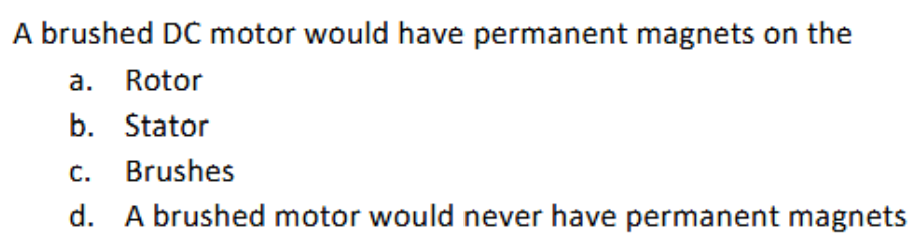
b. Stator
In a permanent-magnet brushed DC motor, the magnets are fixed on the stator and provide the stationary magnetic field. The rotor (armature) carries the windings, which receive current through the brushes and commutator.

c. The braking resistor and the rotor windings
In plugging, the armature voltage is reversed while the motor is still spinning. The supply voltage and the back-EMF then add together and drive a very large current through the armature. A braking resistor is placed in series to limit that current.
The kinetic energy, plus energy drawn from the supply, is converted to heat in:
the braking resistor, which takes most of it
the rotor (armature) windings, through I²R losses
a is wrong. Returning energy to the battery is regenerative braking, not plugging. Plugging actually draws extra energy from the supply.
d is wrong. The braking current flows through the armature, which is on the rotor in a brushed DC motor. It doesn’t flow through the stator.

c. Smaller
In the AWG system, a lower gauge number means a thicker wire. 1 AWG has a diameter of about 7.35 mm, while 12 AWG is about 2.05 mm.
Resistance is R = ρL/A. For the same material (ρ) and the same length (L), a larger cross-sectional area (A) means lower resistance:
1 AWG: about 42.4 mm²
12 AWG: about 3.31 mm²

c. kW
Power is measured in watts, and EV motors are usually rated in kilowatts. For example, a Tesla Model 3 rear motor is about 200 kW.
The other options measure different quantities:
lb·ft is torque.
Wh/km is energy consumption, or efficiency.
Volts is electrical potential, not power.

b. Horsepower·Second/Mile
Energy consumption has units of energy per distance, like Wh/km.
Horsepower × seconds is power × time, which is energy. Dividing by miles gives energy per distance. It’s an odd combination of units, but it measures the same thing as Wh/km.
The other options don’t work:
a. Volts/foot is an electric field gradient, not energy.
c. ft·lb/second is power, not energy per distance.
d. kW/km is power per distance, which is a trap. It’s kWh/km that measures consumption.

c. 12V
EVs still have a 12 V low-voltage system for accessories like windows, wipers, lights, and infotainment. It’s kept topped up by a DC-DC converter that steps down power from the high-voltage traction battery.
The other options:
a. EVs have no engine, so there’s no alternator.
b. AC is only used to drive the traction motor, through the inverter.
d. High-voltage (about 400–800 V) powers the traction motor, the cabin heater, and the A/C compressor, not small accessories.

c. Grade, acceleration
Regenerative braking can only recover energy from road-load terms that can become negative, meaning they push energy back into the vehicle:
Grade: going downhill turns potential energy into recoverable energy.
Acceleration: decelerating turns kinetic energy into recoverable energy.
Aerodynamic drag and rolling resistance always oppose motion and turn energy into heat, so nothing can ever be recovered from them. That’s why a and d are wrong.

a. Reverse the polarity of the voltage applied to the brushes
Torque is F = BIL. With permanent magnets, the stator field B is fixed, so reversing the armature current I through the brushes reverses the torque and the direction of rotation. In practice this is done with an H-bridge or by simply swapping the two supply leads.
The other options don’t work:
b and d: you can’t electrically change a permanent magnet’s polarity. Physically flipping the magnets would technically work, but it isn’t a practical way to reverse a motor.
c: rewinding the rotor is unnecessary.

d. Increase
Base speed is the speed at which the motor reaches the supply voltage while delivering its rated current (rated torque). From the armature equation:
V = E + I·R, where E = k·ω
So:
ω_base = (V − I_rated · R) / k
If I_rated decreases, the I·R voltage drop gets smaller. More of the supply voltage is then available as back-EMF, so the motor reaches a higher speed before running out of voltage. Put simply, a lower rated current means lower rated torque, and on the torque-speed line lower torque corresponds to higher speed.
Base speed is set by the voltage limit and the motor constants, not by thermal limits or road loads, so a and b are wrong.

c. Change the polarity of the rotor with respect to the stator
In a series-wound motor, the field winding (stator) and the armature (rotor) carry the same current. If you reverse the supply polarity to the whole motor, both the field and the armature current flip. Torque is proportional to Φ × I, so the two reversals cancel out and the motor keeps spinning the same way. That’s why a is wrong.
To reverse direction, you have to reverse the connection of the armature relative to the field winding, or the other way round, so that only one of them flips.
The other options:
b is meaningless, because in a resistive winding, reversing the voltage reverses the current.
d doesn’t apply, because series-wound motors use field windings, not permanent magnets.

b. Single motor, single speed transmission
Most EVs use one traction motor driving the wheels through a single fixed-ratio reduction gear and a differential. Examples include the Nissan Leaf, Chevy Bolt, and base Tesla Model 3.
This works because electric motors give high torque from zero RPM and operate efficiently over a wide speed range, so a multi-speed gearbox isn’t needed.
The other options:
a. Multi-speed transmissions are rare. The Porsche Taycan’s 2-speed rear axle is one exception.
c and d. In-wheel motors exist, but they’re uncommon in production cars because they add unsprung mass and increase cost and complexity.
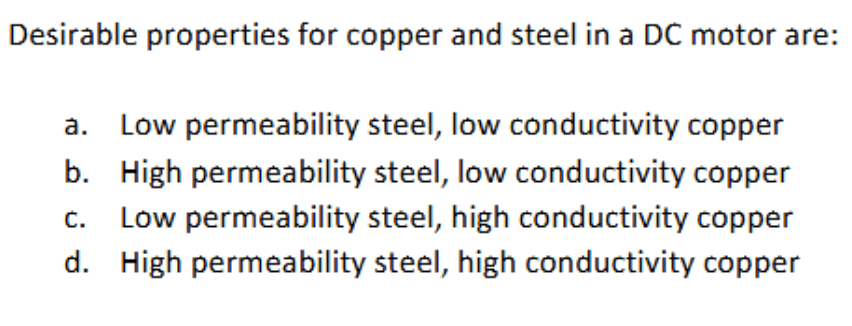
d. High permeability steel, high conductivity copper
High-permeability steel carries magnetic flux easily, so a strong field can be produced with less magnetizing current. That means more torque per amp.
High-conductivity copper has low resistance, so the windings lose less energy as I²R heat. That means higher efficiency and less heating.

a) Battery current while accelerating at 0.5 m/s² from 100 km/h
Vehicle speed: v = 100/3.6 = 27.78 m/s
Road loads:
Rolling resistance: F_r = C_R·m·g = 0.02 × 1600 × 9.81 = 313.9 N
Aerodynamic drag: F_a = ½ρ·C_DA·v² = 0.5 × 1.2 × 1.0 × 27.78² = 463.0 N
Acceleration force: F_acc = (1 + δ)·m·a = 1.05 × 1600 × 0.5 = 840.0 N
Total: F = 1616.9 N
At the wheels:
Wheel torque: T_w = F·r = 1616.9 × 0.35 = 565.9 N·m
Wheel speed: ω_w = v/r = 27.78/0.35 = 79.37 rad/s
At the motor:
Motor speed: ω_m = 6 × 79.37 = 476.2 rad/s, which is 476.2 × 60/2π = 4547 rpm
Motor torque: T_m = T_w / (N·η_gear) = 565.9 / (6 × 0.947) = 99.6 N·m
Motor output power: P_m = T_m·ω_m = 99.6 × 476.2 = 47.4 kW
Reading the efficiency map at about 4550 rpm and 100 N·m: this point is to the right of the 70% contour and above the 60% line. So η_motor ≈ 65%.
Power and current from the battery:
P_batt = P_m / (η_motor·η_inv) = 47,430 / (0.65 × 0.95) = 76.8 kW
I = P_batt / V = 76,800 / 350 ≈ 219 A
If your instructor reads the map as 70%, the current comes out to about 204 A. Show the point you read from the map so the marker can follow your reasoning.
b) Maximum regenerative deceleration from 100 km/h
Motor torque limit at 4547 rpm: the map’s torque envelope is a constant-power curve above 1500 rpm.
Corner power: P_max = 380 N·m × (1500 × 2π/60) = 59.7 kW
This checks out at 5000 rpm: 59,700 / 523.6 ≈ 114 N·m, which matches the curve.
At 476.2 rad/s: T_m,max = 59,700 / 476.2 = 125.3 N·m
Braking force at the wheel: when regenerating, power flows from the wheels to the motor. The gearbox losses therefore add to the braking effect, so the wheel torque is T_m·N/η_gear.
T_w = 125.3 × 6 / 0.947 = 793.9 N·m
F_regen = 793.9 / 0.35 = 2268 N
Road loads also help slow the car: 313.9 + 463.0 = 776.9 N
Deceleration:
a = (2268 + 776.9) / (1.05 × 1600) = 3045 / 1680 ≈ 1.81 m/s²
If your course applies gear efficiency as a multiplier in both directions (T_m·N·η_gear), you get F_regen = 2034 N and a ≈ 1.67 m/s². Check which convention your notes use.
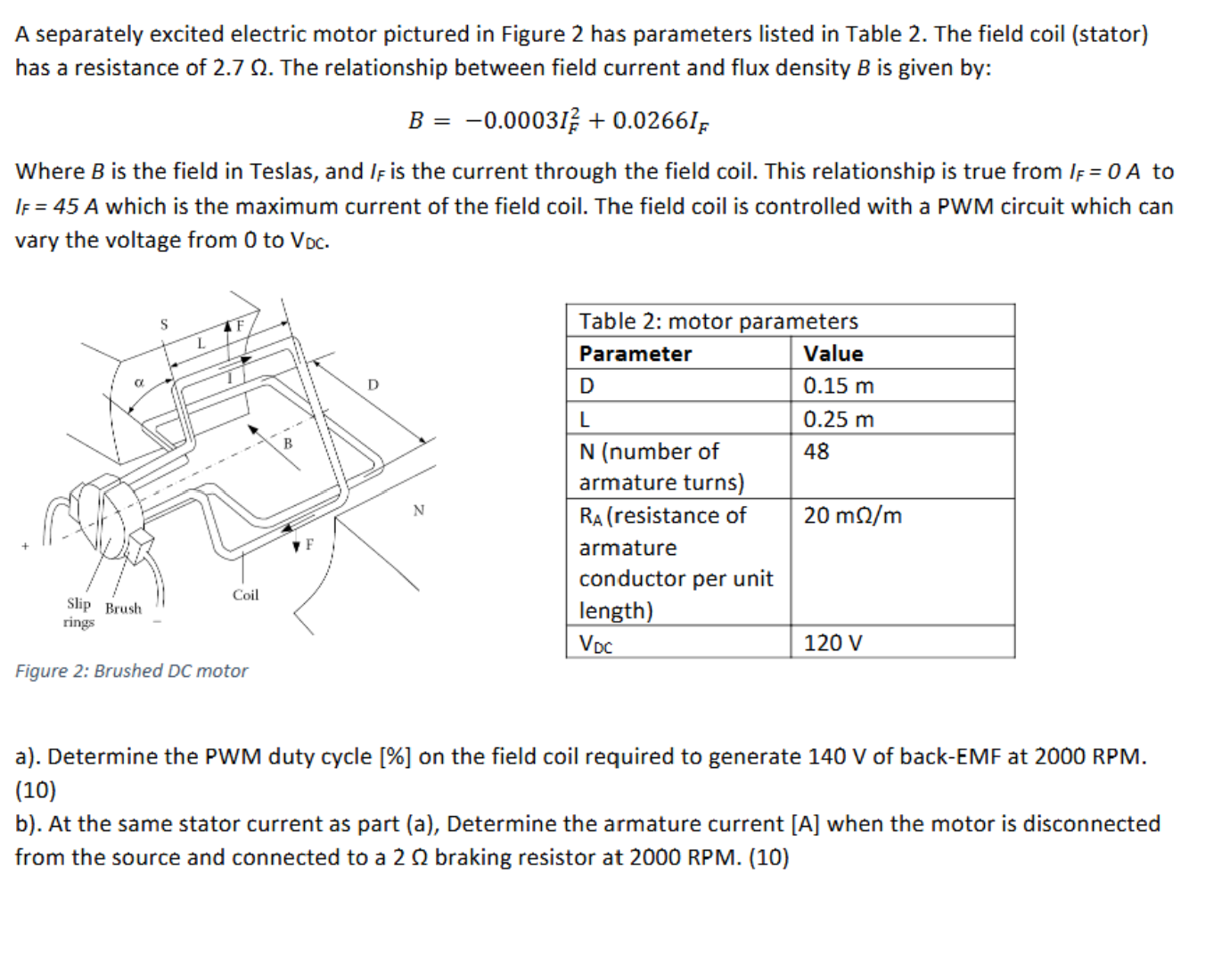
a) PWM duty cycle for 140 V back-EMF at 2000 RPM
Speeds:
Angular speed: ω = 2000 × 2π/60 = 209.44 rad/s
Conductor speed: v = ω·D/2 = 209.44 × 0.075 = 15.71 m/s
Back-EMF: each turn has two active sides of length L, so:
E = 2·N·B·L·v = 2 × 48 × B × 0.25 × 15.71 = 376.99·B
Required flux density:
B = 140 / 376.99 = 0.3714 T
Field current: set the given B–I relationship equal to 0.3714 and rearrange:
0.0003·I_F² − 0.0266·I_F + 0.3714 = 0
I_F = [0.0266 ± √(0.0266² − 4 × 0.0003 × 0.3714)] / (2 × 0.0003)
I_F = (0.0266 ± 0.01618) / 0.0006
The two roots are 17.36 A and 71.3 A. The second is outside the valid 0–45 A range, so I_F = 17.36 A.
Check: −0.0003(17.36)² + 0.0266(17.36) = 0.3714 T ✓
Field voltage and duty cycle:
V_F = I_F·R_F = 17.36 × 2.7 = 46.9 V
Duty = V_F / V_DC = 46.9 / 120 = 39.1%
b) Armature current into a 2 Ω braking resistor at 2000 RPM
With the same field current and speed, the back-EMF is still E = 140 V. The motor now acts as a generator.
Armature resistance: each turn is a loop of two sides of length L and two end-turns of length D.
Length per turn = 2(L + D) = 2(0.25 + 0.15) = 0.8 m
Total conductor length = 48 × 0.8 = 38.4 m
R_A = 38.4 × 0.020 = 0.768 Ω
Current:
I_A = E / (R_A + R_brake) = 140 / (0.768 + 2) = 140 / 2.768 ≈ 50.6 A
If your course counts only the active conductor length (2L per turn, 24 m total), then R_A = 0.48 Ω and I_A = 140 / 2.48 ≈ 56.5 A. Using the full loop length is the more physically correct approach.

Common values:
Weight: Mg = 1350 × 9.81 = 13,243.5 N
Drag constant: ½ρC_dA = 0.5 × 1.22 × 0.35 × 2.3 = 0.4911 kg/m
a) 40 km/h, 75 kW at the wheels
Speed: v = 11.11 m/s
Tractive force: F_t = 75,000 / 11.11 = 6750 N
Drag: F_w = 0.4911 × 11.11² = 60.6 N
d = (F_t − F_w)/Mg = 6689.4 / 13,243.5 = 0.5051
Low-grade approximation: i = d − f_r = 0.5051 − 0.01 = 0.4951 ✓
This value is too large for the small-angle assumption (sin α ≈ tan α), so the exact formula is needed.
Large-grade formula:
sin α = [d − f_r·√(1 − d² + f_r²)] / (1 + f_r²)
sin α = (0.5051 − 0.01 × 0.8631) / 1.0001 = 0.4964
α = 29.77°, so i = tan α = 0.572, or 57.2% ✓
b) 120 km/h, 100 kW at the wheels
Speed: v = 33.33 m/s
Tractive force: F_t = 100,000 / 33.33 = 3000 N
Drag: F_w = 0.4911 × 33.33² = 545.6 N
d = 2454.4 / 13,243.5 = 0.1853
Low-grade approximation: i = 0.1853 − 0.01 = 0.175, or 17.5% ✓
Large-grade formula:
sin α = (0.1853 − 0.01 × 0.9827) / 1.0001 = 0.1755
α = 10.11°, so i = tan α = 0.178, or 17.8% ✓
The low-grade estimate is only about 1.5% off here, so it’s acceptable at this grade.


Given: v = 130/3.6 = 36.11 m/s, and the weight is Mg = 1200 × 9.81 = 11,772 N. A 5% grade gives α = tan⁻¹(0.05) = 2.862°.
a) Force at the wheels
Aerodynamic drag: F_w = ½ × 1.22 × 0.56 × 2.25 × 36.11² = 1001.7 N
Rolling resistance: F_r = 0.015 × 11,772 × cos α = 176.4 N
Grade: F_g = 11,772 × sin α = 587.9 N
Total: F ≈ 1765–1766 N ✓
The small difference from 1765.4 N is just rounding of v.
b) Power at each stage
Stage | Calculation | Power |
|---|---|---|
Wheels | 1765.4 × 36.11 | 63.73 kW ✓ |
Motor output (before gearbox) | 63.73 / 0.97 | 65.70 kW ✓ |
Inverter output (motor input) | 65.70 / 0.91 | 72.20 kW ✓ |
Battery | 72.20 / 0.95 | 76.0 kW ✓ |
c) Share of battery power (76.0 kW)
Load or loss | Power | % of battery |
|---|---|---|
Gearbox loss: 65.70 − 63.73 | 1.97 kW | 2.6% ✓ |
Motor loss: 72.20 − 65.70 | 6.50 kW | 8.6% ✓ |
Inverter loss: 76.0 − 72.20 | 3.80 kW | 5.0% ✓ |
Air resistance: 1001.7 × 36.11 | 36.16 kW | 47.6% ✓ |
Rolling resistance: 176.4 × 36.11 | 6.37 kW | 8.4% ✓ |
Grade: 587.9 × 36.11 | 21.21 kW | 27.9% ✓ |
Total | 76.0 kW | 100% ✓ |
The percentages add up to 100%, which confirms the breakdown.
Energy
Time for 3 km: t = 3 / 130 = 0.0231 h
Energy: E = 76.0 × 0.0231 ≈ 1.756 kWh ✓
Per kilometre: 1756 Wh / 3 km = 585.3 Wh/km ✓


Assuming the “vehicle in (1)” is the 1350 kg car from the gradeability problem (C_d = 0.35, A = 2.3 m², f_r = 0.01), here’s the full check.
Setup:
Effective mass: δM = 1.05 × 1350 = 1417.5 kg
V_b = 30 km/h = 8.333 m/s
V_f = 96.6 km/h = 26.82 m/s
Road resistance: R(v) = f_r·Mg + ½ρC_dA·v² = 132.4 + 0.4911v² (N)
P_max: P_max = F_max × V_b = 6500 × 8.333 = 54.17 kW, not 51.145 kW. Point c on the graph agrees, since about 1.05 kN × 51.4 m/s ≈ 54 kW.
Ignoring road resistance (the standard textbook formula)
t_a = δM(V_b² + V_f²) / (2P_max) = 1417.5 × (69.44 + 719.3) / (2P_max)
P_max used | t_a |
|---|---|
51.145 kW (class value) | 10.93 s |
54.17 kW (corrected) | 10.32 s |
Including road resistance (numerical integration)
Constant-force phase, 0 to 8.33 m/s: dt = δM·dv / (6500 − R). This gives t₁ ≈ 1.86 s.
Constant-power phase, 8.33 to 26.82 m/s: dt = δM·v·dv / (P − R·v). Using Simpson’s rule with P = 54.17 kW, this gives t₂ ≈ 9.76 s.
Total: t_a ≈ 11.6 s
Summary: the class answer of 11.03 s is closest to the no-resistance formula using the class P of 51.145 kW, which gives 10.93 s. Given the information in the question:
If your course expects the simple formula, the answer is ≈ 10.3 s, using P = 54.17 kW.
If road loads are included, the answer is ≈ 11.6 s.


The in-class answers check out. Here’s the full working:
Given: v = 100 km/h = 27.78 m/s. The wheel diameter is 24″, so r = 12″ = 12 × 0.0254 = 0.3048 m.
a) Motor power
Power at the wheels: P_w = F·v = 400 × 27.78 = 11,111 W
The power passes through both the gearbox and the differential, so divide by both efficiencies:
P_m = P_w / (η_gb·η_diff) = 11,111 / (0.98 × 0.97) = 11,111 / 0.9506 = 11.69 kW ✓
b) Motor speed
Wheel speed: ω_w = v/r = 27.78 / 0.3048 = 91.13 rad/s
Total gear ratio: 1.2 × 4.1 = 4.92
Motor speed: ω_m = 4.92 × 91.13 = 448.4 rad/s
Converting: 448.4 × 60/2π = 4283 rpm ✓
c) Motor efficiency
First find the motor torque:
T_m = P_m / ω_m = 11,690 / 448.4 = 26.07 N·m ✓


Given:
m = 1250 kg; CD AF vex = 0.53 m 2
; D wheel = 25 inch; iG = 4.4; fr = 0.01; δ = 1.05; ηG = 0.98; ηinv = 0.97;
Determine:
a) If i = 3%, v = 60 km/h and a = 0 then amax = ? [m/s]
b) If v 1 = 100 km/h and v air = 10 km/h, α = 0° and v = constant then P mot_loss = ? [kW]
c) If v o = 0 km/h, and v f = 60 mph and α = 0 then t a = ? [s]
Solution:
Adopt: ρair = 1.22 kg/m 3
, g = 9.81 m/s 2
Conversions: 25 inch = 0.635 m; 60 km/h = 16.67 m/s; 100 km/h = 27.78 m/s; 10 km/h = 2.78 m/s;
60 mph = 26.68 m/s
a) Cwheel = π · D wheel = (π)(0.635 m) = 1.995 m/rev
ωwheel = v / C wheel = (16.67 m/s)/(1.995 m/rev) = 8.356 rev/s = 501.36 rev/min
ωmot = ωwheel · iG = (501.56 rev/min)(4.4) = 2206 rev/min (rpm)
On the T-ω plot, the maximum torque that can be produced at 2206 rpm is Tmot = 280 Nm
T wheel = T mot · iG · ηG = (280 Nm)(4.4)(0.98) = 1207 Nm
Ft = T wheel / rwheel = Twheel / (D wheel /2) = 1207 Nm / (0.635 m / 2) = 3802 N
Fd = 0.5 · C D AF · ρair · v 2 = 0.5(0.53)(1.22 kg/m 3
)(16.67 m/s) 2 = 89.8 N
α = tan-1
(i) = tan-1
(0.03) = 1.72°
Fr = m · g · fr · cos(α) = (1250 kg)(9.81 m/s 2
)(0.01)(cos(1.72°)) = 122.6 N
Fc = m · g · sin(α) = (1250 kg)(9.81 m/s 2
)(sin(1.72°)) = 368.1 N
Fa max = Ft – Fd - Fr - Fc = 3802N – 89.8 N - 122.6 N – 368.1 N = 3221.5 N
a max = Fa max / (δ · m) = (3221.5 N)/(1.05 · 1250 kg)) = 2.454 m/s 2
b) v veh/air = v 1 + v air = 27.78 m/s + 2.78 m/s = 30.56 m/s
Fd = 0.5 · C D AF · ρair · v veh/air2 = 0.5(0.53)(1.22 kg/m 3
)(30.56 m/s) 2 = 301.9 N
Fr = m · g · fr · cos(α) = (1250 kg)(9.81 m/s 2
)(0.01)(cos(0°)) = 122.6 N
Fc = 0 (because α = 0°)
Fa = 0 (a = 0 because v = constant)
Fwheel = Fd + Fr + Fc + Fa = 301.9 N + 122.6 N = 424.5 N
T wheel = Fwheel · rwheel = (424.5 N)(0.635 m / 2) = 138.8 Nm


What do internal combustion engines rely on to derive the energy necessary for teir propulsion?
hyrdrocarbon (HC)
What is combustion?
It is a reaction between the fuel and the air that releases heat and combustion products
What percentage of the Earth’s atmosphere is made up of nitrogen oxides?
0.93%
What is nitrogen?
an inert gas
very stable in atmosphere
high temperatures (above 1300°C) and the high pressures condition in the combustion chambers of internal combustion engines create favourable conditions for a reaction between nitrogen in the air and oxygen and the formation of nitrogen oxides (NO x )
Can NO2 be decomposed by the Sun’s ultraviolet radiation back to NO?
Yes and highly reactive oxygen atoms that attack the membranes of living cells
How is acid rain made?
NO2 also reacts with atmospheric water to form nitric acid (HNO 3), which dilutes in rain and produces “acid rain” responsible for the destruction of forests in industrialized countries and also contributes to the degradation of historical monuments made of marble
What is carbon monoxide?
Results from the incomplete combustion of HCs due to lack of oxygen
What does CO smell and look like?
It is a poisonous, colorless, odorless and tasteless gas, considered to be the most toxic gas as it shows high affinity to haemoglobin
What is a major impurity?
Sulphur mostly found in diesel and jet fuel, but also in gasoline and
natural gas
In what layer of the Earth’s atmosphere are aircrafts designed to be the most fuel-effiecient?
Stratosphere
avoid turulence
lower air density
reduced drag
fater speeds
What is the Karman line and where is it located?
conventional boundary that separates Earth's atmosphere from outer space, located at an altitude of 100 kilometers above mean sea level
What are the 3 types of UV radiation?
UVA
UVB
UVC
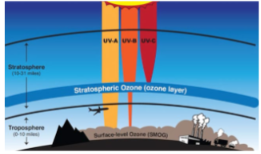
What is UVA?
long wavelength
95% per cent of the UV radiation reaching the Earth's surface
can penetrate into the deeper layers of the skin; responsible for the immediate tanning
unprotected exposure contributes to skin ageing and wrinkling, and development of skin cancers
What is UVB?
medium wavelength
very biologically active but cannot penetrate beyond the superficial skin layers
responsible for delayed tanning and burning
unprotected exposure skin ageing and promotes the development of skin cancer
most solar UVB is filtered by the atmosphere.
What is UVC?
short wavelength
the most damaging type of UV radiation
completely filtered by the atmosphere anddoes not reach the earth's surface.
What are the costs induced by pollution?
health expenses, the cost of replanting forests devastated by acid rain, and the cost of cleaning and fixing monuments corroded by acid rain.
What are the costs associated with global warming?
the cost of the damages caused by hurricanes, lost crops due to dryness, damaged properties due to floods, and international aid to relieve the affected populations
What are the barriers to addopting EVs?

What are electric propulsion systems parts?
They consist of electric motor(s), power converters, and electronic controllers.
Electric motors convert electrical power into mechanical power
Power converters supply the proper voltage, current and frequency to the motor
Electronic controllers calculate the proper voltage, current and frequency based on the motor’s position and the external torque request
ECU: electronic control unit
DSP: digital signal processor

What do motors used in EVs and HEVs usually require?
frequent starts and stops;
high rates of acceleration/deceleration;
high torque and low–speed hill climbing;
low torque and high-speed
cruising;very wide speed range of operation
what are the two main groups that motor drives can be classified in?
Commutator
Commutatorless
What are commutator motors?
traditional DC motor
Include series excited, shunt excited, compound excited, compound excited, and permanent magents (PMs) excited motors
DC series motors need commutators and brushes
are not maintenance-free and have low specific power density
due to their mature technology and simple control, have been used in electric
propulsion sy
Why have commutatorless motors become more attractive?
more attractive due to their higher efficiency, higher
power density, and lower operating cost. They are reliable and maintenance-free
What are the types of commutatorless motors?
Brushless DC (BLDC) motors with PM
AC Synchronous motors
AC Asynchronous (Induction) motors
Switched reluctance motors (SRMs)
Explain brushless DC motors with PM
ability to produce a large torque and a high power density.
BLDC motors are actually AC motors as they are driven by DC voltage that switches
from one stator coil to the next, generating an alternating (AC) trapezoidal waveformgenerally operate with shaft position sensors or use sensor-less technologies
Explain AC synchronous motors
With permanent magnets (PMSM), brushless
simple and inexpensive, but with relatively low output power
high power density, high efficiency; compete with induction motors for E
Explain AC asynchronous (induction) motors?
are commutator-less motor type
variable-voltage variable-frequency control cannot provide the desired performance
field-oriented control (FOC) or vector control of induction motors are better but have
low efficiency at light loads and limited constant-power operating range.EV and HEV propulsion: Tesla Model S, 3, X, Y; Audi e-Tron SUV, Merc.Benz EQC
Explain switched reluctance motors (SRMs)
have good characteristics for EVs and HEV
simple construction, low cost, excellent T-ω character., difficult design and control
operate with shaft sensors or use sensorless technologies
What are DC motor drives used in?
applications requiring adjustable speed; good speed regulation; and frequent starting,
braking, and reversing.
What do all motors have?
rotor and a stator. The stator must cause a magnetic force on the rotor in
order to generate torque
What are the types of wound-fied DC motors and explain them?
In a separately excited motor, the field and armature voltage can be controlled
independently of one another.In a shunt motor, the field and armature are connected in parallel to a common source.
An independent control of field or armature currents can be achieved by inserting a
resistance in the appropriate circuit (inefficient) or by using power electronics based DC–
DC converters that replace the resistance (efficient) .In the case of a series motor, the field current is the same as the armature current;
therefore, field flux is a function of armature current. Can be run from AC, so also known
as a universal motorIn a cumulative compound motor, the magneto-motive force (mmf) of a series field is a
function of the armature current and is in the same direction as the mmf of the shunt field
