APARH Unit 02 | The Oldest Civilizations
 Call Kai
 Learn
Learn Practice Test
 Spaced Repetition
 Match
Match Flashcards
 Knowt Play
1/14

There's no tags or description
Looks like no tags are added yet.
Name | Mastery | Learn | Test | Matching | Spaced | Call with Kai | Chat |
|---|
No analytics yet
Send a link to your students to track their progress
15 Terms
White temple ziggurat
Uruk (modern Warka, Iraq). Sumerian. c. 3500-3000 BCE. Mud brick.

Palette of King Narmer
Predynastic Egypt. c. 3000-2920 BCE. Greywacke.

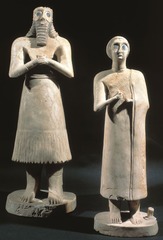
Votive statues
From the Square Temple at Eshnunna (modern Tell Asmar, Iraq). Sumerian. c. 2700 BCE. Gypsum inlaid with shell and black limestone.
Seated scribe
Saqqara, Egypt. Old Kingdom, Fourth Dynasty. c. 2620-2500 BCE. Painted limestone.

Standard of Ur
From the Royal Tombs at Ur (modern Tell el-Muqayyar, Iraq). Sumerian. c. 2600-2400 BCE. Wood inlaid with shell, lapis lazuli, and red limestone.

Great Pyramids and Great Sphinx
(Menkaure, Khafre, Khufu) Giza, Egypt. Old Kingdom, Fourth Dynasty. c. 2550-2490 BCE. Cut limestone.

King Menkaura and queen
Old Kingdom, Fourth Dynasty. c. 2490-2472 BCE. Greywacke.

The Code of Hammurabi
Babylon (modern Iran). Susian. c. 1792-1750 BCE. Basalt.

Temple of Amun-Re and Hypostyle Hall
Karnak, near Luxor, Egypt. New Kingdom, 18th and 19th Dynasties. Temple: c. 1550 BCE; hall: c. 1250 BCE. Cut sandstone and mud brick.

Mortuary temple of Hatshepsut
Near Luxor, Egypt. New Kingdom, 18th Dynasty. c. 1473-1458 BCE. Sandstone, partially carved into a rock cliff, and red granite.

Kneeling statue of Hatshepsut
Near Luxor, Egypt. New Kingdom, 18th Dynasty. c. 1473-1458 BCE. Sandstone, partially carved into a rock cliff, and red granite.

Akhenaton, Nefertiti, and three daughters
New Kingdom (Amarna period), 18th Dynasty. c. 1353-1335 BCE. Limestone.

Tutankhamun's tomb, innermost coffin
New Kingdom, 18th Dynasty. c. 1323 BCE. Gold with inlay of enamel and semiprecious stones.

Last judgment of Hu-Nefer
From his tomb (page from the Book of the Dead). New Kingdom, 19th Dynasty. c. 1275 BCE. Painted papyrus scroll.

Lamassu
From the citadel of Sargon II, Dur Sharrukin (modern Khorsabad, Iraq). Neo-Assyrian. c. 720-705 BCE. Alabaster.
