[ 2.2.2.4 - 2.2.2.5 ] electronegativity & intermolecular forces
 Call Kai
 Learn
Learn Practice Test
 Spaced Repetition
 Match
Match Flashcards
 Knowt Play
1/23

Earn XP
Description and Tags
[ https://chemrevise.org/wp-content/uploads/2022/01/2.2.2-bonding-and-structure.pdf ] + [ https://www.physicsandmathstutor.com/pdf-pages/?pdf=https%3A%2F%2Fpmt.physicsandmathstutor.com%2Fdownload%2FChemistry%2FA-level%2FNotes%2FOCR-A%2F2-Foundations-in-Chemistry%2FDetailed%2F2.2.%20Electrons%2C%20Bonding%20and%20Structure.pdf ]
Name | Mastery | Learn | Test | Matching | Spaced | Call with Kai | Chat |
|---|
No analytics yet
Send a link to your students to track their progress
24 Terms
Electronegativity
Electronegativity is the relative tendency of an atom in a covalent bond in a molecule to attract electrons in a covalent bond towards itself. This attraction for electrons comes from the positive core.
Core Charge
The resultant of the positive charge on the protons and the negative charge on the outer electrons.
Core
protons in nucleus + filled inner shells of electrons
Factors Affecting Electronegativity:
higher core charge → higher positive charge will attract electrons more easily to the atom
smaller sizes of atom → electronegativity increases across a period as the number of protons increases and the atomic radius decreases because the electrons in the same shell are pulled in more
decreases down a group because the distance between the nucleus and the outer electrons increases and the shielding of inner shell electrons increases
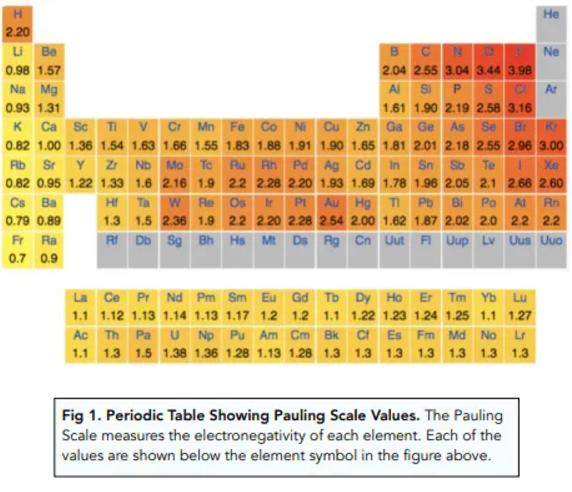
Pauling Scale of Electronegativity:
electronegativity increases from left to right across the Periodic Table
electronegativity decreases down a group of elements
Permanent Dipole
A small difference in charge across a bond that results from a difference in the electronegativities of the bonded atoms; the more electronegative atom has a greater share or the electrons so it becomes slightly negative. Polar covalent bonds have permanent dipoles.
Electronegativity and Bonding Type:
Electronegativity difference increases:
non-polar/pure covalent bonds (0)
polar covalent bonds (0<x>1.8)
ionic bonds (x>1.8)
Polar Molecule
Molecules with an overall dipole taking into account any dipoles across the bonds.
Identifying Permanent Dipoles:
a molecules must have a difference in electronegativity between the atoms in its bonds
molecules must not be totally symmetrical
Bond Dipoles
The dipoles across individual bonds.
Features of a Molecule with No Overall Dipole:
symmetrical molecule
bond dipoles cancel out
non-polar
eg. CO2 , CCl4
Features of a Molecule with an Overall Dipole:
not a totally symmetrical molecule
bond dipoles reinforce each other
molecule has a permanent dipole
polar
eg. SO2 , CHCl3
Intermolecular Forces
The weak forces between molecules; they are important in determining the physical properties of substances made up of separate molecules. The strong covalent bonds inside the molecules are responsible for the identity of the substance and its chemical reactions.
Types of Intermolecular Forces:
London Forces (1-10 kJ mol-1)
Permanent Dipole-dipole Interactions (3-25 kJ mol-1)
Hydrogen Bonds (10-40 kJ mol-1)
London Forces (Induced Dipole-dipole Interactions)
The attractive forces between induced dipoles in neighbouring molecules. This occurs between all molecules (both polar and non-polar).
How London forces Arise:
Electrons at any given moment may by chance move to one side of the molecule, causing an instantaneous dipole
This dipole attracts the electrons of neighbouring molecule → this is an induced dipole
Further attractions will result as these dipoles induce other dipoles in other neighbouring molecules
Factors Affecting London Forces:
the more electrons in the molecules, the greater the instantaneous and induced dipoles, therefore the stronger the London forces
the larger the number of molecules in a space, the higher the chances of instantaneous dipoles occurring, therefore increasing the London forces’ strength
Permanent Dipole-dipole Interactions
The attractive forces between permanent dipoles in polar neighbouring molecules eg. HCl or CHCl3.
How Permanent Dipole-dipole Interactions Arise:
due to the difference in electronegativity in a molecule like HCl, there is a permanent dipole
the slightly positive charge on one molecule attracts the slightly negative charge on the neighbouring molecule
Hydrogen Bonds
A strong permanent dipole-dipole interaction between:
an electron-deficient hydrogen atom next to N, O, or F on one molecule
a lone pair of electrons on N, O or F on a different molecule
Representation of Hydrogen Bonds
dotted line
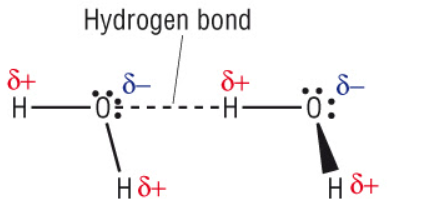
How Hydrogen Bonds Arise:
N, O and F are the most electronegative atoms and are small atoms with lone pairs → provides a concentrated area of electron density
H is electropositive and when its only electron is removed, the nucleus is left quite exposed → provides a concentrated area of positive charge
Effects of Hydrogen Bonds on Properties:
higher than expected boiling points when compared with substances of similar molecular size with no hydrogen bonding
higher than expected viscosity (flow less easily due to molecules clustering together)
Often soluble in water
Special Properties of Water:
higher than expected values of melting and boiling points as a result of strong intermolecular forces
decrease in density on freezing → ice has a rigid structure where the molecules are held apart by hydrogen bonds; when the ice melts, the structure collapses inwards and the density increases
high surface tension → hydrogen bonds strongly link the molecules at the surface of the water so the water acts as a membrane