Movement Analysis: Squats, Rowing, and Jumping
 Call Kai
 Learn
 Practice Test
 Spaced Repetition
 Match
 Flashcards
 Knowt Play
1/17

Earn XP
Description and Tags
Vocabulary flashcards covering the biomechanics and phases of vertical jump analysis, ground reaction forces, jump testing types, and the anatomical characteristics of hip extensor muscles.
18 Terms
Newton's 3rd Law: Action-Reaction
The biomechanical principle stating that to every action there is an equal yet opposite reaction; if object A exerts a force on object B, then object B exerts the same force on object A but in the opposite direction.
Ground Reaction Force (GRF)
The reaction force exerted by the ground onto an individual in response to the action force exerted by that individual against the ground.
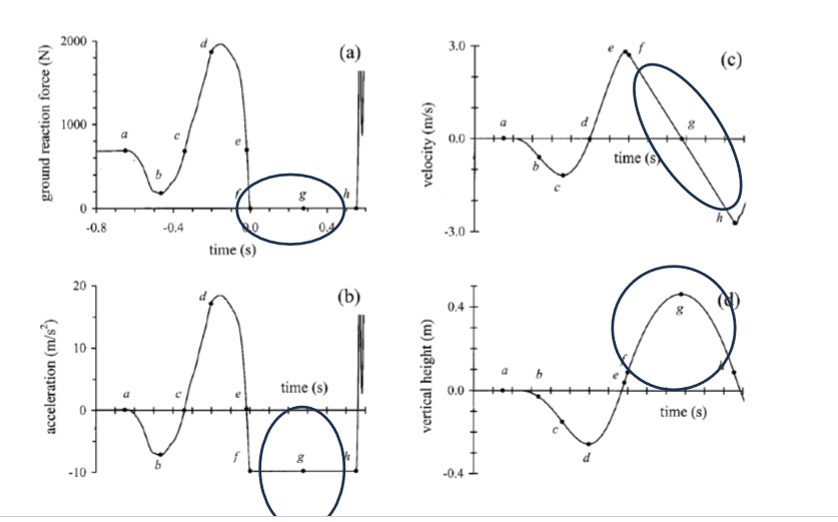
Quiet Phase
The initial period in a vertical jump before movement begins, during which the athlete's body weight can be determined, due to the ground reaction force.

Unweighting Phase
The first movement phase of a vertical jump where the athlete drops down and 'unweights', producing a force lower than body weight (essentially in a free-fall) with negative velocity that continues to increase in the negative direction (downward acceleration).

Braking Phase
The phase of a vertical jump where the athlete begins applying force to slow and then stop the free-fall; centre-of-mass velocity remains negative but ascends toward 0m/s (upward acceleration).

Propulsive Phase
The phase of a vertical jump occurring after the athlete has completely stopped downward motion, during which they actively propel themselves upward; characterized by positive velocity until take-off.
muscle activity switches from eccentric to concentric

Flight Phase
The phase of a vertical jump that begins the moment the athlete takes off from the ground, defined by the absence of ground reaction force as they are in the air, vertical height peaks half way through jump (GRF=0).
Landing Phase
The final phase of a vertical jump that begins when the athlete descends from the air and makes contact back onto the force plate.

Gluteus Maximus
A mono-articular hip extensor muscle that originates on the ilium, sacrum, and coccyx and inserts on the lateral greater trochanter.
Hamstrings
A bi-articular muscle group that extends the hip; all heads originate on the ischial tuberosity (with the short head on the femur) and insert onto either the tibia (semimembranosus and semitendinosus) or fibula (biceps femoris).
Mono-articular Muscle
A classification of muscle that spans and acts across only a single joint, exemplified by the gluteus maximus.
Bi-articular Muscle
A classification of muscle that spans and acts across two distinct joints, exemplified by the hamstring muscle group crossing both the hip and knee.
Biceps Femoris
A hamstring muscle that originates on the ischial tuberosity (with its short head on the femur) and inserts onto the fibula.
Semimembranosus and Semitendinosus
The medial hamstring muscles (abbreviated SM and ST) that originate from the ischial tuberosity and insert onto the tibia.
Countermovement Jump (CMJ)
A linear kinetics jump test protocol characterized by a rapid downward eccentric dip (unweighting and braking) immediately followed by upward concentric propulsion.
involves triple extension (knee, ankle, hip)
asses lower body capacity as arms are on hips
Squat Jump
A vertical jump test performed directly from a held, static squatting position without any preceding countermovement or unweighting phase.
Drop Jump
A vertical jump test where an athlete steps down from an elevated box or platform onto the floor and immediately performs a maximal vertical jump.
what are the 6 phases of a cmj in order?
quiet phase
unweighting phase
braking phase
propulsive phase
flight phase
landing phase