Lecture - Errors in Meiosis
 Call Kai
 Learn
 Practice Test
 Spaced Repetition
 Match
 Flashcards
 Knowt Play
1/13

There's no tags or description
Looks like no tags are added yet.
14 Terms
What are the three most common symptooms of an error in meiosis?
Down syndrome (trisomy 21), Klinefelter syndrome (XXY), turner syndrome (X, also called XO).
On the exam, you WILL be given a nondisjunction problem. Make sure you study them!
Nondisjunction: the failure of chromosomes to separate during anaphase I or II.
Tell me what needs to happen in meiosis I and II for a gamete to get one complete set of chromosomes…
In meiosis I, the pairs of homologous chromosomes must separate.
In meiosis II, the sister chromatids must separate from each other.
Look at image for nondisjunction

What is first division nondisjunction?
THis is when the non-sister chromatids bivalent separate to only one cell, leading to one cell producing gametes that have an extra chromosome (diploid) and another not producing anything.
Look at image


from top to bottom, label te ploidy of the gametes.
n+1, n+1, n-1, n-1.
they are anueploid because of a nondisjunction.
What is a second division nondisjunction? What does it reesult in?
This happens in meiosis II (hence second) and it’s when the sister chromatids fail to separate correctly.
This results in gametes with an extra chromosome, missing a chromosome, and even a normal number of chromosomes.
Look at image

You will need to know how to draw the three major nondisjunctions. I want you to draw Trisomy 21 with a first division nondisjunction and a second division nondisjunction.
Look at image

Let’s say you get an egg that has n+1 and n-1, and they both get fertilized by a sperm with n. What is the result of each one?
The n+1 and n become 2n+1 or trisomy (three copies of one chromosome).
The n-1 and n become 2n-1 or monosomy (one copy of one chromosome).
What does anueploid mean?
This is when a cell has too many or too few chromosomes.
MOST of these cases do not survive.
Why do mistakes occur in meiosis specifically for women?
Remember that a woman begins with millions of eggs in fetal development, and that number constantly decreases via apoptosis throughout their life. If they are fertile for 40 years, then the chances of a mistake happening only increase because cohesins deteriorate, causing sisters to prematurely separate in meiosis I.
Smaller chromosomes have a higher rate of nondisjunction. Why?
This is because smaller chromosomes have fewer opportunities for crossing over in prophase I, making them less likely to form chiasmata. Chiasmata (plural of chiasma) help to keep homologs connected and aligned at the metaphase plate until analphase. Without these connections, homologs are more likely to separate incorrectly.
You are either going to be asked to make a nondisjunction event of an autosome or a sex chromosome. Look to see if the PCG will be an egg!
Okay.
What are some of the symptoms with klinefelter syndrome?
This is XXY. There will be tall stature, small testes, some mental impairment. Sterile.
What are some fo the symptoms with turner syndrome?
XO , and have short stature, webbing of skin between neck and shoulders. Sterile.
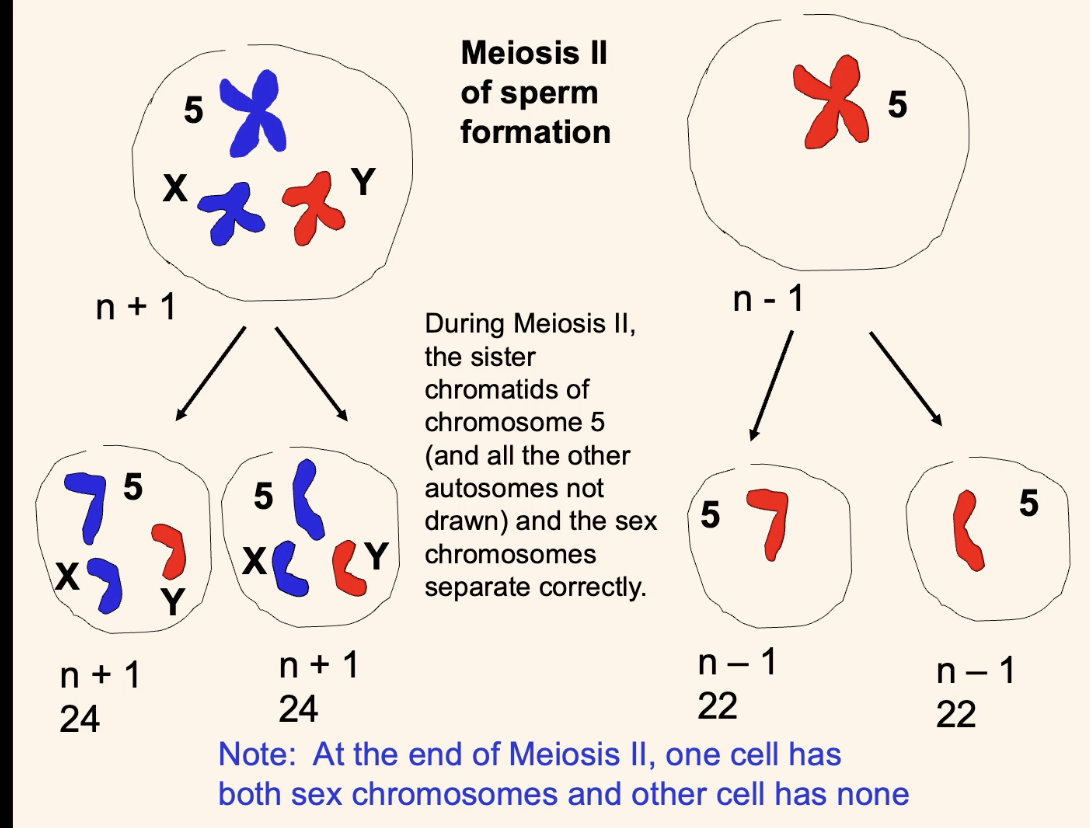
Practice EXAM question:
Turner syndrome is a chromosomal condition that affects females, leading to short statue and loss of ovarian function. Turner syndrome is caused by a non-disjunction of the X chromosome during sperm development. When a normal egg is fertilized by one of these sperm, the resulting zygote has 45 chromosomes, as it is missing an X chromosome.
a. Draw meiosis of a PGC that is going to become sperm. Make sure you draw the correct number of gamete cells and chromosomes in each step (do not draw crossovers). For simplicity, only draw chromosome #5 and the sex chromosomes. Label them to distinguish the two.
Draw a non-disjunction of meiosis I. Also draw meiosis two. Look at THIS SPECIFIC CARD. Youneed to label the X and you ened to label the Y.
Look at this. You need to tell the ploidy.
