Chapter 19 - The Transatlantic Slave Trade
 Call Kai
 Learn
 Practice Test
 Spaced Repetition
 Match
 Flashcards
 Knowt Play
1/140

Earn XP
Description and Tags
Bramble- did not send out Flashcards until Oct. 26th at 2:30... PM! Aka. Pd. 9 gets 4 whole nights to study, and I get 4 whole nights to make Flashcards. How great.
141 Terms
Rich men who owned most of the slaves and most of the land
Plantocracy
A privileged male slave whose job it was to ensure a slave gang did its work
Driver
An often difficult period of adjustment to new climates, disease environments, and work routines, such as that experienced by slaves newly arrived in the Americas.
Seasoning
Goods whose importation, distribution or possession is illegal.
contraband
Merchant ships that are accompanied by warships for protection.
convoy
A rapid increase of rise, especially in the seriousness of something or a situation.
escalation
Carefully designed or planned to serve a particular purpose or advantage.
strategic
To bind someone to labor or service by contract or agreement
indenture
Showing or having an insensitive and cruel disregard for others.
callous
Any person or other entity (mutual fund) who commits capital with an expectation of receiving a financial return.
investor
A written grant by a country, by which a trade company or settlement is founded in which rights and privileges are outlined or defined.
charter
To refuse to obey the orders of people in authority; an open rebellion against authority.
mutiny
a person who has been forced to leave their homeland or country in order to escape war, persecution, or natural disaster.
refugee
Englissh Ship which arrived in 1694 at the West African port of Whydah
Hannibal
Port at which the Hannibal arrived
Whydah
The Hannibal purchased 692 slaves, of whomn about a third were ___
women
The Hannibal traveled to ___
Barbados
The African slave trade was a sure-fire money maker for Europeans. True or False
False.
Initial crop farmed by the Spanish in the West Indies shortly after 1500
Sugarcane
Crop which the Engblish hoped to farm in the West Indies
Tobacco
English King opposed to Tobacco
James I
By the 1630s and 1640s, the West Indies colonies of England/France faced stiff competition from ___ tobacco (which also used indetured servitude), causing them to switch to farming ___ and using ___ for labor.
Virginia, sugarcane, African Slaves
Portuguese sugar plantations were intially ___ along the West ___ coast.
islands, African
By 1600, ___ was the Atlantic world’s greatest sugar producer.
Brazil
The ___ participated in the Brazilian sugar business in an important manner as investors, merchants, and processors.
Dutch
In 1624, the Dutch attacked the port of ___ in Brazil (numerous historical reasons for this, mostly bc. Philip II got the Portuguese throne and didnt like the dutch because dutch war of independence / 80 years war so yk)
Salvador
Trading company chartered by the Dutch government to conduct its merchants trade in the Americas and Africa
Dutch West India Company
Portuguese ports in Africa taken by the Dutch
Elmina, Luanda
French colonies in the Caribbean
Guadeloupe, Martinique
By 1700, ____, the best example of the impact of sugarcane in the Carribbean, and other West Indian colonies had collectively surpassed Brazil as the world’s princiapl source of sugar.
Barbados
There was no environmental cost to sugarcane farming. True or False
False
North America imported ten times more slaves than the Caribbean region between 1640 and 1807. Change the bolded/underlined word to make this statement true.
less
Cash short tobbacco planters in the seventeenth century preferred:
A) Enslaved Africans to Indentured Europeans because they cost less
B) Indentured Europeans to slaves because they cost more
C) Enslaved Native Americans to indetured Europeans or Enslaved Africans because they were already there and cost less
D) Indentured Europeans to African slaves because they cost half as much
D
Why did Indentured Europeans come to prefer the North American colonies to West Indies colonies for indetured servitude?
Rising Land Prices
In 1655, the English seized ___ from the Spanish
Jamaica
The French seized the western half of ____ in the 1670s.
Hispaniola
Two most important English sugar colonies
Jamaica and Barbados
Places were sugarcane was crushed and juice was extracted.
Mills
After mills, cane juice wwas put in large copper ___ where excess water was boiled off, leaving thick ___.
kettles, syrup
As syrup dried in conical clay molds, it turned to ___ sugar.
crystallized
Term describing the economics of the sugar mills, describing those were the more efficient, large scale producers had lower costs and greater profits allowing them to drive many small scale farmers out of business.
economies of scale
The Spanish brought no new animals to the west indies and these new animals did not multiply rapidly. True or False.
False
On most (West Indies) islands, ___ percent or more of the inhabitants were slaves.
90
On a typical Jamaican plantation about 80 percent of the slaves were actively engaged in productive tasks; the only exceptions were ___, the seriously ___, and the very ___.
infants, ill, old
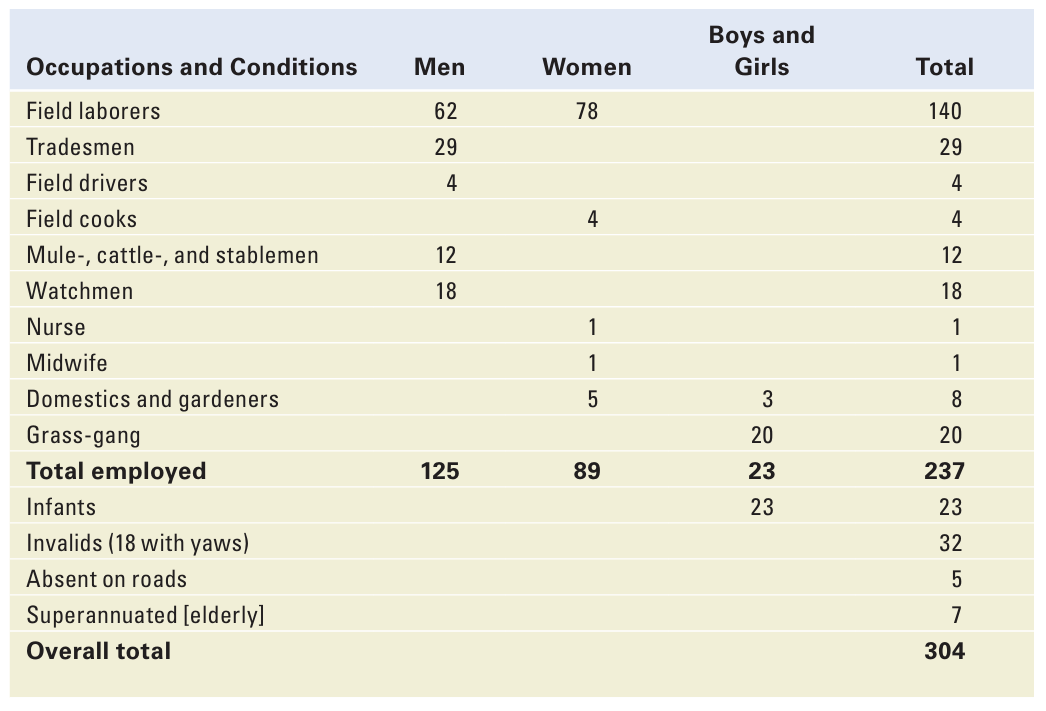
You should study this table! I had no idea how to make flashcards on this that were not incredibly annoying, but there may be some question about division of labor or what gender a certain worker would likely be. Yes, or no?
Yes
Group composed of children under the supervision of an eldery slave that weeded and did other simple work.
Grass Gang
Group made up of the strongest slave in their prime of life, who did the heaviest work.
Great gang
The slave trade imported ___ as many males as females
twice
There was a high rate of natural population increase among slaves. True or False
False
Pregnant slaves were exempt from labor. True or False
False
In Jamaica in 1760, for example, a slave named ____, who had been a chief on the Gold Coast of Africa, led a large rebellion
Tacky
European planters believed that the more recent arrivals from Africa with more African culture were more likely to rebel. True or False
True
Modern African-derived religion in Brazil which syncretizes Christianity and African traditions.
candomble
African derived religion founded in Haiti
Vodou
In the British West Indies, only ____ enforced Chrstianity among their slaves before 1800.
Quakers
Jamaican African Religious practice
Obeah
Highest class in the society of Saint Domingue
grands blancs
Second highest class in Saint Domingue
petits blancs
Were the plantocracy more powerful in British or French colonies? (Answer with either British or French)
British
The largest expense for running a plantation in Jamaica was the purchase of ____
slaves
Manumission was more common in the ___ than in North American colonies like South Carolina.
Caribbean
English planters were able to gain political power and even secure election to the British Parliament. True or False
True
Jamaican maroons led by Captain _____, after withstanding several attacks by the colony’s militia, signed a treaty in 1738 that recognized their independence and freedom in return for their cooperation in stopping new runaways and suppressing slave revolts.
Cudjoe
The growth of the Atlantic economy played an important role in the development of modern ____.
capitalism
Monopoly control proved both ___ and ____.
expensive, inefficient
The economic system of large financial institutions—banks, stock exchanges, investment companies—that first devel oped in early modern Europe. Commercial capitalism, the trading system of the early modern economy, is often distinguished from industrial capitalism, the system based on machine production.
Capitalism
Chief among the institutional innovations of Capitalism were private banks, joint-stock companies, speculative markets in commodities and shares, and commercial insurance. True or False
True
In 1602 the Netherlands gave the Dutch East India Company a monopoly over trade in the ____Ocean.
Indian
A trading company chartered by the English government in 1672 to conduct its merchants’ trade on the Atlantic coast of Africa
Royal African Company
Louis XIV’s finance minister who charatered the French East India company and French West India Company to expel Dutch and English traders from French colonies.
Jean Baptiste Colbert
Headquarters of the RAC, just east of Elmina
Cape Coast Castle
French mercantalist legislation
Exclusif
The network of trade routes connecting Europe, Africa, and the Americas that underlay the Atlantic system.
Atlantic Circuit
The Dutch differed from the French, English, Portuguese, and Spanish because they relied upon ____ trade rather than the ___ circuit
Asian, Atlantic
On the first leg, from Europe to Africa, traders carried European manufactured goods like metals, hardware, and ___, as well as ___ textiles.
guns, cotton
On the second leg, from Africa to the Americas, the major good carried was ____.
slaves
On their third leg, ____ goods returned to europe.
plantation
The North American trade where New England sent rum to west africa (And sometimes Europe), slaves to the west indies, and molasses and rum back to New England
Triangular Trade
Europeans of modest means spooned ____ into popular new beverages imported from overseas—tea, coffee, and chocolate—to overcome the beverages’ natural bitterness
sugar
English cities which slave traders operated out of
Liverpool and Bristol
French cities which slave traders operated out of
Nantes and Bordeaux
Which region imported the most slaves?
A) Brazil
B) East Asia
C) India
D) North America
A
West African country + the region where many slaves came to Brazil from
Angola, Gold Coast
Term for the journey from Africa to the Americas endured by slaves
Middle Passage
On slave ships, ____ spread by contaminated food and water caused many deaths. Other slaves died of contagious diseases such as ___ carried on board by infected slaves or by crew members.
Dysentry, smallpox
European sailers and seamen were very nice to slaves on the slave ships. No force feeding or other travesties occurred and the slaves had ample room, meaning many normal seamen were willing to do it and cruel officers were few and far between. True or False
False
As the African slave trade mushroomed after 1650…
A) African kings and merchants sold slaves at many coastal sites, but African states maintained their independence
B) African kings and merchants sold slaves at many coastal sites but were unable to maintain their independence
C) African kings and merchants did not sell slaves at many coastal sites and were unable to maintain their independence
D) African kings and merchants did not sell slaves at many coastal sites and maintained their independence
A
Import trade goods from Africa (one of these is problematic to call a good…)
slaves, ivory, gold, lumber
African merchants were very discriminating about merchandise they took in exchange for slaves or other goods. True or False
True
Goods in high demand / welcome in Africa (sold by European merchants → Africans)
Textiles, hardware, guns, rum, tobacco
The European nations worked together so that Africans had less bargaining power and could not shop for deals among different nations. True or False
False
In 1700 the head of the Dutch East India Company in West Africa, ___, bemoaned the fact that, to stay competitive against other European traders, his company had to include large quantities of muskets and gunpowder in the goods it exchanged, thereby adding to Africans’ military power.
Willem Bosman
In 1727, ____, strengthened militarily by firearms acquired in the slave trade, annexed Whydah.
Dahomey
Two other regional powers, the kingdoms of ____ and ____, also participated in the Atlantic trade, but neither kingdom was as dependent on it as Dahomey
Oyo, Asante
Oyo and Asante were/were not wholly dependent on trade and were weakened/strengthened by it.
were not, strengthened
_____ were the most common source of slaves sold to Europeans by Africans
Prisoners of war
a bend in a coast forming an open bay
bight
In the eighteenth century the slave trade expanded eastword to the ____
Bight of Biafra
The Bight of Biafra contained no regionally dominant ____, unlike the Gold and Slave Coasts where htey were strong ___.
polities, kingdoms
The greatest source of slaves for the Atlantic trade was the Congo estuary at ____
Angola