Ch. 34: Assessment and Management of Patients with Allergic Disorders
 Call Kai
 Learn
 Practice Test
 Spaced Repetition
 Match
 Flashcards
 Knowt Play
1/105

There's no tags or description
Looks like no tags are added yet.
106 Terms
what is an allergic reaction
An allergic reaction is a manifestation of tissue injury resulting from the interaction between an antigen and an antibody (a protein substance developed by B cells in response to and interacting with a specific antigen)
what is an allergy
•inappropriate response of the immune system
what is an allergen
•substances that cause an allergic response
what is an antigen
•a foreign protein recognized as an invader by B-lymphocyte cells
what is an antibody
•: a protein made by B-cell (Plasma cell) after interacting with a specific antigen (Humoral Immunity
•Antibodies aka serum protein Immunoglobulins
what is specificity
• the antibodies have a memory and interact in future exposures to the antigen
How does the body respond when an allergen enters? A:
General white blood cell response occurs
B lymphocytes are activated by the antigen
B cells differentiate into plasma cells
Plasma cells produce specific antibodies (immunoglobulins) against the antigen
What is humoral (antibody-mediated) immunity?
B lymphocytes become plasma cells and produce antibodies
Antibodies target specific antigens
This antibody production and action is called humoral immunity or antibody-mediated immunity
What does antibody specificity mean?
Antibodies are specific to particular antigens
The relationship is often described as a lock-and-key mechanism
Antibodies have memory and respond more quickly during future exposures to the same antigen
What happens during first and subsequent exposures to an antigen?
First exposure: Triggers an inflammatory or allergic response and antibody production
Subsequent exposures: Existing antibodies recognize and bind the antigen, helping neutralize it more rapidly
How do antibodies help eliminate antigens?
Coat the antigen's surface
Neutralize toxins
Precipitate dissolved antigens out of solution
May react with similar antigens (e.g., cowpox antibodies helping protect against smallpox)
Complete protein antigens
◦Animal dander, pollen, horse serum
◦humoral response
Haptens (incomplete antigens)
◦Low molecular-weight substances such as medications
◦Bind to tissue or serum proteins to produce a carrier complex that elicits an antibody response
what is the function of antigens
1.Allergen enters the body
2.Allergen sensitization occurs (development of IgE antibodies)
3.Macrophages respond, process the antigen, and present it to the B-cells
4.B-cells mature into allergen-specific secreting Plasma cells that secrete antigen-specific antibodies.
What is the role of IgE in allergic reactions?
Immunoglobulin E (IgE) is the antibody produced during an allergic response
IgE-producing B cells are found in the respiratory and intestinal mucosa
IgE binds to allergens and triggers allergic reactions
What is the role of B cells in humoral immunity?
B-cell activation causes differentiation into plasma cells
Plasma cells secrete antibodies
Specific antigen = specific antibody
Each B lymphocyte produces one specific antibody
What is the role of T cells in cell-mediated immunity?
Macrophages present antigens to T cells
T cells directly attack antigens and target cells
T cells stimulate macrophages
T cells assist B cells by directing cellular activities
Where are immunoglobulins found, and what happens when IgE binds an allergen?
Immunoglobulins are serum proteins found in the lymph nodes, tonsils, appendix, and GI tract
Peyer patches are lymphoid follicles in the submucosa of the distal small intestine
When IgE binds an antigen, it triggers mast cells to release chemical mediators
What is the role of mast cells in allergic reactions?
When two or more IgE antibodies bind to an allergen, mast cells (and basophils) are activated
They release chemical mediators including:
Histamine
Serotonin
Kinins
These mediators produce allergic responses such as:
Allergic skin reactions
Asthma
Hay fever (allergic rhinitis)
Where are immunoglobulins found, and what is the role of IgE?
Immunoglobulins are found in the lymph nodes, tonsils, and GI tract
IgE is involved in allergic disorders and some parasitic infections
Where are IgE-producing cells located?
Located in the respiratory mucosa
Located in the intestinal mucosa
Produce IgE antibodies involved in allergic responses
What happens when IgE binds to an allergen?
Two or more IgE molecules bind to an allergen
Activates mast cells and basophils
Triggers the release of chemical mediators
What chemical mediators are released by mast cells, and what do they cause?
Mediators released:
Histamine
Serotonin
Kinins
Slow-reacting substances of anaphylaxis
Neutrophil factor
Cause:
Allergic skin reactions
Asthma
Hay fever
What are primary mediators in allergic reactions?
Primary mediators are preformed and stored in mast cells and basophils
Released immediately after allergen exposure
Include:
Histamine
Eosinophil Chemotactic Factor of Anaphylaxis (ECF-A)
Platelet-Activating Factor (PAF)
Prostaglandins
What are the effects of histamine?
Peaks 5-10 minutes after antigen exposure
Causes:
Erythema (redness)
Wheals (localized edema)
Pruritus (itching)
Wheezing and bronchospasm
Increased gastric/mucosal secretions → diarrhea
Acts through:
H1 receptors (bronchioles and blood vessels)
H2 receptors (gastric parietal cells)
Treatment:
H1 blocker: Diphenhydramine (Benadryl)
H2 antagonist: Cimetidine/Pepcid
What are the functions of ECF-A and Platelet-Activating Factor (PAF)?
ECF-A: Attracts eosinophils to the allergen site
PAF:
Initiates platelet aggregation
Promotes leukocyte infiltration
Causes vasodilation
Causes bronchoconstriction
Increases vascular permeability
What are the effects of prostaglandins?
Cause:
Smooth muscle contraction
Vasodilation
Increased capillary permeability
Enhance the actions of other inflammatory mediators
Sensitize pain receptors
Manifestations:
Erythema
Heat
Edema
Pain
What are secondary mediators in allergic reactions?
Secondary mediators are inactive precursors formed or released in response to primary mediators
Include:
Leukotrienes
Bradykinin
Serotonin
What are the effects of leukotrienes?
Initiate inflammation
Cause smooth muscle contraction
Cause bronchial constriction/bronchospasm
Increase mucus secretion in airways
Produce the wheal-and-flare skin response
100-1000 times more potent than histamine in causing bronchospasm
Montelukast (Singulair) blocks leukotriene effects in asthma
What are the effects of bradykinin and serotonin?
Bradykinin
Increases vascular permeability → edema
Causes vasodilation → hypotension
Causes bronchospasm
Produces pain by stimulating nerve fibers
Serotonin
Potent vasoconstrictor
Causes bronchial smooth muscle contraction (bronchospasm)
what is Hypersensitivity
is an excessive or aberrant (deviant) immune response that can cause tissue injury and disease.
It usually does not occur with the first exposure to an allergen, the reaction follows a re-exposure after sensitization (buildup of antibodies)
Types I, II, and III are immediate reactions as they occur within 24 hours of exposure to the antigen or allergen.
These are primarily mediated IgE, IgM, and IgG antibodies.
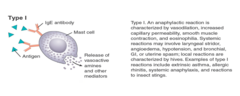
What is Type I (anaphylactic) hypersensitivity?
Type I hypersensitivity (anaphylaxis) is a severe, immediate allergic reaction
Begins within minutes of exposure to an antigen
Can be localized or systemic
Symptoms are caused primarily by the release of chemical mediators from mast cells and basophils
Why is anaphylaxis life-threatening?
Can cause:
Laryngeal edema/angioedema → airway obstruction
Laryngeal stridor
Bronchospasm
Hypotension
Cardiovascular collapse
Requires immediate treatment because airway and circulation can rapidly fail
What body systems are affected by the primary chemical mediators in Type I hypersensitivity?
Skin: edema, wheals, itching
Lungs: wheezing, bronchospasm, airway edema
GI tract: cramping, diarrhea
Primary mediators are responsible for most of the immediate symptoms of Type I hypersensitivity
What can happen if chemical mediators continue to be released during a Type I hypersensitivity reaction?
A delayed reaction may occur
Symptoms can persist for up to 24 hours
Continued mediator release prolongs inflammation and allergic manifestations
What conditions are examples of Type I hypersensitivity reactions?
Anaphylaxis
Asthma
Allergic rhinitis (hay fever)
Reactions to insect stings
What is Type II (cytotoxic) hypersensitivity?
Also called cytotoxic hypersensitivity
Occurs when antibodies are directed against antigens on the body's own cells or tissue basement membranes
The immune system mistakes normal body components as foreign ("mistaken identity")
Can lead to cell lysis (cell destruction) and tissue damage

How does Type II hypersensitivity cause damage?
Antibodies bind to antigens on cells or tissues
The immune system then attacks those cells
Results in:
Cell destruction (lysis)
Inflammation
Tissue damage
The body's own cells become unintended targets
What is an example of a Type II hypersensitivity transfusion reaction?
Occurs when incompatible blood is transfused
Example:
A person with Type B blood receives Type A blood
The recipient's anti-A antibodies attack the donor red blood cells
Results in hemolysis (destruction of RBCs)
What disorders are associated with Type II (cytotoxic) hypersensitivity?
Myasthenia gravis
Pernicious anemia
Hemolytic disease of the newborn
Transfusion reactions
Thrombocytopenia
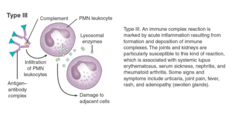
What is Type III (immune complex) hypersensitivity?
Also called immune complex hypersensitivity
Occurs when antigens bind to antibodies, forming insoluble immune complexes
These complexes are too large to be removed by phagocytes
The complexes become deposited in tissues and blood vessel walls, triggering inflammation
How does Type III hypersensitivity cause tissue damage?
Antigen-antibody complexes form in the circulation
Immune complexes deposit in tissues or vascular endothelium
Deposited complexes trigger inflammatory reactions
Inflammation can occur at multiple sites throughout the body, causing tissue damage
How does rheumatoid arthritis relate to Type III hypersensitivity?
An unknown antigen triggers antibody formation
Antigen-antibody complexes form
Immune complexes deposit in the joints
The resulting inflammation contributes to rheumatoid arthritis
What autoimmune disorders are associated with Type III hypersensitivity?
Many autoimmune disorders are Type III hypersensitivity reactions
In systemic lupus erythematosus (SLE):
Autoantibodies are produced
Immune complexes form
Complexes deposit in the:
Lungs
Skin
Kidneys
Inflammation and tissue damage result
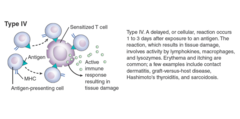
What is Type IV (delayed) hypersensitivity?
Also called delayed hypersensitivity
A T-cell mediated immune reaction
Occurs 24-48 hours after antigen exposure (may take up to 1-3 days)
Unlike Types I-III, it is primarily mediated by sensitized T lymphocytes, not antibodies
What are the manifestations of Type IV hypersensitivity?
Erythema (redness)
Itching (pruritus)
Induration (firm swelling)
Contact dermatitis
Can occur days after exposure to the antigen
What is the classic example of a Type IV hypersensitivity reaction?
The PPD (tuberculin skin) test
Uses purified protein derivative from Mycobacterium tuberculosis
Patients previously exposed to TB develop:
Erythema
Induration
Reaction occurs because of sensitized T cells
What conditions are associated with Type IV hypersensitivity?
Contact dermatitis (e.g., poison ivy)
Graft-versus-host disease
Sarcoidosis
Positive PPD/TB skin test
What assessments and diagnostic tests are used to evaluate allergic disorders?
Comprehensive history and physical examination
CBC with differential
Eosinophil count
Total serum IgE level
Skin testing
Provocative testing
Serum-specific IgE testing
What CBC findings are commonly seen in patients with allergic disorders?
WBC count is usually normal unless infection or inflammation is present
Eosinophil count is increased in many patients with allergic disorders
Total serum IgE levels are elevated in allergic disorders
How are skin tests used to diagnose allergies?
Small amounts of allergen are injected or applied at several sites
A wheal-and-flare reaction indicates a positive response
Helps identify specific allergens causing symptoms
What is provocative testing?
Direct administration of the suspected allergen to sensitive tissues:
Conjunctiva
Nasal mucosa
Bronchial mucosa
GI tract (by ingestion)
Response of the target organ is observed
Disadvantage: May trigger an allergic reaction
When are provocative testing and serum-specific IgE testing used?
Used when routine allergy test results are inconclusive
Provocative testing: Uses a more concentrated allergen exposure
Serum-specific IgE testing: More specific blood testing for allergen identification
What medication precautions should be taken before allergy testing?
Corticosteroids and antihistamines should be stopped 48-96 hours before testing
Prevents interference with allergy test results and improves accuracy
Allergic disorders: atopic
genetic component:
-Asthma
-Allergic Rhinitis
-Hereditary Angioedema
-Urticaria and Angioneurotic Edema
Allergic disorders: Nonatopic
(no known genetic component)
-Anaphylaxis
-Contact Dermatitis
-Dermatitis Medicamentosa (Drug Allergy)
-Food Allergy
-Latex Allergy
What is anaphylaxis?
A sudden-onset, potentially life-threatening allergic reaction
Can range from mild to severe
Caused by release of:
Histamine
Prostaglandins
Inflammatory leukotrienes
These mediators are released from mast cells and basophils
What happens during an anaphylactic reaction?
Histamine, prostaglandins, and leukotrienes are released
Platelets, eosinophils, and neutrophils are activated
Results in reactions involving multiple body systems
At least two body systems are involved in anaphylaxis
When does anaphylaxis occur after allergen exposure?
Usually occurs after the SECOND exposure to an allergen
The first exposure is called sensitization
During sensitization, IgE antibodies are produced
On re-exposure, the allergen binds IgE and triggers mast cell degranulation
What substances commonly cause severe anaphylactic reactions?
Antibiotics
Radiocontrast agents
These are among the most severe causes of anaphylaxis
What is an anaphylactoid reaction (nonallergic anaphylaxis)?
A reaction that resembles anaphylaxis but is not IgE-mediated
May be local or systemic
Can be triggered by:
Food
Medications
Exercise
Cytotoxic antibody transfusions
What are the manifestations of an anaphylactoid reaction?
Urticaria (hives)
Angioedema
Occurs at the site of antigen exposure
Symptoms are similar to anaphylaxis but occur through non-IgE-mediated mechanisms
What causes anaphylaxis?
An allergen is recognized as a foreign antigen
IgE antibodies from prior sensitization are attached to mast cells and basophils
When the allergen binds IgE, mast cells and basophils release chemical mediators such as histamine
Results in a massive, multisystem allergic response
Why is anaphylaxis considered a multisystem reaction?
Unlike typical allergic reactions, two or more body systems are involved
Histamine and other mediators cause widespread inflammation
Multiple organs and tissues react simultaneously
How does anaphylaxis affect the respiratory system?
Airways constrict
Bronchial tissues swell
Breathing becomes difficult
Severe reactions may cause airway obstruction and respiratory distress
How does anaphylaxis affect the cardiovascular system?
Blood vessels dilate (vasodilation)
Blood pressure drops severely (hypotension)
Fluid leaks into tissues, reducing circulating blood volume
May progress to anaphylactic shock and cardiovascular collapse
What complications can occur during anaphylactic shock?
Cardiovascular collapse
Inadequate oxygen and fluid delivery to tissues
Organ dysfunction or failure
Pulmonary edema from fluid leaking into the lung alveoli
Can be fatal if not treated immediately
What is the priority treatment for anaphylaxis?
Immediate epinephrine injection
Reverses airway constriction, hypotension, and other life-threatening symptoms
After epinephrine, seek emergency medical care immediately (call EMS/911)
What are the mild manifestations of anaphylaxis?
Peripheral tingling
Fullness in the mouth and throat
Nasal congestion
Periorbital swelling
Pruritus (itching)
Sneezing
Tearing
What are the moderate manifestations of anaphylaxis?
Flushing
Warmth
Anxiety
Itching
Bronchospasm
Airway edema
Dyspnea
Cough
Wheezing
What respiratory symptoms may occur as anaphylaxis progresses?
Bronchospasm
Airway edema
Dyspnea
Wheezing
Cough
Laryngeal edema (severe stage)
Cyanosis (severe stage)
What are the severe manifestations of anaphylaxis?
Bronchospasm
Laryngeal edema
Cyanosis
Hypotension
Dysphagia
Abdominal cramping
Nausea, vomiting, diarrhea (N/V/D)
Seizures
Cardiac arrest
Coma
Anaphylaxis Precautions
•Strict avoidance of potential allergens
•Epi-Pen autoinjector at all times for those:
•Sensitive to insect bites and stings
•Have had food or medication reactions
•Have had idiopathic or exercise-induced reactions
•Wear a medical alert bracelet or lanyard.
Describe how to use eip-pen
Every epi-pen comes with an epi-pen trainer.
There are other brands of autoinjectors that do not function like the Epi-Pen! Read instructions.

Nursing management for anaphylaxis
-Assess airway, breathing patterns and vital signs.
-Observe for signs of increasing edema and respiratory distress.
-Call rapid response or CODE BLUE. Have someone notify provider.
-Have emergency medications (epinephrine) and intubation equipment at hand (crash cart).
-Start IV and administer fluids and oxygen therapy if needed.
-Document interventions and patient's response to treatment.
-Monitor patient for signs/symptoms of recurrent anaphylaxis.
-Ensure unit leadership is aware of event, patient's status, and any need for transfer to another level of care.
-Notify family of event if not at bedside.
Allergic Rhinitis
Immediate Type I hypersensitivity reaction
(IgE- Mediated response)
Hay fever and seasonal allergic rhinitis incidence increases with age
Signs/symptoms akin to viral rhinitis, but more persistent due to seasonal variation of airborne pollens (molds):
Spring- tree pollen
Summer- grass pollen
Fall- weed pollen (ragweed)
What are the common symptoms of allergic rhinitis?
•Nasal discharge, nasal congestion, sneezing, nose and throat itching
•Post-nasal drip, itchy watery eyes, headache, hyposomnia
What environmental triggers worsen allergic rhinitis?
Dust, pets, smoke, carpets, linens, pillows, and humidity.
What are the main medications used for allergic rhinitis?
Antihistamines
Adrenergic agents (decongestants)
Mast cell stabilizers
Corticosteroid nasal sprays
Leukotriene modifiers
First-generation vs. second-generation antihistamines?
First-gen: Cross BBB → sedation + anticholinergic effects (dry mouth, blurry vision, urinary retention, confusion). (Diphenhydramine, Hydroxyzine, Chlorpheniramine)
Second-gen: Less sedation; preferred (loratadine, cetirizine, fexofenadine).
What do adrenergic agents do?
Vasoconstrict nasal blood vessels → decrease congestion.
Examples: Pseudoephedrine, oxymetazoline (Afrin).
Chronic nasal spray use → rebound congestion.
What do mast cell stabilizers do?
Prevent mast cells from releasing inflammatory mediators.
Example: NasalCrom; takes about a week to work.
What do corticosteroid nasal sprays do?
Reduce nasal inflammation; used for persistent symptoms.
Examples: Rhinocort, Nasacort.
What does montelukast (Singulair) do?
- Blocks leukotrienes → decreases allergic inflammation and asthma symptoms.
•Immunotherapy (allergen desensitization)
•Increasing injected doses of antigen until effective dose reduces severity from natural exposure
•80 to 90% effective for allergens such as grass and pollen, other allergens that cannot be avoided
•As an adjunct to pharmacological therapy
•Subcutaneous immunotherapy
•Sublingual immunotherapy
•Epicutaneous immunotherapy
•Subcutaneous immunotherapy
•injections begin very small and increase each week
- patient must remain at the office for at least 30 minutes to monitor for systemic reaction; emergency equipment, trained personnel, and EPINEPHERINE must be available.
•Sublingual immunotherapy
•three times per week with a rapidly dissolving tablet or liquid under the tongue
- efficacy close to SCIT.
Epicutaneous Immunotherapy
•delivery of allergen to the skin with increasing doses each time
Less vascular. Less risk of systemic side effects. Long-term studies in progress for peanut allergies.
Nursing Care for allergies
•Improving breathing pattern
•Promoting understanding of allergy and allergy control
•Coping with a chronic disorder
•Monitoring and managing potential complications
•Promoting home, community-based, and transitional care
Dermatitis Medicamentosa (Drug Allergy)
•45% of deaths from anaphylaxis are related to medication reactions
•Parenteral administration of drugs is greatest risk
•Rash is the most common reaction and occur in 2-3% of hospitalized patients
•Stop medication immediately if reaction noted and symptoms should subside
•Patients should be taught to list allergies accurately, carry drug allergy information with them, and to call provider if they are starting a new medication at home and experience symptoms
what are most common drugs associated with dermatitis medicamentosa
•Penicillin, sulfa drugs and cephalosporin are the most common offenders
•Urticaria
•Multiple wheals with itching (hives)
•May involve any part of the body, but especially the mouth, larynx, and GI tract
•Causes: infection, allergic reaction to food, insect stings, medications
•Avoid the use of NSAIDS, treat with corticosteroids, antihistamines, eliminate triggers
•Angioneurotic edema (angioedema)
•Diffuse swelling in deeper layers of the skin
•Nonpitting edema, non-pruritic
•Most common in facial areas, hands, feet, genitalia, tongue
•Most common offenders are PCN and ACE inhibitors such as captopril
Hereditary Angioedema
•Rare, life-threatening, autosomal dominant disorder
•Same s/s of angioedema, may include GI edema
•May be caused by trauma but can appear spontaneously
•Observe carefully for signs of laryngeal obstruction and asphyxiation
•Epinephrine, antihistamines, and corticosteroids
The reaction should resolve by itself within 2-4 days
What foods commonly cause severe allergic reactions?
Peanuts, tree nuts, and seafood/shellfish.
Any food can cause an allergy.
What are signs/symptoms of food allergies?
Urticaria, dermatitis, itching
Wheezing, cough, laryngeal edema, angioedema
GI symptoms
Can cause anaphylaxis.
How do patients prevent/manage food allergies?
Avoid trigger foods and hidden ingredients (ex: peanut oil).
Carry an EpiPen.
Wear/list medical allergy identification.
Teach family to recognize anaphylaxis and use EpiPen.
What medications may help manage food allergies?
H1 antihistamines (cetirizine, loratadine)
Corticosteroids
Cromolyn sodium (GI symptoms)
Epinephrine for anaphylaxis.
Do food allergies ever disappear?
Yes, some childhood food allergies resolve with age.
Is shellfish allergy caused by iodine?
No. Shellfish allergy is NOT caused by iodine.