Fluvial Processes
0.0(0)
Studied by 0 people Call Kai
 Learn
Learn Practice Test
 Spaced Repetition
 Match
Match Flashcards
 Knowt Play
Card Sorting
1/15

There's no tags or description
Looks like no tags are added yet.
Last updated 5:55 PM on 8/5/26
Name | Mastery | Learn | Test | Matching | Spaced | Call with Kai | Chat |
|---|
No analytics yet
Send a link to your students to track their progress
16 Terms
1
New cards
Fluvial Processes
The processes that operate in rivers: EROSION (wearing away the land), TRANSPORTATION (carrying eroded material), and DEPOSITION (dropping eroded material). From source to mouth.
2
New cards
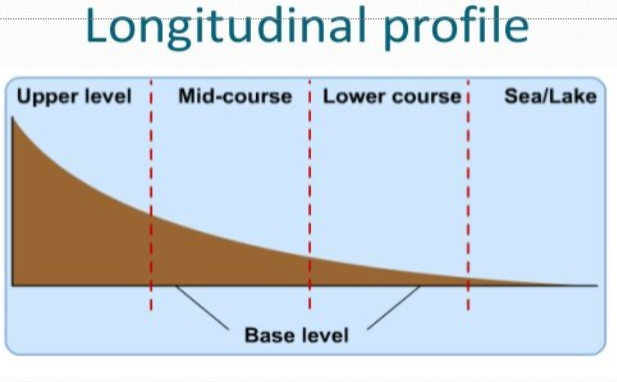
Longitudinal Profile of a River
A visual representation (side view graph) of the gradient of a river from its source to its mouth. In theory, the shape is CONCAVE.
3
New cards
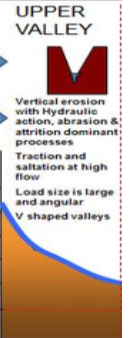
Upper Course
The steep upstream section near the SOURCE of the river. Steep gradient, fast flow, vertical erosion, V-shaped valleys.
4
New cards
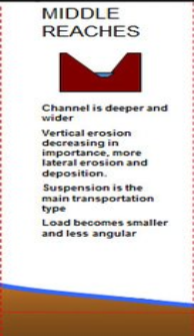
Middle Course
Downstream of the upper course. The river leaves the mountains. Gradient is more gentle. Lateral erosion becomes dominant.
5
New cards
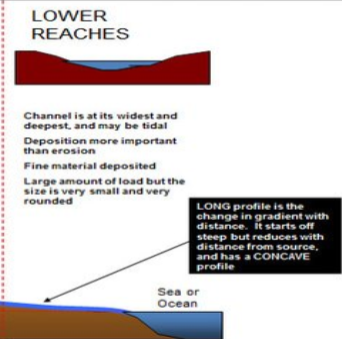
Lower Course
The flat, final stage of the river as it approaches sea level. Deposition is the main process. Wide, flat valley.
6
New cards
Base Level
The LOWEST level to which a river can erode. The SEA forms the permanent base level.

7
New cards
Temporary Base Level
A feature that temporarily acts as a base level and prevents a river from eroding below it. Examples: a waterfall, a dam, a lake, rapids.
8
New cards
Permanent Base Level
The sea / sea level — the absolute lowest level to which a river can erode.
9
New cards
Hydraulic Action
Erosion process: the FORCE of flowing water loosens and removes pebbles, stones, sand and silt from the sides and bed of the channel (no tools needed — just the force of water).
10
New cards
Abrasion (Corrasion)
Erosion process: sand and silt particles CARRIED by the river SCRATCH and WEAR AWAY the bed and sides of the channel (like sandpaper).
11
New cards
Attrition
Erosion process: particles SCRATCH AGAINST EACH OTHER as they are transported, becoming SMALLER and ROUNDER (e.g. boulders → pebbles → sand).
12
New cards
Solution (Corrosion)
Erosion process: soluble minerals in rocks are dissolved by the river water (chemical process).
13
New cards
Traction
Transportation: BOULDERS and large rocks are PUSHED and ROLLED along the riverbed.
14
New cards
Saltation
Transportation: smaller rocks and stones BOUNCE along the riverbed.
15
New cards
Suspension
Transportation: SILT and very small particles are CARRIED within the flow of the water (float in the water).
16
New cards
Solution (Transportation)
Transportation: load is DISSOLVED in the water (chemical change — invisible).