Chapter 5 slides: Insourcing and Outsourcing
 Call Kai
 Learn
 Practice Test
 Spaced Repetition
 Match
 Flashcards
 Knowt Play
1/24

There's no tags or description
Looks like no tags are added yet.
25 Terms
Vertical Integration
Performing upstream or downstream activities within the firm
Benefits of vetical integration
Fewer disruptions, more control, higher margins.
Cons of vertical integration
Less specialization, flexibility, capacity bottlenecks, lower competetive pressure on internal stages.
Insourcing
Bringing an activity back inside the organization after external purchase. A sourcing and capability building decision
Difficulties of insourcing
Terminating or redesigning existing supply conracts
Building or rebuilding supply network
Developing internal design,production maangement capabilities
Outsourcing
Obtaining an activty from an external supplier
Benefits of outsourcing
Lower production cost, stronger focus on core compentencies, greater volume flexibility, less internal conflict
Downsides of outsourcing
Transaction costs, relationship management, potential loss of internal compentencies, greater risk of disruption

Categorize the four supplier types
I Profficient supplier
II Dependable supplier
III At arms-length supplier
IV Risky supplier
Subcontracting
A tiered structure where a primary contractor hires secondary contractors
When is subcontracting needed
When needs are complex
What aspects of subcontracting is harder to control
Cost, schedule, quality, conformance to specifications
Service triad
An outsorcuing model where the supplier serves the buyers customer directly
Third party logistics
A provider bundles services such as transportation, warehousing, operations support
The three ways to outsource the supply and logistics function
Procure to Pay (recurring purchase/payment activities)
Source to Contract (sourcing analysis, supplier selection, contracting)
Source to pay (Integrated S2C+P2P process)
Modern Outsourcing
Firms may outsource entire processes and customer facing activities
Agency Theory and Supplier Risk
When firms overrely on external suppliers they face performance, quality and incentive alingment risks
Common supplier risks
Inability to cope with demand flunctuation, delivery disruption, non competetive pricing, low quality gaps
Managerial responses to supplier risks
Supplier certification, development, quality management programs, target costing
Human factors of market failiure
Bounded rationality from desicon makers
Opportunism out of self interest
Atmosphere (in house vs outsourcing)
Transactional factors of market failiure
Uncertainty, limited competition, information asymmetry between parties
Effective SCM today
Close, long term relationships with one or two partners with high levels of interactive development.
Open market negation > Co-operartion > Coordination > Collaboration
price based discussion > limited supplies > information linkages > Supply chain integration

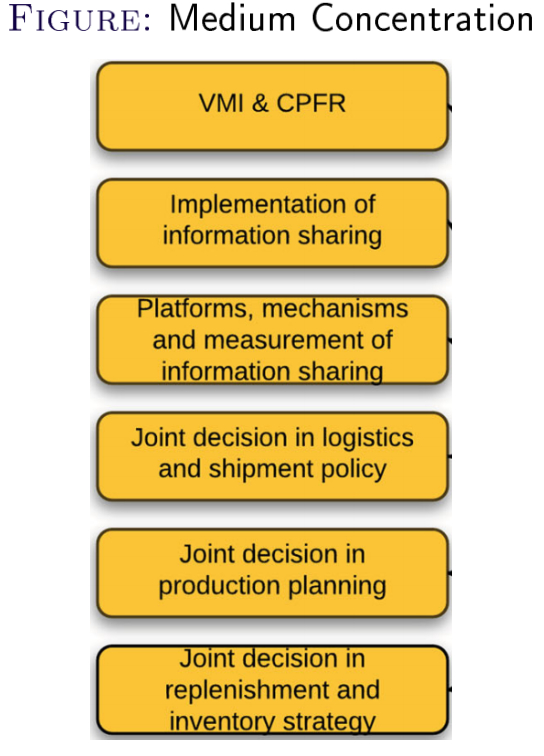
Medium concentration practices
VMI & CPFR, information sharing, joint sharing
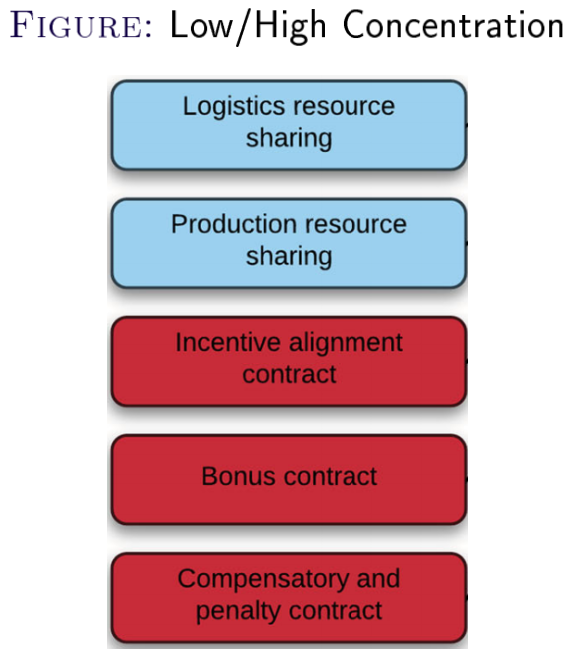
Low/High concentration practices
Logistics and production resource sharing, contracts