Articles about Social Cognition
 Call Kai
 Learn
 Practice Test
 Spaced Repetition
 Match
 Flashcards
 Knowt Play
1/6

Earn XP
Description and Tags
Adolphs, R. (2003).Cognitive Neuroscience of Human Social Behaviour.Download Cognitive Neuroscience of Human Social Behaviour. Nature Reviews Neuroscience, 4(3), 165–178. Adolphs, R. (2009). The social brain: neural basis of social knowledge + Download The social brain: neural basis of social knowledge. Annual Review of Psychology, 60, 693-716. Amodio, D. M. (2014). The neuroscience of prejudice and stereotyping + Download The neuroscience of prejudice and stereotyping. Nature Reviews Neuroscience, 15(10), 670–682.
7 Terms
Social Brain Hypothesis
In primates: size of frontal lobe correlates with size of social networks
Humans have ca 150 meaningful relationships
Correlations within e.g. amygdala
Perceiving others
Recognizing faces
The core face system
Consists of:
Occipital face area
Low-level perceptual attributes - recognizing a face as a face
Fusiform face area
Face identity, regardless of low-level features
Superior temporal sulcus
Changeable aspects of face - e.g. mimics
Interacts with:
Other brain regions forming “the extended system” - to extract meaning from faces
.

Effects of Expertise in the FFA
The FFA has been suggested to be an area for visual expertise
Comprising faces in humans, but can also extend to experize (e.g. in birds)
Meaning that activation in FFA correlates with being able to discriminate between indviduals/objects if you are “an expert” in that field

Judging others
Trustworthiness
Judgements of trustworthiness can be made extremely quickly - after 100ms
Ratings after only seeing a face for 100ms are similar to ratings when seeing the picture for a long while
.
Amygdala is involved in judgements of trustworthiness
When participants do a task unrelated to trustworthines - e.g. sorting faces into gender - bilateral amygdala is activated by less trustworthy faces (as they were later asked to divide the faces into)
Patients with amygdala damage have impaired judgements of trustworthiness
.
Can faces decide elections?
Experiment:
Not knowing the candidates, were asked to judge the candidates’ trustworthiness when seing the face for 1s
The answers correlated with/predicted the outcome of the election
.
Baby-face bias
Round, youthful, soft faces are seen as naive and innocent, and clumsy
.
Beauty-is-good stereotype
Beautiful people are seen as more intelligent, warm, trustworthy and morally good
Signals in the orbitofrontal cortex (OFC) and the insula correlates perceived goodness and attractiveness
OFC: more active when perceiving faces judged as more beautiful + more active when perceiving goodness
Insula: more active when perceiving a face as ugly + more active when perceiving badness - a sort of “stress/pain” reaction in the brain
.
PFC in evaluation - changing the schema of how you perceive a person

Orbitofrontal prefronal cortex
Predict reward and value
First impression determining what a person means for you in terms of reward
Ventromedial prefrontal cortex
Interprets nonverbal behavior and social value outcomes
Intepreting what is happening in the moment
Dorsomedial prefrontal cortex
Updates knowledge and impressions of others
Updating how you perceive the person in relation to the initial prediction - influencing how you perceive the person in future encounters
Inhibiting or enhancing activity in the vmPFC
.
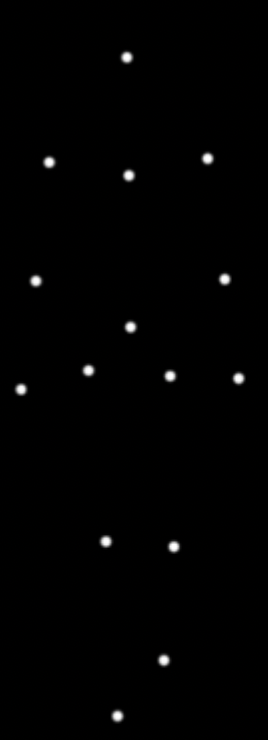
Point displays
Just by looking at a persons’ point-walkers, you can determine their emotion, gender, sexual orientation, weight and identity (for acuaintances)
Feeling & understanding others
Empathy
What it is:
An affective state, caused by sharing of the emotions or sensory states of another person - isomorphic with other’s state, but in an embodied manner
Often tested by watching others receive painful stimuli
Since pain is such a universal experience
Insula involved in empathy
Interoception - monitoring the state of the body
Used to construct how we would feel in a situation
.
Theory of Mind (ToM)
Cognitively infering the state of other’s minds
Aka - mentalizing or perspective taking
Tested in “false belief tasks”
Absent in very young children - but developed at ca 4-6 years

Neural correlates of empathy & ToM
Empathy - orange
Anterior cingulate cortex (ACC)
Anterior insula
Secondary somatosensorial cortex
ToM - green
Medial frontal cortex
Temporo-parietal junction
Superior temporal sulcus
Temporal pole

.
Mirror Neurons
Some neurons in premotor cortex responds similarly to executing and observing an action
Perception-action-coupling model
By mirroring actions, we can build up a representation of their experience, and then infer reasond and intentions behind the action
Most convincingly shown in monkeys
Reducing social complexity
Ingroups and Outgroups
Ingroups - “those like me”
Outgroups - “those unlike me”
Can be formed by any size and criterion
Minimal group paradigm:
Arbitrary group assignment in experiments

.
Effects of groups
Entativity/similarity
Outgroup perceived as more homogenous
Face memory
Worse memory for outgroup faces - e.g. other race effect
Empathy
Reduced neural reaction and less helping behavior for outgroup
Social support
More likely to allocate rewards to ingroup
Schadenfreude
Relishing on other’s misfortune
Predictions
Stereotypes and prejudice
Memory
.
Stereotypes and prejudice
Stereotypes:
Generalized characteristics ascribed to a social group
Dual-process theory of stereotypes
Stereotype activation
Thinking of traits and characteristics that are commonly associated with a particular social group
Automatic and difficult to inhibit and control
Stereotype application
Evaluations, judgements, and behaviors toward people based on the activated stereotypes
More controlled and can be inhibited
Prejudices
Negative evaluations and prejudgements of others in accordance with stereotypes
Self-regulatory processes
Despite persistence of stereotypes and prejudices in society, people frequently engage in self-regulatory processes to mitigate the effects of bias on their behavior
Examples of prejudice playing out
Misclassification of tools as gun
More often get misclassified when preceded by a black face
Bias can be implicit! - tested by IAT
Prejudice network
Affective, wuick emotional judgements
Consists of:
Amygdala, striatum and OFC
Involved in the initial emotional evaluation response
Insula
More strongly activated in response to ingroups than outgroups (empathy)
vmPFC
More engaged towards ingroup than outgroup members (mentalizing and perspective taking)

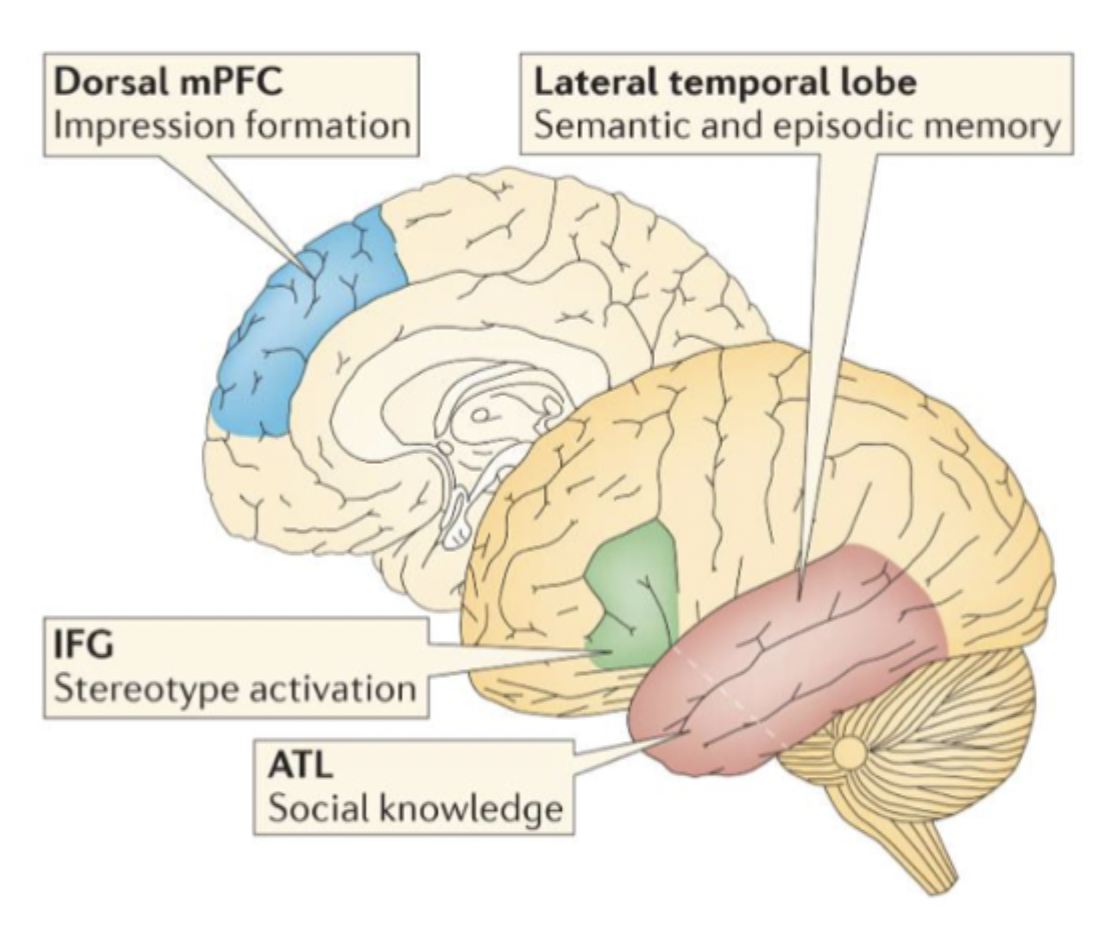
Stereotype network
More cogntive and slow - so more top-down involvement
Constists of:
Anterior Temporal Lobe (ATL), temporal poles
Representing stereotype-related knowledge
The knowledge is activated and biases first impression formation in the brain
Lateral PFC
Associated with goal representation and response inhibition - controls the application of stereotypes to behavior
Regulation network
Reasoning and rationality
Consists of:
Anterior cingulate cortex (ACC)
Involved in the detection of conflict between biased tendencies and internal goals or external cues
Medial PFC
Involved in perspective taking and mentalizing - providing further representation of interpersonal cues to guide regulatory processing
dlPFC
Selects appropriate responses and the inappropriate responses are inhibited by the dorsal inferior frontal gyrus
Stereotypes and prejudices are then not implemented in behavior


Antidotes
Focusing on other group memberships
E.g. when making university affiliation more salient than race —> mitigation of other race effect
Moral exemplar intervention
Showing people highly moral outgroup members - e.g. risking their lives to save a member of the persons watching’s ingroup - leading to long term change in perception of the outgroup
Intergroup contract & focusing on other identities

Groups in our memories
Better encoding in ingroup
Group reference effect
Material is remembered better when encoded in reference to ingroup
Ingroup > outgroup - especially for positive traits
Potentially stronger when ingroup identification is stronger

.
More additions to established memories in ingroup
Social contagion
When we discuss an event with others, we are more likely to unconsciously incorporate wrong details in the updated version of the event if they were brought forward in the discussion by ingroup rather than outgroup members
- meaning that we trust ingroup members more
Memory conformity
Same effect in a more forensic literature - conforming to the ingroup members recollection because of social factors and not an unconsciously adoption of the recollection
.
More forgetting of unmentioned elements in ingroup
Socially shared retrieval-induced forgetting
Listening to somebody else retrieving some of the learned material, but not retrieving som relevant elements - resulting in forgetting of the information not being retrieved
E.g. Coman et al., (2014)
US-american participants forget unmentioned justifications of atrocoties of Afghan solders, but not of US soldiers
.
Collective memories
Individuals’ personal memories of events are also shared across a community - a shared experience
Narrative templates
Schematic narrative templates transcending events form collective memory - influencing retelling of a historical event
E.g. russian “expulsion of foreigners” narrative
First, Russia as peaceful
Then, foreign enemy attacks without provocation
Then, RU almost loses everything in defeat
At last, heroism and against all odds triumphs
.
Are worse memories always bad?
Sharing memories fulfils social function
Having memories of certain events indicates group membership
Shared stories, narratives, and myths can increase group cohesion