Amphibian Development and the Organizer
 Call Kai
 Learn
 Practice Test
 Spaced Repetition
 Match
 Flashcards
 Knowt Play
1/36

There's no tags or description
Looks like no tags are added yet.
37 Terms
Is the vertebrate body plan identical to an invertebrate body plan?
No! The vertebrate body plan is an inversion of the invertebrate body plan, dorsoventrally
The nervous system instead forms on the dorsal side!
BMP inhibitors in induction of nervous system is conserved, but expressed on opposite sides

What is the organizer in amphibians?
Dorsal lip of the blastopore

What do cells that gastrulate through the organizer become?
They become the dorsal mesoderm (prechordal plate and notochord)
What do dorsal mesoderm cells (that gastrulate through the organizer) secrete? Why?
They secrete BMP inhibitors (noggin, chordin, follistatin) in order to induce dorsal structures in the ectoderm above them (most obviously the nervous system)
Same as in Drosophila, except this is happening dorsally instead of ventrally
What does the sperm contribute to the amphibian egg during fertilization?
A centriole that helps organize the egg's microtubule network.
What happens to the microtubules following fertilization in amphibians?
Microtubules become organized into a parallel array beneath the egg cortex, helping drive cortical rotation and transport dorsal determinants
What is cortical rotation?
The rotation of the egg's outer cytoplasmic layer (cortex) approximately 30° relative to the inner cytoplasm following fertilization.
What is the purpose of cortical rotation in amphibian development?
To redistribute dorsal determinants toward the future dorsal side of the embryo, helping establish the dorsal–ventral axis.
Where does the future dorsal side of the amphibian embryo (organizer) typically develop relative to the sperm entry site?
Opposite the sperm entry site.
What is the grey crescent?
A lighter-coloured region that becomes visible on the future dorsal side of the amphibian embryo following cortical rotation.
What does the grey crescent indicate?
The future dorsal side of the amphibian embryo, where dorsal structures will develop.

What do the different colored regions indicate?
Blue: Animal pole → Ectoderm
Orange: Marginal zone → Mesoderm
Yellow: Vegetal pole → Endoderm
What kind of cleavage do Xenopus undergo?
Radial holoblastic mesolecithal cleavage
Whole cleavage
Yolk at vegetal pole inhibits cleavage, resulting in large cells at the vegetal pole
What types of cell movements are there during gastrulation?
Epiboly
Radial intercalation to spread outer cell out
Vegetal rotation
Invagination
Bottle cells of the dorsal lip
Involution and migration
Migration of mesenchymal bottle cells in the interior
Convergent extension
Intercalation towards the midline
What initiates gastrulation and formation of the blastopore?
Bottle cells undergo apical constriction on the future dorsal side of the embryo.
Their apical surfaces narrow, causing the cells to become wedge-shaped.
This creates an indentation that forms the dorsal lip of the blastopore.
Describe the early movements of cells during early gastrulation following blastopore formation by bottle cells
Once gastrulation begins, two major movements occur simultaneously:
Involution: Mesodermal and endodermal cells move inward over the blastopore lip, spreading along the inner surface of the embryo.
Epiboly: The ectoderm thins and spreads over the embryo's surface, gradually enclosing the deeper tissues.
The first cells to involute are those that will make up the _____?
Pharyngeal endoderm, then the prechordal plate (future head mesoderm) followed by the chordal mesoderm (future notochord) followed by somitic mesoderm
Does the blastopore lip always contain the same cells?
No! Cells are constantly moving through it, and so the cells that make the blastopore up are also constantly changing throughout gastrulation
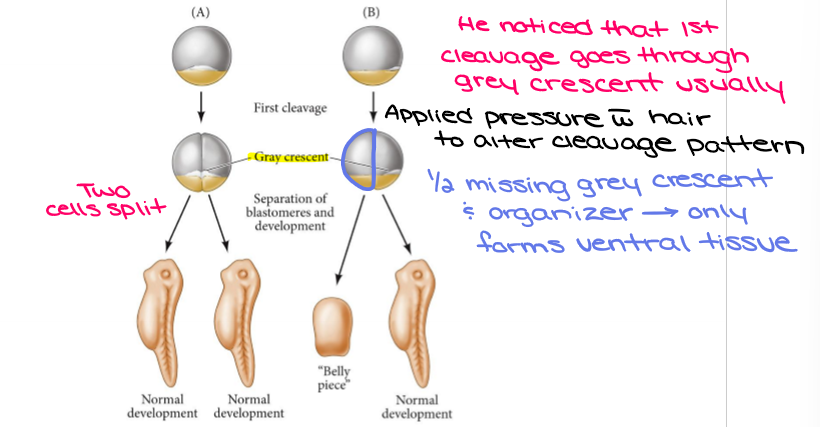
What did Hans Spemann discover?
Recognized the importance of the gray crescent for proper development
Noticed that the 1st cleavage usually goes through the gray crescent
Applied pressure with hair to alter cleavage pattern:
½ containing the gray crescent underwent normal development
½ missing gray crescent → only forms ventral tissue
What model was used to discover the function of the organizer?
Two species of Triton newts
One is darkly pigmented, other is light
What was the Mangold-Spemann experiement?
Sought to discover the function of the gray crescent - why was it so important?
Took the dorsal lip from a lighter-coloured newt and transplanted it into a darker newt
This caused a secondary invagination, followed by a secondary blastopore and a secondary nervous system to form
Ventral tissue → dorsal tissue

Is organizer function discovered in amphibians conserved across all vertebrates?
Yes
What does the organizer produce that makes it so important?
BMP inhibitors (Noggin, Chordin, Follistatin) are necessary to form dorsal structures such as the notochord and CNS

What is this image showing?
Stained for chordin expression
Expression expands as more cells pass through the organizer
What two signals are required to induce the formation of the organizer in a specific location?
Nuclear Beta-catenin stabilized in dorsal cells of the blastula in cells below where the organizer will form and at the site of future organizer formation
Dorsal mesoderm-inducing signals (Nodal-related TGF-B family members; Smad2,3) are secreted by cells of the Nieuwkoop center (below futute organizer site)
What blocks mesoderm-inducing signals from diffusing to the animal pole from the vegetal pole?
Blastocoel cavity

Vegetal cells, which will form the ____, induce the cells _____ them to form the _____
Vegetal cells, which will form the endoderm, induce the cells above them to form the mesoderm
How do vegetal cells induce the mesoderm above them?
Maternal mRNAs → proteins that diffuse
VegT: T-box transcription factor
Veg1: Nodal-like TGF-B superfamily member
What is the importance of VegT?
VegT controls the expression of several Nodal-related genes (TGF-B superfamily). The protein products of these genes diffuse toward the animal pole where they are required for mesoderm induction
Without VegT, what happens?
No blastopore forms → no mesoderm formed → No development (ball of tissue)
What is the dorsalizing signal?
Beta-catenin and canonical WNT signaling
Remember GSK3/Axin bound by disheveled via Frizzled → Free APC → Stable Beta-catenin → Nuclear beta catenin to turn target genes on
At fertilization, where is disheveled protein located?
Vegetal pole (very bottom of embryo)
What causes Disheveled to be transported from vegetal pole and up towards the marginal zone where the organizer will form?
Cortical rotation by 30 degrees
Kinesin motor proteins on the organized microtubule array
Besides disheveled, what else do the kinesins/microtubules/cortical rotation move?
Kinesins also bind GBP (GSK3 Binding Protein)
Together, Disheveled (binds GSK3 and Axin) and GBP help keep beta-catenin active and stabilized due to the inhibition of the beta-catenin destruction complex)

How does the transport of GBP and Disheveled affect Beta-catenin localization?
Causes dorsal enrichment of beta-catenin
No beta catenin in ventral nuclei
Beta catenin in dorsal nuclei
In dorsal cells, what target genes does beta-catenin turn on?
Siamois and twin genes → Siamois and twin proteins
What is the role of Siamois and twin protein?
With Smad2 (from Nodal paracrine factors), they bind organizer genes → Chordin, Noggin which produce BMP inhibitor proteins