Mea 100 exam 2 NCSU
 Call Kai
 Learn
Learn Practice Test
 Spaced Repetition
 Match
Match Flashcards
 Knowt Play
1/59

There's no tags or description
Looks like no tags are added yet.
Name | Mastery | Learn | Test | Matching | Spaced | Call with Kai | Chat |
|---|
No analytics yet
Send a link to your students to track their progress
60 Terms
Run-off
water flowing on the surface of the earth flows downhill to the lowest point
watershed
An ecosystem where all water runoff drains into a single body of water
stream properties
channel dimensions, gradient, discharge, sediment load
chanel dimensions
width and depth
gradient
slope
discharge
volume/time
sediment load
erosion, transport, deposition, and sediment grain size
Meanders
amplify the sinuosity, can form an ox bow lake

aquifer
permeable layer transporting groundwater

springs
occur whenever the water table reaches the surface typically near the base of steep slopes
artesian wells
occur when a break in a confined aquifer transports water to the land surface below the recharge elevation
overpumping
the cone of depression is a local decrease in the water table surrounding a well as a result of excessive pumping
Salt water intrusion
in coastal environments, the cone of depression lowers the freshwater table, which causes the intrusion of saltwater from below
Water quantity threats
too much or too little water
water quality threats
condition of water relative to the requirements of biological species
Dams
creates flood control, reservoirs for drinking water and irrigation, recreation, electricity generation. Also traps sediment, degrades river ecosystems and can fail catastrophically
Channelization
creates flood control and transportation. causes loss of wetlands, loss of biodiversity and disappearing deltas
overpumping of groundwater
the cone of depression is a local decrease in the water table surrounding a well as a result of excessive pumping

tragedy of the commons
individually rational economic decisions about shared resources can work against the interests of all
Why the ocean matters
food and resources, transportation, climate, recreation, and safety

ekman spiral
surface water flows 45° angle to the right of the wind

coriolis effect
due to the rotation of the earth, to the right in the northern hemisphere and to the left in the southern hemisphere

Upwelling
brings cold, nutrient rich water up from below

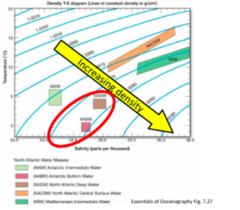
Deep ocean circulation
driven by density of water
Great ocean conveyor belt
deep and slow currents

atmosphere
the gaseous envelope that surrounds a celestial body
air
the invisible, odorless mixture of gases and suspended particles that surrounds earth
air composition
78% Nitrogen
21% Oxygen
1% Other Gases
1-4% Water vapor by Volume
Ozone
necessary to protect life on the surface from harmful ultraviolet radiation from the sun
Stromatolites
where the oxygen on earth came from
Pressure
force (gravity) per area
adiabatic lapse rate
the rate at which atmospheric temperature decreases with increasing altitude in conditions of thermal equilibrium
Atmospheric structure
thermosphere, mesosphere, stratosphere, troposphere

Auroras
in the thermosphere
coldest layer
in the mesophere
ozone
in the stratosphere
weather
in the troposphere
weather
the state of the atmosphere at a given time and place, determined by five variables
Air temperature decreases
when pressure decreases (PV = nRT)
temperature changes
due to seasonal changes, day to night change, when traveling north or south, or changing elevation
sea breeze
land heats up more rapidly than the seas, pressure gradient develops, air flows onto the land, creating a ________ breeze
land breeze
land cools off more rapidly than the sea, pressure gradient develops, air flows away from the land, creating a _________ breeze
pressure gradient
air always flows from high to low surface pressure

isobars
lines of equal pressure on a map
steeper pressure gradient
faster wind on a map
fronts
very large volume of air (covering thousands of miles) with similar temperature and humidity
Polar P
cold front
Tropical T
warm front
Marine m
moist weather
Continental c
dry weather
front
boundary between air masses
density lifting
warm, low-density air rises convectively
frontal lifting
two flowing air masses of different density meet, one forcing the other up
orographic lifting
flowing air is forced upwards due to terrain
convergence lifting
flowing air masses converge and are both forced upward
climate
weather patterns of a place over many years
differential heating
the amount of solar radiation at any given location on earth depends on the angle of sunlight and the hours of daylight
seasonal variation
summer: hemisphere tilted towards the sun
winter: hemisphere tilted away from the sun
thermal circulation
rising and sinking air due to variation in density with temperature
atmospheric circulation
3 thermal cells circulations between equator and pole, like a gear system
