4. Plasticity and functional recovery
 Call Kai
 Learn
 Practice Test
 Spaced Repetition
 Match
 Flashcards
 Knowt Play
1/10

There's no tags or description
Looks like no tags are added yet.
11 Terms
What is brain plasticity?
Brain plasticity refers to the brain’s ability to modify its own structures and functioning in response to new experiences
What is functional recovery?
Functional recovery refers to the re-establishment of abilites and mental processes that have been compromised as a result of brain injury or brain disease
What is synaptic pruning?
Synaptic pruning= the deletion of rarely used synaptic connections to allow for the strengthening of the more frequently used ones
What happened in Davidson et al’s study?
Davidson et al. (2004) compared 8 practitioners of Tibetan meditation with 10 student volunteers with no prior experience of meditation. Both groups were monitored via EEG whilst meditating for short periods. There were more activations of gamma waves in the monks than in the students. The researchers concluded that meditation produces both short term and permanent effects in the way that brains function.
What happened in Maguire et al’s study?
Maguire et al. (2000) examined London black cab drivers' brains via MRI before and after the Knowledge test and compared both to a control group not taking the test. They found a higher density of connections, and grey matter in the posterior hippocampi of taxi drivers and a positive correlation between density and experience i.e. those that had been cabbies for the longest had the highest levels of plasticity.
What processes did Davidson and Maguire et al’s studies both have?
Processes that Davidson and Magurire et al’s studies both have=
Synaptic pruning and axon sprouting in both studies" (+ Denervation supersensitivity)
What are the processes involved in functional recovery set out by Doidge?
Processes involved in functional recovery set out by Doidge=
Axonal Sprouting
Denervation Supersensitiviy
Recruitment of Homologous Sites
Neuronal Unmasking
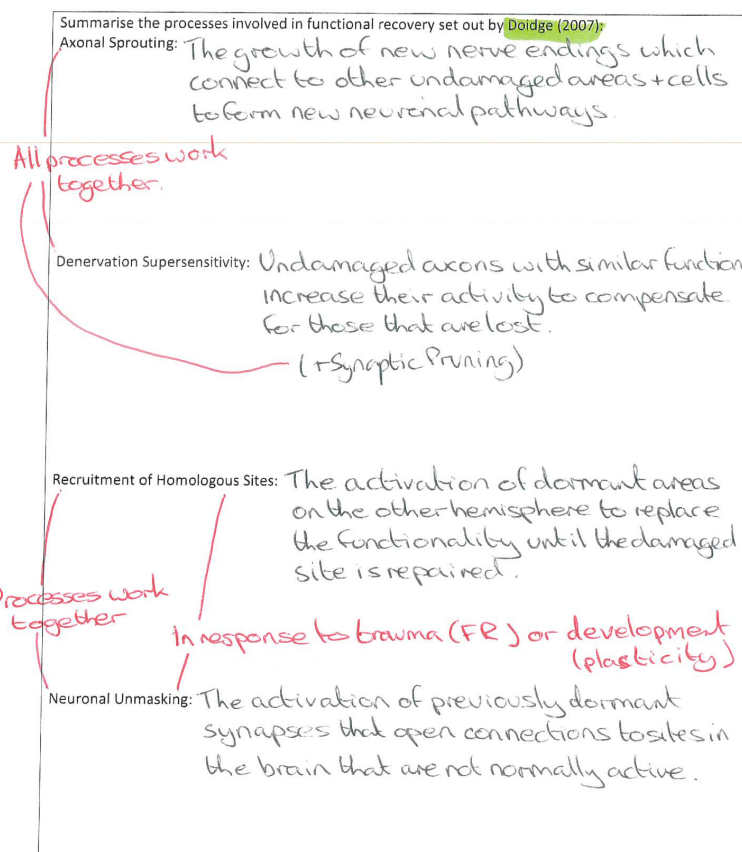
What is involved in axonal sprouting?
Axonal sprouting= The growth of new nerve endings which connect to other undamaged areas +cells toferm new neuronal pathways
What is involved in denervation supersensitivity?
Denervation supersensitivity= Undamaged axons with similar functions increase their activity to compensate for those that are lost. (SynopticPruning)
What is involved in recruitment of homologous sites?
Recruitment of homologous sites= the activation of dormant areas on the other hemisphere to replace the functionality until the damaged site is repaired.
What is involved in neuronal unmasking?
Neuronal unmasking= The activation of previously dormant synapses that open connections to sites in the brain that are not normally active.