Movement
 Call Kai
 Learn
Learn Practice Test
 Spaced Repetition
 Match
Match Flashcards
 Knowt Play
1/35

There's no tags or description
Looks like no tags are added yet.
Name | Mastery | Learn | Test | Matching | Spaced | Call with Kai | Chat |
|---|
No analytics yet
Send a link to your students to track their progress
36 Terms
Movements are only possible at
synovial joints
The more distal a muscle/bone is
the more movement is possible
Movement according to axis
nonaxial, uniaxial, biaxial, multiaxial
nonaxial
slipping or gliding movements

uniaxial
movement in one plane

biaxial
movement in two planes that are perpendicular to each other
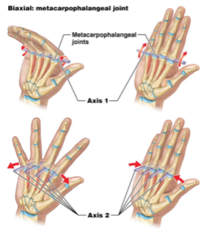
multiaxial
movement in all three planes of space; around several axis

Angular movements in the sagittal plane
Flexion, extension

Flexion
decreasing bone angle, typically in relationship to anatomical position (bending)

Two types of Flexion
Plantarflexion and dorsiflexion

Plantarflexion
bending of the foot toward the plantar surface (sole)
ex: tiptoe

Dorsiflexion
Bending of foot upwards

Extension
increasing bone angle, typically in relationship to anatomical position (straightening)

type of extension
hyperextension
hyperextension
increasing bone angle past anatomical position (more than 180 degrees)

angular movements in frontal plane
abduction, adduction
abduction
movement away from the midline

adduction
movement toward the midline

circular movements
rotation, pronation, supination, circumduction
types of rotation
medial rotation, lateral rotation, upward rotation, downward rotation
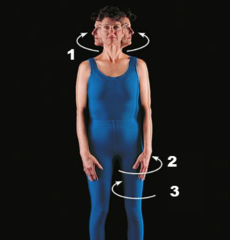
medial rotation
(3) anterior surface rotates toward midline
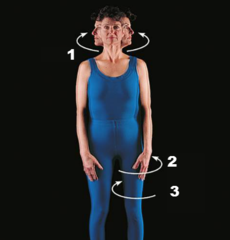
lateral rotation
(2) anterior surface rotates away from midline
upward rotation
specifically refers to movement of the scapula
scapula's lateral edge rotates upwards

downward rotation
specifically refers to movement of the scapula\
scapula's lateral edge rotates downward

pronation
rotation of palm to face down
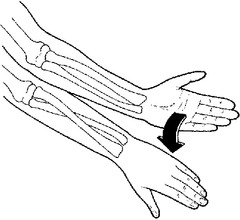
Supination
rotation of palm to face up

circumduction
movement that outlines a cone in space

Special movements
elevation, depression, protraction, retraction, opposition, reposition, inversion, eversion

elevation
lifting a body part superiorly

depression
lowering a body part inferiorly
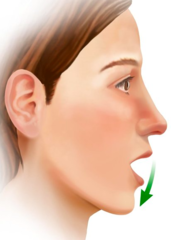
protraction
moving a body part anteriorly

retraction
moving a body part posteriorly
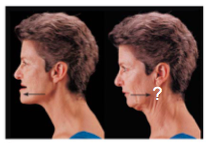
opposition
thumb and another finger brought together

reposition
thumb and finger brought back to original position

inversion
plantar surface (sole) turned medially

eversion
plantar surface (sole) turned laterally
