NUFT 204: Head, Neck, Neuro & Health Assessment
 Call Kai
 Learn
Learn Practice Test
 Spaced Repetition
 Match
Match Flashcards
 Knowt Play
1/76

There's no tags or description
Looks like no tags are added yet.
Name | Mastery | Learn | Test | Matching | Spaced | Call with Kai | Chat |
|---|
No analytics yet
Send a link to your students to track their progress
77 Terms
When preparing for a physical exam, what should a nurse do?
ensure proper infection control (PPE, hand hygeine)
physical prep of the patient (proper positioning)
considering patients age group
What are the 2 common positions for a head-to-toe exam?
supine
sitting
Techniques of physical assessment: What does inspection involve?
carefully looking, listening, and smelling to distinguish normal from abnormal
Techniques of physical assessment: What does palpation involve?
touching of body to gather info
When palpating the skin, what are you looking for?
abnormalities in:
temp
moisture
texture
turgor
tenderness
thickness
When palpating the abdomen, what are you looking for?
abnormalities in:
distention
tenderness
masses
Using the palmar surface of the hands and fingerpads is used to determine what?
position
texture
size
consistency
masses
fluid
What part of the body is most sensitive to vibration?
palmar surface of the hand and fingers
When assessing body temp, what body part is best to use?
back of the hand
What involves tapping the skin with the fingertips to vibrate underlying tissues and organs?
percussion
What is indirect percussion?
tapping over the middle finger
What is direct percussion?
striking the finger/hand directly against the body
What is listening to detect variations from normal over the lungs and abdomen?
ausculation
What are the 5 percussion tones?
tympany
resonance
hyperresonance
dullness
flatness
What is loud and high pitches sound heard over the abdomen?
tympany
What sound is heard over normal lung tissue?
resonance
What sound is heard in overinflated lungs?
hyperresonance
What sound is heard over the liver?
dullness
What sound is heard over bone and muscle?
flatness
Explain AA0X4
Awake, alert, oriented to person place time and situation X4
During the neurological examiniation, what is being performed?
mental status
level of consciousness
behavior and appearance
language
intellectual function
motor function
cranial nerve function
When you see someone has +3-+4 edema, what should you immediately check?
lungs
What is sensory aphasia?
language disorder caused by damage to the posterior part of the left temporal lobe
What is expressive aphasia?
a language disorder resulting from damage to the Broca's area in the frontal lobe
What do we use to assess the level of consciousness?
glasgow coma scale
How do we interpret the glasgow coma scale?
3 criteria:
eye opening response
verbal response
motor response
When assessing intellectual function, what exactly are we evaluating?
memory
knowledge
association
judgement
What test do we use when assessing motor function?
rombergs test
When we assess the motor function of a patient, what are we specifically evaluating?
coordination
strength
balance
What is the technique when assessing reflexes?
position the limb, tap the tendon briskly, compare corresponding sides
Someone has a score of 0 or 1+ in the reflex grading scale, what does that indicate?
hypoactivity
Someone has a score of 3+-4+ in the reflex grading scale, what does that indicate?
hyperactivity
What is a normal grade on the reflex grading scale?
2+
A 0 on the reflex grading scale indicates what?
no response
A 1+ on the reflex grading scale indicates what?
sluggish or diminished response
A 2+ on the reflex grading scale indicates what?
active and expected response
A 3+ on the reflex grading scale indicates what?
brisker then expected response
A 4+ on the reflex grading scale indicates what?
a very brisk/hyperactive response, possibly with clonus
When assessing the neck, what exactly do we focus on?
neck muscles
lymph nodes
thyroid gland
caratoid and jugular vein
trachea
How do we assess the head?
inspection and palpation
When assessing the eyes, what are we looking for?
visual activity
extraocular movements
visual fields
external eye structures
internal eye structures
List the external eye structures.
position/ alignment
eyebrows
eyelids
lacrimal apparatus
conjunctive/ sclerae
corneas
pupils/ irises
Break down the mnemonic PERRLA.
p: pupils
e: equal
r: round
r:reactive to light
a: accomadating
What does accomodation mean when assessing the eyes?
the patient fixes on a distant object and then asked to look at a close object
What should the result be when assessing accomodation?
The pupils should constrict when focusing on a near object and dilate when returning to a distant object
THINK: DILATE= DISTANCE CONSTRICT= CLOSENESS
What is the ability of the eyes to move inward (medially)
to focus on a near object?
convergence
Explain the convergence test.
ask patient to focus on finger or pen light 12-15 inches from nose
slowly move it toward the bridge of the nose
observe how well the eyes converge (constrict)
note when patient sees double or an eye drifts outward
What are the six cardinal directions of gaze controlled by six eye muscles that allow the eyes to move together smoothly and symmetrically in all directions?
extra-ocular eye movements
What are the 6 cardinal fields of gaze?
Moving object in an H pattern:
right—→up—→down
left—→up——>down
What are normal results when doing the H test?
smooth movements in all directions, patient only follows with eyes and doesnt move head
What are abnormal results when doing the H test?
jerky movements
lagging
double vision
Explain the peripheral vision confrontation test.
having the patient cover one eye and report when they see a moving object in their peripheral field of view.
What is conjunctivitis?
inflammation of the conjunctiva, often resulting in redness, irritation, and discharge from the eye
What is cellulitis?
a bacterial infection of the skin and underlying tissues, characterized by redness, swelling, warmth, and pain, often accompanied by fever.
What is a stye?
painful, red bump on the eyelid caused by an infection of the eyelash follicle or oil gland, often resulting in swelling and tenderness.

What is happening here?
patient has a stye

What is happening here?
patient has pink eye
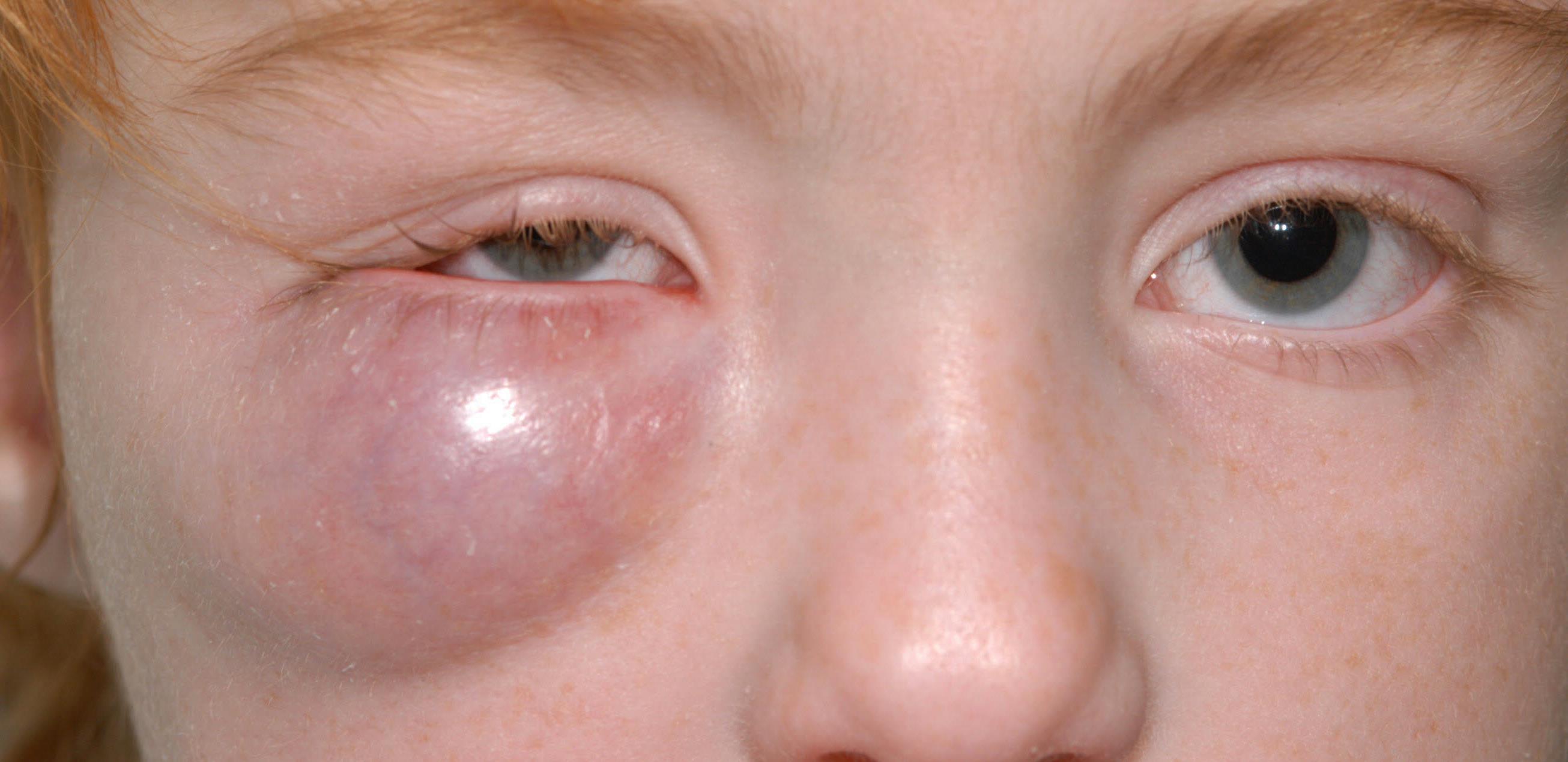
What is happening here?
patient has cellulitis
What do we assess when looking at the ears?
auricles (outside of the ear)
ear canals
eardrums
hearing acuity
ototoxicity
What are the 3 types of hearing loss?
conduction
sensorineural
mixed
What is used to assess hearing and distinguish between conductive and sensorineural hearing loss?
weber and rinne tests
Explain the Weber test.
strike turning fork
place on center of skull/ forehead
ask “do you hear it equally in both ears or more than one”
Explain the Rinne test.
strike the fork
place on mastoid process
when no longer heard, move in front of the ear canal
ask if they can hear it now
What does the weber test really assess?
which ear can hear better
What does the Rinne test really assess?
compares air conduction (AC) to bone conduction (BC)
What is a normal positive Rinne test?
AC>BC
What is a normal weber test?
heard equally in both ears
During the Weber test, if the sound lateralizes to the affected ear, what does that indicate?
conductive hearing loss
During the Weber test. os the sound lateralizes to the unaffected ear, what does that indicate?
sensorineural hearing loss
If the results of the Rinne Test are BC>AC, what does that indicate?
conductive hearing loss: earwax, fluid, infection
If the results of the Rinne Test are AC>BC but both are reduced, what does that indicate?
sensorineural hearing loss: nerve damage
How does we assess the sinuses?
palpation
What do we assess when looking at the mouth?
lips
buccal mucosa
gums
teeth
tongue and floor of mouth
palate
pharynx
tonsils
Where are the sinuses located?
above the eyes
in between the eyes
deeper part behind the nose and eyes
cheeks below the eyes
If a patient has 20/20 vision that indicates?
normal vision
If a patient has 20/40 vision what does that indicate?
patient sees at 20 ft what a normal-vision person sees at 40
If a person has 20/200 vision or worse, what does that indicate?
legal blindless