ARTH Lecture #4 (Sick Day) (*)
 Call Kai
 Learn
Learn Practice Test
 Spaced Repetition
 Match
Match Flashcards
 Knowt Play
1/49

There's no tags or description
Looks like no tags are added yet.
Name | Mastery | Learn | Test | Matching | Spaced | Call with Kai | Chat |
|---|
No analytics yet
Send a link to your students to track their progress
50 Terms
Hellenistic architecture
. Greek architectural forms/orders being applied to new uses and building types that had not traditionally been part of the Greek world.
Alexander the Great
.Expanded the Macedonian Empire.
. Died 323 BCE.
Mausoleum of Halicarnassus — c. 350 BCE
· Greek city on the Ionian coast.
· Tomb of Mausolus, a non-Greek Carian king.
· Architect: Pythius.
· One of the Seven Wonders of the Ancient World.
· Gave us the word “mausoleum.”
· Approximate dimensions 120 × 120 ft plan / 140 ft high
Why it is important (Mausoleum of Halicarnassus)
· A major example of Hellenistic hybridity.
· A royal tomb was unusual for Greek architecture
Hippodamus of Miletus & Orthogonal Planning
. Architect associated with the development of orthogonal city plan.
· Orthogonal plan:
. Regular grid of streets
. Streets intersect at right angles.
· This became an extremely long-lasting form of city planning.
· Used extensively in the Hellenistic world.
Hellenistic Miletus
· Greek city in the Greek East during the Hellenistic period.
· City included:
. theater
. temple
. palestra/gymnasium
. markets
. bouleuterion
. stoas.
Bouleuterion — c. 170 BCE
· Council chamber.
· Boule = citizens' council.
· Hellenistic cities adopted Greek civic institutions.
. Propylon entrance
. Corinthian columns at entrance
· Council chamber was semicircular
Important Hellenistic development (Bouleuterion)
. Greater interest in interior space.
. Greek temples had primarily emphasized exterior experience and freestanding colonnades.
. Here, the architectural order is applied directly to walls.
. Large windows and wall architecture become important.
Priene
· Orthogonal Plan
· Hellenistic city on the Ionian coast.
· Orthogonal grid:
. Streets intersect at right angles
. Regular rectangular blocks.
· Associated with the Hippodamian planning system.
· Streets mentioned as approximately 14 ft wide.
· Blocks could be approximately 200 ft wide.
Theater at Epidaurus — c. 300 BCE
· Designed by Polyclitus the Younger.
· Built around 300 BCE.
· Capacity mentioned:
. Approximately 11,750–14,700 spectators.
Religious/communal function (Theater at Epidaurus)
· Theater connected to the cult of Dionysus.
· Plays were submitted as competitions.
· Theater was a communal religious activity, not primarily a private experience.
Architecture (Theater at Epidaurus)
· Theater nestles into the hillside/natural terrain.
· Earlier Greek theaters were originally wooden; later construction used stone.
Acropolis of Pergamum
· Hellenistic kingdom in Asia Minor.
· Ruled by the Attalid dynasty.
· Pergamum was not laid out on a strict orthogonal grid like Miletus and Priene.
· Built in harmony with the natural terrain.
· City built on hilly terraces.
· Extensive use of stoas (on everything pretty much).
Attalus II
· Built the Stoa of Attalus in the Athenian Agora.
· Attalid dynasty later transferred its kingdom to Rome.
· The transfer demonstrated that power in the Mediterranean world was shifting toward Rome.
Altar of Zeus at Pergamum — c. 170 BCE
· Built at Pergamum.
· Associated with Eumenes II in the lecture/cheat sheet.
· Now located in the Pergamon Museum in Berlin.
· Extremely elaborate Hellenistic structure.
Architecture (Altar of Zeus at Pergamum)
· Greek altars had traditionally been relatively modest.
· This altar was dramatically monumentalized.
· Surrounded by a magnificent colonnade/stoa.
· Colonnade uses the Ionic order.
· Includes:
. monumental staircase
. rich high-relief sculpture
. freestanding sculpture above roofline.
Stoa
· A roofed space faced with columns/colonnade.
· Stoas were used for:
. public activities
. commercial activities
. protection from sun/weather.
· Philosophers taught in stoas.
· Stoic philosophy received its name from the stoa.
Stoa of Attalus II — Athens
· Built by Attalus II.
· Located in the Athenian Agora.
· Mid-2nd century BCE.
· Roofed rectangular colonnade.
· Used as a public/commercial space.
Two orders in one building (Stoa of Attalus II)
· Doric order on the ground floor.
· Ionic order on the upper floor.
· Important example of the relaxation of Classical rules.
· Dimensions mentioned:
. Approximately 388 × 63 ft.
Why important (Stoa of Attalus II)
. Use of Greek orders in non-religious buildings
. Combination of two orders in one building
. Hellenistic experimentation with Classical rules.
· Also demonstrates reverence for Athens and the claim of later rulers to be heirs of Athenian civilization.
Roman Republic
· Roman Republic traditionally dated 508–27 BCE.
· Rome's legendary founding: 753 BCE.
· Rome began as a small settlement on the Palatine Hill.
· Rome was surrounded by more advanced civilizations:
. Etruscans to the north
. Greek cities to the south/west.
· Rome was ruled for several centuries by Etruscan kings of the Tarquin line.
· In 508 BCE, Romans revolted against Etruscan rule.
· This became the traditional founding date of the Roman Republic.
Roman Expansion
· Rome developed major military power.
· Expanded by conquering neighboring peoples.
· Allies were called socii.
· Many allies were eventually granted Roman citizenship.
Major events (Conquest and Greek influence)
. 211 BCE: Syracuse sacked by Roman General Marcellus.
. 146 BCE: Corinth destroyed/looted.
. 133 BCE: last Attalid king of Pergamum left his kingdom to Rome.
Roman attitude toward Greek culture
. Traditional Roman self-image emphasized:
. farmers
. soldiers
. practicality
. public service
. austerity
. rejection of luxury.
· Yet Romans were strongly attracted to Greek art and architecture.
Temple of Fortuna Virilis / Portunus — Forum Boarium
· Early 1st century BCE.
· Located on the Forum Boarium in Rome.
· Probably dedicated to Portunus, god of the harbor/port.
· Important because it is a distinctly Roman temple, unlike the nearby round Greek-style temple.
Round “Temple of Vesta” / Hercules Victor
· Located on the Forum Boarium.
· Late 2nd century BCE.
· Probably dedicated to Hercules Victor Olivarius.
· Round temple.
· Designed by a Greek architect.
· Made from imported marble.
· Corinthian peripheral colonnade.
· Greek-style post-and-lintel construction.
· Pretty much a Greek temple on Roman soil.
· Contrasts with the more distinctly Roman Temple of Fortuna Virilis/Portunus.
Roman construction (arch/vaults/groin vault advantage)
· Romans embraced arcuated construction rather than relying only on post-and-lintel construction.
· Arch
· Made from wedge-shaped masonry pieces called voussoirs.
· Includes a keystone.
· Vaults
· Extending an arch into the third dimension creates a barrel vault.
· Crossing two barrel vaults at right angles creates a groin vault.
· Concentrates downward thrust at the corners.
· Allows greater openness on the sides.
Porticus Aemilia — c. 179 BCE
· Large Roman warehouse/storehouse.
· Built along the Tiber.
· Construction began around 193 BCE and continued to 179 BCE.
· Associated with Marcus Aemilius Lepidus and Marcus Aemilius Paulus.
Construction (Porticus Aemilia)
· Series of concrete barrel-vaulted cells.
· Built in terraces on rising terrain.
· Walls made of concrete faced with irregular stones.
· Opus incertum = irregular stone facing.
· Demonstrates early Roman use of concrete for practical/utilitarian structures.
Aqueducts
. Roman aqueducts transported water to cities.
· Carefully designed with a gradual incline.
· Gravity carried water from its source toward the city.
· Romans often brought aqueducts above ground.
· Greek aqueducts could be underground.
· Roman above-ground aqueducts demonstrated Roman engineering and control over nature.
Sanctuary of Fortuna Primigenia — Praeneste/Palestrina
· Possibly late 2nd century BCE.
· Located at ancient Praeneste, modern Palestrina.
· Sanctuary dedicated to Fortuna Primigenia.
· Represented an abstract quality/idea given divine form.
. Very innovative construction
· Sanctuary was associated with:
. pilgrimage
. fortune
. an oracle.

Purpose (Sanctuary of Fortuna Primigenia)
· People could travel there seeking things such as:
. health
. children
. wealth
. success.

Theater of Pompey — 55 BCE
· Built by Pompey the Great.
· 55 BCE.
· Important because permanent theaters had traditionally been politically/conservatively controversial in Rome.
· Earlier Roman theaters were often temporary wooden structures.
· Pompey built a major permanent theater in Rome.

Features (Theater of Pompey)
· Semicircular theater.
· Built over vaulted concrete structures.
· Had a large peristyle garden in front.
· Included a temple to Venus Victrix.
· Demonstrates the connection between theaters and religious structures.
. Made this innovation more expectable

Theater of Marcellus — 13–11 BCE
· Planned by Julius Caesar.
· Built by Augustus.
· Dated 13–11 BCE on the cheat sheet.
· Demonstrates Roman use of Greek architectural vocabulary on a Roman concrete structure.

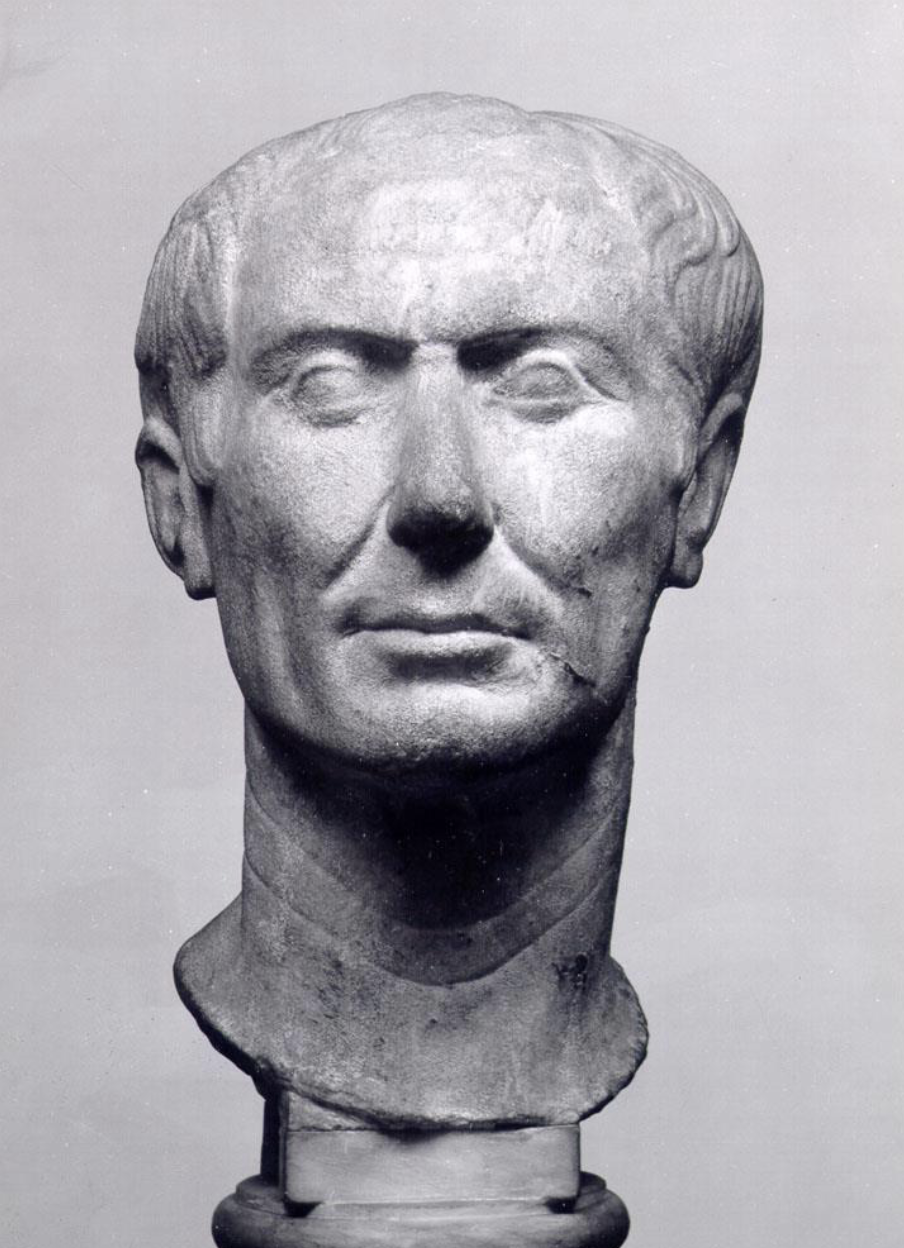
Julius Caesar
· Powerful Roman general.
. Largest following of the poor in Rome.
· Ruled/conquered in Gaul.
· Returned to Italy with his army.
· Did not disband his troops.
· Became dictator for life.
· Dictatorship had traditionally been temporary.
· Assassinated in 44 BCE.
Roman Forum, Basilica Julia and Basilica Aemelia
Were two grand public buildings facing each other across the main square of the Roman Forum in ancient Rome.
. Basillica, building type, long building row of columns (rectangular shoebox shape)
. Not a temple, not for religious

Basilica Julia
Location & Purpose: Stood on the southern side of the Forum and served as a law court, meeting place, and center for civic business.
History: Julius Caesar began building it in 46 BC using money from the Gallic Wars, and Augustus finished it, naming it after his adoptive father.

Basilica Aemilia
Location & Purpose: Stood on the northern, opposite side of the Forum and functioned mainly as a commercial center with indoor shops and bankers' offices.
History: Originally built in 179 BC as Basilica Fulvia, it was rebuilt and restored several times by the Aemilius family and later emperors before being destroyed by fire during the Sack of Rome in 410 AD.
Civil Wars between Octavian ( also called Augustus) and Ceasar’s enemies, and later between Octavian and Marc Anthony
The transition (replaced) from the Roman Republic to the Roman Empire was defined by two major phases of civil war involving Octavian: first alongside Mark Antony against Julius Caesar’s assassins, and later against Mark Antony himself.
. Image is Augustus of Primaporta

War Against Caesar’s Enemies (44–42 BC)
The Assassination: Following Julius Caesar's murder on the Ides of March in 44 BC, his adopted heir Octavian, Mark Antony, and Marcus Aemilius Lepidus formed the Second Triumvirate in 43 BC to seize control and hunt down the conspirators.
The Battle of Philippi (42 BC): The Triumvirate forces met the army of the assassins (led by Brutus and Cassius) in Macedonia. Octavian and Antony won a decisive victory, leading to the suicides of Brutus and Cassius and destroying the "Liberators" faction.
War Between Octavian and Mark Antony (32–30 BC)
The Breakdown of the Alliance: After defeating Caesar's enemies, the Roman world was split, but tensions rose as Antony aligned himself with Queen Cleopatra VII of Egypt, fathering children with her and distributing Roman lands to them.
The War of Actium (32–30 BC): Octavian used Antony's ties to Cleopatra to turn public opinion against him, convincing the Senate to declare war on Cleopatra.
The Aftermath: Octavian pursued them to Alexandria, Egypt, where both Antony and Cleopatra committed suicide in 30 BC. Octavian emerged as the undisputed master of Rome, changing his name to Augustus and becoming the first Roman Emperor.
Battle of Actium 31 BCE
Was a decisive naval engagement fought on September 2, 31 BCE, off the western coast of Greece, where Octavian’s fleet defeated the combined forces of Mark Antony and Queen Cleopatra.
Octavian become “Imperator”-Emperor Augustus 27 BCE, rules until 14 CE
The Roman Senate bestowed upon him the title "Augustus" (The Revered One) on January 16, 27 BCE. He took on the role of princeps (first citizen) and utilized the military title imperator (commander) to consolidate sole rule while maintaining the illusion of a restored Republic.
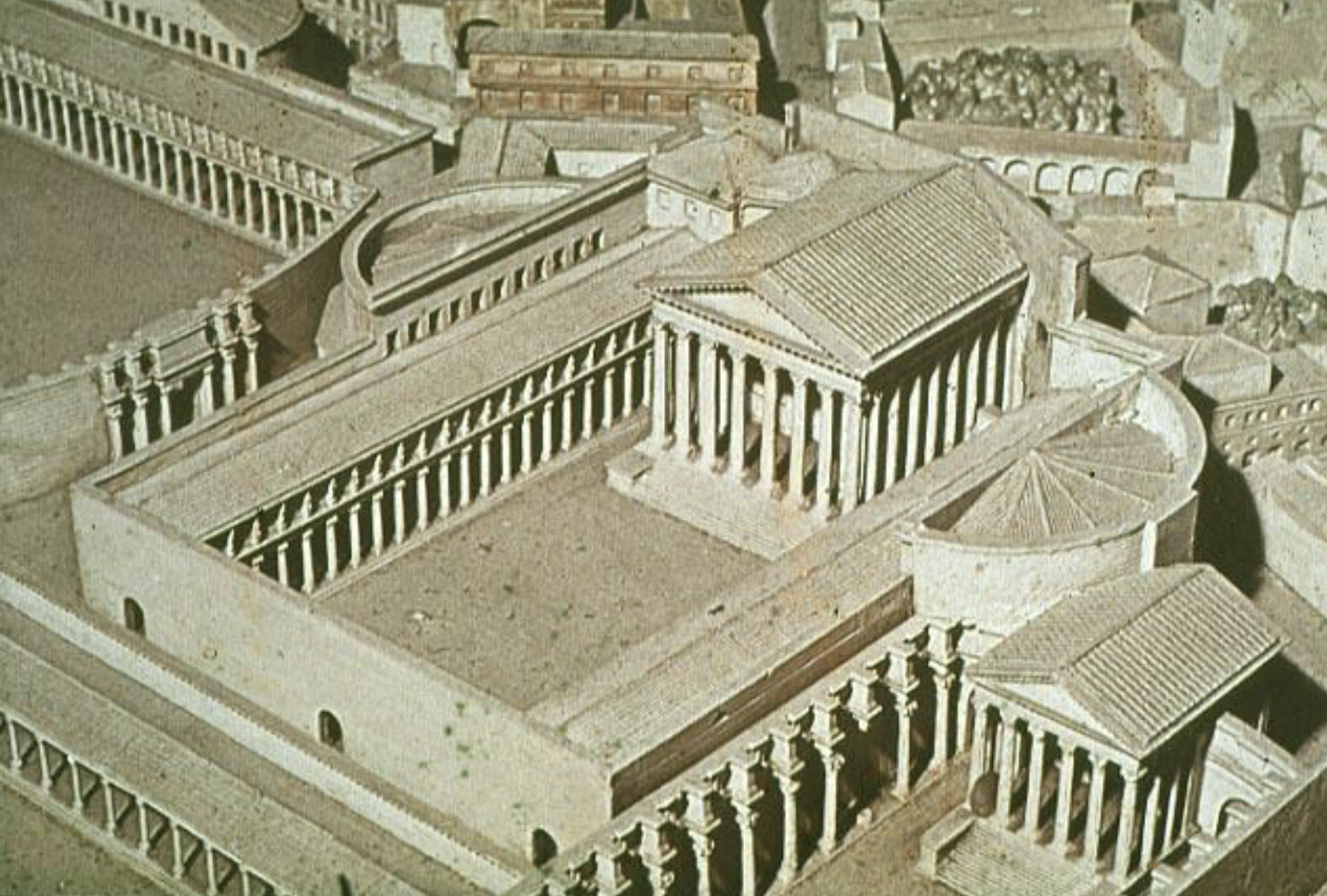
Forum of Augustus 2 CE—Temple of Mars Ultor (Mars the Avenger)
Was inaugurated in 2 BCE as the grand centerpiece of the Forum of Augustus in Rome.

History and Meaning (Forum of Augustus)
The Vow: Octavian vowed to build the temple in 42 BCE before the Battle of Philippi.
The Vengeance: He fought to avenge the assassination of his adoptive father, Julius Caesar.
The God: It honored Mars, the Roman god of war, in his role as Ultor (the Avenger).
Political Focus: It served as the heart of military planning, foreign policy, and imperial propaganda.
Hellenistic civilization
· Developed after the Macedonian conquest and Alexander the Great's empire.
Philip of Macedon
.Conquests of the Greek world: 359–336 BCE.
.Was the king of Macedon from 359 BC until his death in 336 BC.
Hellenistic hybridity
Is the blending of ancient Greek culture with the native traditions of the Middle East, North Africa, and Asia following the conquests of Alexander the Great.
Roman architecture emphasizes
. engineering
. interior space
. axiality
. symmetry
. dominance over nature.