bio year 1: water, ions, sugars (biological molecules part 1)
 Call Kai
 Learn
 Practice Test
 Spaced Repetition
 Match
 Flashcards
 Knowt Play
1/42

There's no tags or description
Looks like no tags are added yet.
43 Terms
what does electronegativity mean?
the tendency of an atom of an element to attract shared electrons in a chemical bond
why is water a polar molecule?
oxygen is more electronegative than hydrogen, so the electrons are more strongly attracted to the oxygen than the hydrogens and spend most of their time closer to the oxygen
this means oxygen is slightly negative (delta-negative) and the hydrogens are slightly positive (delta-positive)
how are hydrogen bonds formed between water molecules?
since water is polar, the slightly negative end of one water molecule is attracted to the slightly positive end of another water molecule
this results in weak hydrogen bonds
what are the properties of water?
ice floats in water
water has a high boiling point
water is adhesive (sticks to the sides of a container) and cohesive (sticks to each other), creating surface tension (when the surface of water contracts to the smallest possible surface area)
the temperature of large bodies of water (i.e. lakes, rivers, etc) stays stable
it has a high specific heat capacity
water is a solvent for salts
why does ice float in water?
H2O is denser in liquid form than solid form because, at freezing temperatures, the hydrogen bonds fix the positions of the molecules slightly farther apart by forcing them into a giant, fixed, open structure
this means ice is less dense than water
why does water have a high boiling point and specific heat capacity?
since there are so many hydrogen bonds, there is strong attraction between the water molecules which requires a lot of thermal energy to overcome (or loosen for the sake of increasing the particles’ kinetic energy)
why can insects like pond skaters walk on water?
the hydrogen bonds between water molecules causes them to be very cohesive (they tend to stick together)
this creates surface tension so the water’s surface is film-like and the insect doesn’t sink
why does water move up the xylem vessel in plants?
transpiration pull: the evaporating water molecules at the surface of the water pull water molecules up (due to the cohesion caused by hydrogen bonds)
capillary action: the adhesion between the water molecules and the sides of the vessel (caused by hydrogen bonds between water and hydrophilic cellulose) means the water molecules stick to the vessel + the cohesion between water molecules (caused by hydrogen bonds between water molecules) causes the water molecules to pull each other up
why can water dissolve salts?
water is a good solvent for ionic compounds because it is polar, so its slightly negative end attracts positive ions while its slightly positive end attracts negative ions
this breaks up the ionic lattice of salts
why do lakes, rivers, etc have a stable temperature?
when the environment is colder, a layer of ice forms over the large body of water
this is because ice is less dense than water, so it floats on top of the water
this means it insulates the lake/river/etc
why is sweating used as a cooling mechanism by some animals?
large amounts of energy are needed to overcome the hydrogen bonds between water molecules, so when sweat evaporates, a lot of thermal energy leaves the animal
why doesn’t oil mix with water?
it’s hydrophobic
it is non-polar while water is polar, so it doesn’t form hydrogen bonds with water
what is the biological role of Ca2+?
nerve impulses
muscle contraction
what is the biological role of K+?
nerve impulses
opening and closing of stomata
what is the biological role of H+?
catalyst for reactions
determining pH
what is the biological role of Na+?
nerve impulses
kidney function
what is the biological role of NH4+?
production of nitrate (NO3-) ions by bacteria
what is the biological role of NO3-?
nitrogen for plants to make amino acids
what is the biological role of HCO3-?
blood pH maintenance
what is the biological role of OH-?
catalyses reactions
determining pH
what is the biological role of PO43-?
makes up cell membranes
what is the biological role of Cl-?
balances the positive charge of Na+ and K+ in cells
what elements are proteins made up of?
CHONS
what elements are nucleic acids made up of?
CHONP
what is the difference between alpha glucose and beta glucose?
alpha: the OH at C1 is below the ring’s plane, and the glucose is less stable because the hydroxyl groups are closer together and so repel each other more
beta: the OH at C1 is above the ring’s plane, and the glucose is more stable because the hydroxyl groups are farther apart and so repel each other less
what does the term ‘‘hexose monosaccharide’’ tell you about the carbohydrate?
6 carbons
one sugar monomer
what is a glycosidic bond?
a covalent bond between two carbohydrate molecules
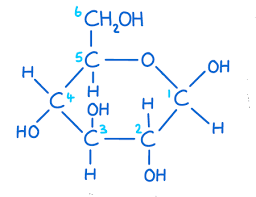
is this glucose alpha or beta?
beta
what is a condensation reaction?
the joining of two monomers by covalent bonds, removing water in the process
E.g. 2C6H12O6 → C12H22O11 + H2O
(glucose → maltose + water)
what is a hydrolysis reaction?
the breaking of covalent bonds between two monomers by adding water
what is a dimer?
two monomers joined together
what are the two polysaccharides that starch is made up of?
amylose (unbranched alpha glucose)
amylopectin (branched alpha glucose)

which carbons in amylose are being used to link the molecules together?
C1 and C4
(alpha 1,4 glycosidic bonds)
which carbons in amylopectin are being used to link the molecules together?
C1 and C4
C1 and C6
(alpha 1,4 and 1,6 glycosidic bonds)
what are the benefits of amylose’s structure?
the angle of the 1,4 glycosidic bond gives it a helix shape that coils up so more amyloses can be packed together
since it has many hydrogen bonds, its structure is stable
amylose is therefore very compact and insoluble (unlike glucose)
what are the benefits of amylopectin’s structure?
since it’s branched, there are more terminal glucose molecules
this gives more sites that enzymes can act on to hydrolyse amylopectin into glucose more quickly
this means glucose is released for respiration faster
what is the structure and properties of glycogen?
alpha 1,4 glycosidic bonds
branched
compact due to having more branches than amylopectin
insoluble
what is the structure of cellulose?
beta 1,4 glycosidic bonds
some molecules are rotated 180 degrees for the hydroxyl group on C1 to interact with the one on C4
what is the test for reducing sugars like glucose, galactose, fructose or maltose?
put the same volume of each sample into a different boiling tube, then use a dropping pipette to add a set volume of Benedict’s reagent to each one
place all the boiling tubes into a water bath for four minutes (taking notes after each two minutes)
positive result: a brick-red precipitate forms (because the soluble blue copper(II) oxide has been reduced by the sugar, forming insoluble red copper(I) oxide)
negative result: the solution remains clear and blue
what is the test for non-reducing sugars like sucrose?
put the same volume of each sample into a different boiling tube and use a dropping pipette to add Benedict’s reagent
place all the boiling tubes into a water bath for four minutes and see if there are reducing sugars present
use a dropping pipette to add a small set volume of HCl to fresh samples and mix
neutralise the acid by slowly adding sodium hydrogencarbonate, stirring with a glass rod after each addition
check the pH by dipping indicator paper into the sample (not the foam on top): if it is now neutral or slightly alkaline, stop adding sodium hydrogencarbonate
using a dropping pipette, add a set volume of Benedict’s reagent to each one and record your observations
place all the boiling tubes into a water bath for four minutes (taking notes after each two minutes)
positive result: (having already received a negative result for the reducing sugars test) a brick-red precipitate forms (because the HCl hydrolysed the glycosidic bonds in the carbohydrate, leaving monosaccharides that can reduce the soluble blue copper(II) oxide to form insoluble red copper(I) oxide)
negative result: the solution remains clear and blue
what do cellulose chains form when they make hydrogen bonds with each other?
microfibrils
what do microfibrils form when they join?
macrofibrils
what do macrofibrils form when they join?
strong, insoluble cellulose fibres