PSYC 001 Midterm
 Call Kai
 Learn
 Practice Test
 Spaced Repetition
 Match
 Flashcards
 Knowt Play
1/78

There's no tags or description
Looks like no tags are added yet.
79 Terms
(LC) What is Metacognition?
Awareness + Understanding of own thoughts
(LC) Why is it easier to remember words the second time? Purpose of count vowel activity?
1st try brain is making new pathways, 2nd time the pathways are connecting
(LC) What is the Study Cycle? Why does it work?
P.A.R.S.A
1. Preview - skim chapters, view objectives, view lecture slides
2. Attend - Attend lectures, Engage with material when assigned and take meaningful notes
3. Review - Review after class (within 24 hrs.), read notes, fill in gaps and note questions
4. Study - Repition is key, Ask "why", "how", "what if". (3-5) study sessions per day, read notes and material from week to make connections
5. Assess - periodically perform knowledge checks, determine if you're able to recall the information without depending on notes.
(LC) What is the process of an Intense Study Session?
(S.S.R.R)
1. Set a goal
2. Study with Focus
3. Reward Self
4. Review
(LC) What is the Pomodoro Method?
Breaking study sessions/workload into segments (e.g. 15, 25 mins) with 5 minute breaks in between
(LC) What are effecting study techniques? Why?
Give "mini lectures" - You don't just know it but can teach it
Test self frequently - Allows for repetition
Break large tasks into small ones - Makes taks appear less daunting/intimidating
(LC) What is psychology? What are examples of it?
The scientific study of mind and behavior;
Introspection, Functionalism, Behaviorism
(LC) How does psychology differ from other fields? (e.g. philosophy & physiology)
Study of different processes, Emphasis on adhering to scientific method
(LC) How did physio, philosophy, + scientific method make psych?
Early psychologists were trained in physiology and sought to apply scientific training to the study of mind;
Philosophical concepts and physiological understanding of the brain as an organ of thought (v. the heart)
(LC) What psych focuses on scientific method as base? Which focus on understanding humans
- Neuroscience, Clinical, & Biological focuses on scientific method.
- Social, Cultural, & Developmental focus on understanding humans
(LC) What Questions could align with different schools of thought?
- Introspection: "Why did I get jealous?"
-Functionalism: "What is fight or flight?"
- Behaviorism: "What makes people cuss?"
(LC) What questions could align with different lenses of psych?
-Neuroscience: "How do cell phone distract people when driving?"
- Clinical: "What factors lead to depression?"
- Social: "When do people form impressions of others?"
- Cultural: "How does culture change sense of self?"
(LC) How do we come to know things about psych? Pros and Cons?
Experiences: Personal Events relating to a phenomenon
+ : Reflective ; - : Objective/Projecting
Intuition: Subjective feelings about what makes sense
+ : Strong sense of self ; - : Disregard information that disagress (even if it makes sense)
Authority: Government, Media, Professors, and Parents
+ : create sense of guidelines ; - : can be oppressive/restrictive
(LC) What are the steps of the scientific method? (Pertaining to psych)
Observation,
Question,
Hypothesis,
Prediction,
Test,
Collect/Analyze Data,
Conclusions (Test doesn't support hypothesis you should pose and test a new one)
(LC) What is operationalization? Examples of variables that could be studied in psych?
Measuring or manipulating abstract variables
(e.g. measuring stress; asking people to measure on a scale of 1 - 5)
(LC) What are the pros and cons of operationalization?
+ : gives numeric value, allows for consistency and easier analyzation
- : variable can be complex, people can false report, measurement may not properly measure variable
(LC) What are validity and Reliability? How do they apply to variables?
Validity: are ACTUALLY measuring variable
Reliability: You get the same results with repetition, repeatability
(e.g. measuring stress; a questionaire directly answers question, and if desgined well will produce similar results everytime, but using a heart monitor to measure stress may NOT be valid for this variable)
(LC) What are examples of variables of interest in psychology?
Mental Health, Emotions, Social life, Relationships, Personality
(LC) What are the different types of studies in psychology? Pros & Cons?
Descriptive: Measures how people typically think, feel, or behave
+ : Can measure many variables
- : Cannot test relationships among variables
Correlational: Measures how variables are related to each other
+ : Can measure many variables
- : Cannot identify casual direction of relationship
Experimental Tests whether one variable causes another; (Random Assignment)
+ : Can establish casual direction of relationship
- : Can only examine a few variables in one study; Not all variables can be maniuplated
(LC) What is the importance of random assignment in experimental designs?
Makes groups similar, reduces biases and confounding variables (allows for establishment of relationship)
(LC) Why can't correlational studies be causational?
Third Variables, Preexisting (relationship, knowledge, etc.)
(Basically because no random assignment and manipulation of variable)
(LC) What are the three belmont principles? Examples?
Autonomy (respect for persons): Consent forms, allowing to leave study
Beneficence: Avoiding unnecessary harm
Justice: Not choosing only low income particpants
(LC) What is the Astonishing Hypothesis?
Idea that our thoughts, feelings, and sense of self are result of activity in our brain cells (neurons)
(LC) What makes up a neuron? What are their roles?
- Dendrite: Receives Message
- Cell body (aka soma): Contains neural info, contains the nucleus, and provides life sustaining functions
- Axon: transports electrical impulses
- Terminal branch (aka terminal buttons): converts electrical signals into chemical messages
- Myelin sheath: Layer of fatty tissue covering & insulating axon; ensures messages travel fast w/ less resistance
- Glia: cells that make up the myelin sheath; insulate, support, and nourish neurons
Responsible for vacuuming up neuronal debris; serve as cellular glue between neurons
(LC) What is electrochemical signaling?
Electrical Signaling: activation of the action potential
Chemical Signaling: flow of neurotransmitters
(LC) How does an action potential work?
1. (-70v) Channels open
2. (-50v) (IF) Threshold met (Going up/Firing)
3. (+50v) Action Potential
4. Repolarization (Come down)
5. Refractory period
(ALL OR NONE; Either fires or doesn't)
(LC) How does inhibitory and excitatory inputs contribute to the Action Potentional?
(about post synaptic neuron; neuron receiving message thru dendrite)
Excitatory synapses encourage depolarization
Inhibitory synapses encourage to remain polarized

(LC) What are the basic functions of each lobe?
(INSULAR LOBE ONLY EACH OTHER LOBE HAS OWN CARD)
(Supports sense of taste) Allows perception of internal organs

What is the frontal lobe?
(Complex thought, planning control of movement, map of body's muscles) Essential for movement and planning

What is the parietal lobe?
(Touch, Spatial Awareness, Map of body's skin surface) Attention and locating objects

What is the temporal lobe?
(Hearing, Memory, Object); Responsible for the ability to hear and understand language; Person and object recognition

What is the occipital lobe?
Vision
(LC) How would damage to each lobe be displayed?
Frontal: Impulsivity, Difficulty breathing
Parietal: Can't tell where they are being touched, can't determine object position
Temporal: Struggling to understanding spoken words or new information/languages
Occipital: Difficulty what they see or having blind spots

(LC) What are the functions of the Subcortical structures?
(BASAL GANGLIA ONLY EACH STRUCTURE HAS OWN CARD)
Coordinates movement (activate/inhibit)
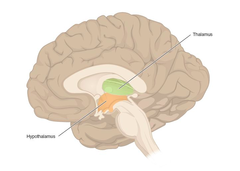
What is the function of the Thalamus?
sensory relay station; alertness and conciousness
(EXCEPT SMELL)
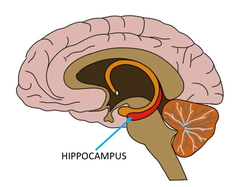
What is the function of the Hippocampus?
(memory) Encoding and Retrieval

What is the function of the amygdala?
fear and emotions
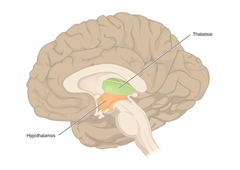
What is the function of the hypothalamus?
(body needs) Releases hormones, Regulates body temp

What is the function of the brainstem?
(survival) Atop spinal cord; collects sensory signals & sends signals down from brain for movement & regulation of vitals

What is the pons?
Controls breathing; Relays sensations (Hearing, Taste, Balance)

What is the Medulla Oblongata?
Controls autonomic functions; Heart Rate, Blood Pressure, Reflexes

What is the Reticular Formation?
Central role in arousal and attention; regulates sleep and wakefulness
(Plays role in A.D.H.D.)

What is the cerebellum?
(coordination) Coordination, precision, balance, accurate thinking, adjusting head and eye movement
(LC) How would damage to each subcortical structure be displayed?
Thalamus: Difficulty processing touch or sound
Hypothalamus: Difficulty regulating body temp, unusually hungry/thirsty
Amygdala: Difficulty responding to threats
Basal Ganglia: Development of stiffness, tremors/Difficulty initiating movement
Brain Stem: Difficulty with breathing and consciousness
Cerebellum: Difficulty walking steadily / maintaining balance
(LC) What is contralateralization and lateralization?
Contralateral: The opposite-side organization of the brain (Right side control left, Left side control right)
Lateralization: Some functions of the brain are located on either the right or left side
(Left = Language & Logic ; Right = Spatial skills & Visual patterns)
(LC) Why might split brain patients experience world differently?
One side of the brain might lack relaying info or not relay at all; report on objects differently, depending on the hemisphere
(e.g. if a split brain patient were shown the word screwdriver to their right visual field, how would they report their experience of that word? A: they would say screwdriver out loud)
(LC) How doe neural plasticity change throughout lifespan?
Infants & Childhood: Forming all basis/necessary neural pathways
Adulthood: Shaping and Reshaping to navigate/survive/succeed
Elderly: Deteriorating
(LC) What is early work in the perception of psychology?
Ḥasan Ibn al-Haytham (AKA Alhazen; 965-1040 CE)
- Study of perception
- Refined understanding of vision (i.e., eyes receive light; don't emit light)
Abū Rayhān al-Bīrūnī (al-Biruni, 973-1050 CE)
- First to describe the concept of reaction time (how quickly you can make a response to a stimulus)
(LC) Would a tree make a sound when it falls and no one is around to hear it?
Yes? Tree makes sound but nobody is there to perceive that sound
(LC) What is sensation? What is Perception? How do they work together?
Sensation: Detecting the information from the world around us
Perception: Constructed representation of reality
Our senses allow us to collect information while our perception allows us to organize and interpert it.
(LC) How can our perception and biases filter our world through an imperfect lens? Examples?
We can base on past experiences or expectations rather than the reality
(e.g. my opp didn't say anything to me because they are bitter, rather than because they are busy or having a bad day)

(LC) What is the absolute threshold? What is the difference threshold? What are examples of this?
Absolute Threshold: Stimulus must be present repetitively; what's required to activate sense & detect
Difference Threshold: Ability to detect difference in stimult 50% of the time
(e.g. how/if we are able to tell when brands change logo/designs)
(LC) Biologically, How do humans and nonhumans have different perceptual experiences?
Humans: A young person can hear a sound an older person can't
Nonhumans: Elephants opperate at lower frequency while dolphins operate on a higher frequency
(one needs echolocation to communicate through dense ocean waters)
(LC) What is the process from visual transduction to perceptual experience?
1. Eyes process info
(Retina = Sensory Receptor of light; Rods (Night) & Cones (Color) )
2. Pass through optic nerve to the optic chiasm
(SWITCH: Right eye -> Left brain ; Left Eye -> Right Brain)
3. Enter into thalamus
4. Enter into occipital lobe
(LC) What do top down and bottom up influences have on perception? Other sensory modalities?
Top Down: Use of past experiences, knowledge, and expectations to interpret what you sense
(uses what you already know)
Bottom Up: Brain builds perception from sensory it receives
(starts with what you detect)
Other senses:
- Depth: Ability to gauge distance
- Color: Ability to know apple is red under colored lighting
(TC) What is the difference between empirical research and pseudoscience?
Empirical Research: uses observations, experiments, and evidence to test ideas and drop conclusions
Pseduscience: claims to be scientific but lacks reliable evidence or doesn't properly test claims
(TC) How do scientists use evidence to support claims? (Hint: Scientific Method)
Using scientific method to determine whether evidence supports or contradict claims
(TC) What are examples of how psychology can be applied to your personal life or community?
Personal: "Am I addicted to technology? If so, how does my addiction affect me, and what can I do about it?"
Community: "How can I foster a stronger sense of community in my neighborhood?"
(TC) What are examples of how psychology can be applied to different career fields?
Criminal Justice: The Misremembering of eyewitness; important to separate reasonable conclusions based on available evidence from interpretations based on personal biases
Education: Using programs that help students cope and increase belonging boost academic performance
Poli-Sci: Helping people believe in growth and change can help them think less negatively of opposing groups/more willing to compromise
(TC) How does the textbook use information sciences to help learn psych?
- Chapter Outlines
- Study Units
- Explore Questions
- Interactive figures/videos
- Checking for understanding
(TC) What is the difference between random assignment and random sampling? Examples
Random Assignment: random method is used to decide which participants will be in which group
(e.g. having people draw colors from hat for placebo v treatment v control group)
Random Sampling: Ensures study has every person from population of interest
(e.g. if studying college kids, you use some from each region, not just west coast or south)
(TC) Why are Random sampling and random assignment important to make causal claims?
To avoid biases and ensure results can be generalized to pop
(TC) What are examples of construct, internal, and external validity?
Construct: How well the variable was operationalized
(e.g. If asking "Wellness of the U.S.A?" you would want to measure well being with a 10 point self measurement, not a 3 point asking about satisfaction)
Internal: If there was any other influence/alternative explanation
(e.g. If said "Bedrooms in TV link to childhood obesity", is that because of TV, or extracurricular or parental involvment)
External: Can the results of study/sample be generalized to population of interest
(e.g. if studying college kids, you use some from each region, not just west coast or south)
(same example because good external validity uses random sampling!!!)
(TC) Why is replication important for high quality science?
If a study can be replicated and produce the same results, it allows for transparency and honesty from general public about the work being produced (35)
(TC) How can you evaluate claims from popular media?
Using critical thinking, evaluating who's making claims, the evidence these claims are based on, and the honesty and validity of the people/institutions producing the evidence.

(TC) What are examples of central tendency and standard deviation in research?
Standard Deviation: finding the distance between each individual score and the mean, and then computing the average of these distances.
Central Tendency: the center of the scores
(mean, median, mode)

(TC) What is statistical significance? How do we know if there is or isn't?
If there is ( p < 0.05) than we can reject Null, If there isn't (p > 0.05) than we fail to reject; not accept because we don't know that there is no relationship just that we couldn't measure or detect it
(Null Hypothesis: No effect or no relationship)

(TC) What is the central and peripheral nervous system?
Central: Brain & Spinal Cord
Peripheral: Sensory and Motor nerves throughout body
- Somatic: feel external v
Autonomic: feel internal
(In autonomic)
- Sympathetic ("snakes" prepares body for action) v Parasympathetic ("peace" returns body to resting state)

(TC) What are the three major divisons of the brain? How would they display damage?
1. Forebrain: Home to all the lobes and higher level functions (thinking, memory, sensory, emotion)
(e.g. lobe damage examples like personality change or spotty vision; memory problems )
2. Midbrain: Home to movement systems and visual and auditory info
(e.g. difficulty controlling movement or responding to visual and auditory stimuli)
3. Hindbrain: Survival and coordination
(e.g. breathing or heart rate problems; poor balance or coordination)
(43)
(TC) What is double dissociation? Why is it important? What are examples?
The idea that when damage occurs to two different brain areas causing two different functions to be impaired independently
Proves different brain areas have specialized roles and functions
(e.g. damage to frontal lobe causes personal change while occipital lobe causes visual changes)

(TC) What are different brain imaging techniques that allow us to see brain activity?
1. EEG: Record brain wave activity
2. CT Scan: Brain structure
3. PET Scan: Brain Activity
4. MRI: Detailed Structure
5. fMRI: Brain activity and Locations
(TC) What is transduction as it relates to sensory and perception?
1. Eyes process info
(Retina = Sensory Receptor of light; Rods (Night) & Cones (Color) )
2. Pass through optic nerve to the optic chiasm
(SWITCH: Right eye -> Left brain ; Left Eye -> Right Brain)
3. Enter into thalamus
4. Enter into occipital lobe
BUT... We have blind spots, brain fills these blind spots using its beliefs about the world, given the context, to make you perceive what it thinks the stimulus must be.
(67)(is it bad that I giggled?)
(TC) What is the difference between sensory and perceptual adaptation? Examples?
Adaptation: when a stimulus remains constant overtime and eventually seems to disappear
Sensory adaptation occurs at the level of sensory receptors; perceptual adaptation happens higher up in the brain
(e.g. you no longer smell food or perfume after being exposed to it for some time; you believe your saliva is tasteless)
(64)
(TC) What is the role of the "What" and "Where" pathways? How would damage to these be displayed?
Ventral: "What"
(e.g. difficulty saying what an object is, but not where)
Dorsal: "Where" and & "How"; Location, Depth, and Motion
(e.g. can see and recognize object without knowing where it is or how to grasp it)
(TC) How does transduction look in different sensory systems?
Sight: Photoreceptors turn light into neural signals (images/vision)
Sound: Cochlea turns fluid vibrations into neural energy (sound/hearing)
Touch: Proprioception/Skin Receptors convert pressure, temp, or pain into neural signals
Smell: Olfactory receptors turn chemical odors into smell
Taste: (Gustation) Taste receptors allow us to process taste
(TC) What is a perceptual set? How does it influence perception? Examples?
Perceptual Set: A predisposition that influences what we perceive based on recent experience or context you
(e.g. if you're walking alone at night and you hear a noise you might think someone is following you, when it's just a cat)
(e.g. being in a bad mood so interpreting someone's neutral message as rude or disrespectful)
(M) what is the difference between media articles reporting on empirical findings, empirical articles, and generative AI results?
Media Articles Reporting: written for general public that summarized the reports of scientific research
Empirical Articles: Scientific research papers that report data collected through observation experiments surveys or other research methods; typically backed by peer reviews and accredited institutions
Generative AI Results: generated responses by AI tools based on patterns learned from data and prompted received
(M) How can you investigate the validity of scientific claims online?
1. Identify claim
2. Look for scientific evidence
3. Check original research
4. Evaluate methods and results
5. Compare multiple sources
6. Conclusions
(M) How can you vet a source that reports scientific findings?
- Author Qualifications
- Publication
- Original Research
- Evidence and Citations
- Bias and Purpose
- Date and Relevance
- Peer Review