Dementia + Alzheimer’s
 Call Kai
 Learn
Learn Practice Test
 Spaced Repetition
 Match
Match Flashcards
 Knowt Play
1/32

There's no tags or description
Looks like no tags are added yet.
Name | Mastery | Learn | Test | Matching | Spaced | Call with Kai | Chat |
|---|
No analytics yet
Send a link to your students to track their progress
33 Terms
What is dementia?
An acquired generalised impairment of intellect, memory, personality but with no impairment of consciousness.
What are the symptoms of dementia?
- Impaired memory and thinking.
- Poor cognitive function.
- Disturbed behaviour
- Lack of insight
- Lack of spontaneity
- Poverty of speech and low mood.
Describe poor cognitive function.
- Forgetfulness
- Poor attention
- Disorientation in time and place
- Dysphasia (names of things)
- Dyspraxia
Describe impaired thinking.
- Slow
- Impoverished
- Incoherent
- Rigid
Describe disturbed behaviour.
- Disorganised
- Inappropriate
- Distracted
- Restless
- Antisocial
What are risk factors for developing dementia?
- Older age
- Low BMI or overweight.
- Slow physical performance
- Lack of veg in diet.
- Lack of alcohol consumption
- Diabetes
- Depression or bipolar disorder.
What are the types of dementia?
- Alzheimers
- Vascular disease
- Lewy body disease
- Frontotemporal dementia
Describe alzheimers.
- Memory impairment with gradual onset and continual decline.
- Symptoms include aphasia, apraxia, agnosia and disturbance of executive functioning
What are the stages of alzheimers?
- Early Stage
- Mid Stage
- Late Stage
Describe the early stage of alzheimers.
- Years 1-3
- Language difficulties
- Depression
- Impaired activity of daily living
- Recent memory impairment and forgetting names
- Losing direction.
Describe the mid stage of alzheimers.
- Years 2-7
- BPSD
- Inability to calculate solutions
- Inability to bathe, eat or go toilet without assitance.
- Amnesia
Describe the late stages of alzheimers disease.
- Seizures
- Short and long term memory loss
- Rigid posture
- Complete dependence on others
- Mutism or nonsensical speech
- Double incontinence
What are the causes of alzheimers?
- Demographic factors
- Genetic factors
- Environmental and medical risk factors
What demographic factors can cause alzheimers?
- Increasing age
- Family history
- Down syndrome
What genetic factors can cause alzheimers?
- Down syndrome
- ApoE4
What environmental and medical risk factors that can cause alzheimers?
- Low IQ
- Previous head injury
- Cerebrovascular disease
- Depression
- Diabetes
- Obesity
Describe vascular dementia.
- Sudden onset at late 60s.
- Step-wise progressive decline.
- Caused by an infarct.
- Generally history of HTN and stroke.
What are symptoms of vascular dementia?
- Emergent of emotional changes and memory impairment e.g., depression.
- Apraxia
- Agnosia
- Dysarthria
- Dizziness
- Weakness of extremities
- Extensory plantar response
What are the causes of vascular dementia?
- Family history
- Male sex
- Hypertension
- History of stroke
- Diabetes
- Smoking
- AF
Describe Lewy body dementia.
- Progressive cognitive decline.
- Parkinson's type features
- Early gait disturbances
- Persistent and well-formed hallucinations
What are symptoms of Lewy Body dementia?
- Repeated falls
- Transient loss of consciousness
- Systemised delusions
- REM sleep behaviour disorder
- Extreme sensitivity to side-effects of antipsychotics.
What are the causes of lewy body dementia?
- Closely related to parkinson's
- Family history
- No known environmental risk factors.
Describe frontotemporal dementia.
- Onset between 45-70 years.
- Frontal lobe pathology responsible for behavioural and personality changes
- Temporal lobe pathology responsible for language disorder.
What are the symptoms of frontotemporal dementia?
- Language features
- Affective features
What are the language features of frontotemporal dementia?
- Progressive decrease in speech output
- Echolalia
- Perseveration
What are the affective features of frontotemporal dementia?
- Depression
- Apathy
- Emotional blunting
What are the causes of frontotemporal dementia?
- Primarily unknown
- Mutations in progranulin
- TAU-chromosome 17
- TDP-43 and C90RF72 genes.
How is diagnosis of dementia achieved?
- Complete history
- Review any medicines especially those with anticholinergic and sedative side effects.
- Meet diagnostic criteria from either DSM or ICD.
- Psychometric tests have been performed.
- Neuroimaging has been performed if possible e.g., MRI
What tests are conducted in primary care?
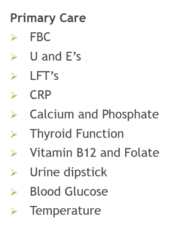
What tests are conducted in secondary care?

What clinical screening tools are available to help diagnose?
- MMSE
- AMTS
- ADAS-cog
- ACE3 or mini ACE
Describe MMSE (Mini-mental state examination).
- Tests cognitive functions.
- Used to diagnose alzheimers.
- 8 questions and score between 0-30.

What are limitations of MMSE?
- Pre-existing intellect levels (e.g., difficulty with math/spelling).
- Non-native English speakers face a disadvantage.