Chemical machining and water jet
 Call Kai
 Learn
 Practice Test
 Spaced Repetition
 Match
 Flashcards
 Knowt Play
1/5

There's no tags or description
Looks like no tags are added yet.
6 Terms
Water jet machining
Energy source is created from the momentum change of a stream of water which produces a high force
using a narrow nozzle water gains enough energy to cut though materials
nozzle diameter = 0.05-1mm
Only used for 2d shapes
water jet cutting pressure is between 400MPa TO 1400MPa

Water jet vs wire EDM
Water jet cutting is:
a cleaner operation
more efficient
material does not have to be conductive
no heat
cut can start from any location (no need for a starting hole)
rougher surface
not as accurate
Abrasive water jet
energy source comes from the change of momentum of the water AND with particles to produce a high force
abrasive particle e.g. silicon carbide / aluminium oxide
Metallic / non metallic, advanced composites can be machined
Nozzle material e.g. ruby, sapphire, diamond to avoid being worn down by the abrasive particle
good for heat sensitive material
min hold diameter = 0.4mm
max hole depth = 25mm
for very thick materials e.g. the anvil when being cut water jet can bend causing defects
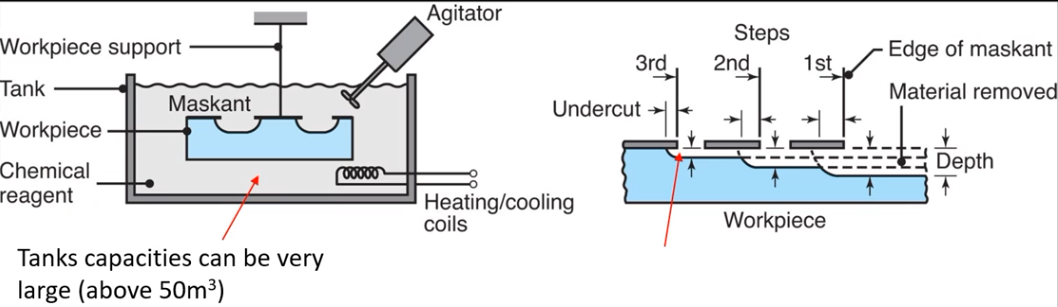
Chemical machining (milling)
Produces shallow cavities on the plates, sheets, forgings and extrusions
selective attack by the chemical reagent on different workpiece areas accomplished by:
Masking area to expose only the surface to be machined
multiple masks can be used incrementally to achieve variable depths
No forces or machine tools are involved in this process
Main defect: The chemical attacks from etchant also occurs horizontally, creating undercuts
Chemical machining (milling) application example
A - missile skin panel section can be chemically milled to reduce weight
B - weight reduction is space launched vehicles
Safe machining as it generally does not bring defects that could trigger the formation of cracks
Designs considerations for chemical machining
No sharp corners
No deep and narrow cavities
No porous workpieces
the etchant attacks all exposed surfaces!!!
Yes, complex shapes
yes, brittle materials
yea, difficult to clamp shapes
yes, shallow cavities
yes, no stresses to the parts
yes, good surface Finnish
slow process