Lecture 20 - Human Developmental Disorders and Rodent Models
 Call Kai
 Learn
 Practice Test
 Spaced Repetition
 Match
 Flashcards
 Knowt Play
1/37

Earn XP
Description and Tags
Lecture 20 - Developmental Neuroscience - Prof. Shawn Sorrells - Pitt
38 Terms
What are the 6 common animal models in development?
Zebrafish
Chicken
Mouse
Frog
Fruit Fly
Nematode (elegan)
Despite our efforts to breed test animals the same way, what is one issue that still occurs?
Random events introduce the largest source of variability despite all efforts to maintain a homogenous population.
Why are the six animal models (ZCMFFN) ideal for development?
They have known, clear strengths and weaknesses which make them model organisms; lack of clarity about weaknesses makes them harder to use as models because it can introduce variation that skews finding and subsequent interpretations.
What are the three steps to studying human disorders in rodents?
break the brain (break the process of neurodevelopment)
Measure how it was disrupted/broken
Try to fix/unbreak it (usually through a therapeutic outline
Rodent model strengths. How are they relevant and tractable?
They are relevant because they are mammals like humans. They are tractable because they are easy to manipulate.
Rodent model strengths. How does is it relate to mutations?
You can manipulate a gene or allele and study its impact on itself and other nearby proteins
Rodent model strengths. How does it relate to identifying changes?
ISH or immunostaining can be used to track anatomical of physiological changes
Rodent model strengths. How does it relate to pathways and biomarkers?
We can find common pathways affected by different gene changes and specific biomarkers that reflect the changes we observe
Rodent model strengths. How does it relate to therapeutic effects?
We can observe and test the therapeutic effect of different behavioral or pharmacological treatments.
Rodent model strengths. What is temporally-specific genetic deletion and rescue?
We can induce changes in specific cells at a specific part in time to identify critical periods in development which can help find time periods where intervention would be effective.
How and what is an elevated maze used to test for in mice?
An elevated maze is used to test anxiety in mice. It has a closed arm and two open arms. If it afraid, it will enter the closed arm but if not, it will explore the open arms and even jump off.
How and what is a y-maze used to test for in mice?
A Y-maze tests cognition or something called spontaneous alternation. The test exploits a mice’s natural behavior to be curious and explore so it tests how many arms the mouse will visit in succession. Greater successive visits indicate greater cognition.

In the ExpMs21 - Habituation experiment, where is the mouse seen most and what does its magnitude of speed indicate?
It shows the mice preferred the corners, likely because its the safest spot and were also the fastest when moving around the middle which shows they were quick to engage in center avoidance.
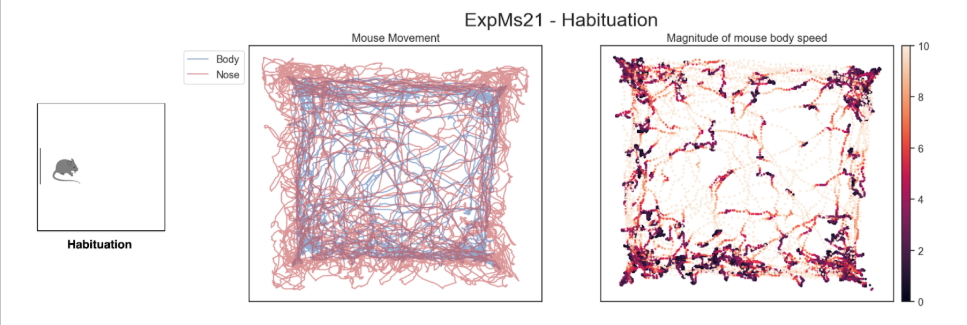
How does this relate to human behavior?
Humans are also inclined to spend more time in safer spaces, which can also tend to be corners or places with less people.
Explain novel object recognition
It contains two phases of task-training and task-testing where two of the same objects are shown, before one is switched out for a new, completely different (novel) object. Greater time spent with the new object indicates greater recognition ability (because it was trained to see the initial object so its exploring the new one).
Explain the morris water maze and what it test
The Morris Water maze tests spatial memory and cognition. It first swims around extensively in the water before finding a platform where it can stop swimming and in subsequent trials, it takes a shorter time to find the platform which shows increasing spatial memory and cognition.
What are three characteristics of autism spectrum disorders (ASDs)
developmental disorders
deficits in social interactions and language
repetitive and restrictive behaviors
Autism is clinically heterogenous. T/F.
T
What are the ASD-related behaviors and functional disruptions in the PTEN model of ASD?
Behaviors include decreased sociability and increased grooming. Functionally here is decreased LTD and intrinsic excitability via SK channels
What are four ways we can use social tests to find autism like behavior in rodents?
social approach
social memory/cognition
reciprocal interactions (sniffing/playing)
visible burrowing (huddling together)
What are four ways to look for autism-like behaviors in mice via social communication?
USVs when separated
juvenile same-sex USVs
male-female USVs
female urine and other social odors
What are four ways to identify autism-like behaviors via motor stereotypes?
repetitive self grooming
marble burying - more is compulsive
hole exploration
cognitive rigidity
PTEN Mutants experiment. What question is this experiment trying to answer?
What are the cellular changes that underlie PTEN mutant behaviors?
PTEN Mutants experiment. What were the results of the experiment? (4 answers)
loss of somatostatin (SST) interneurons
increases ratio of PV/SST interneurons
increases PV+ projections in layer 1
increases inhibition onto glutamatergic cortical neurons
PTEN Mutants experiment. What was the conditional circumstance of the experiment and what were the two tasks which showed statistical significance?
The KO was conditional for PTEN only in Nkx2.1 cells (MGE cells) which make PV and SST interneurons. The two skills of social interaction and novel object recognition showed significant differences where PTEN mutant mice spend less time interacting and did worse on recognizing novel objects.
MGE dissection + transplantation. Explain the process of transplantation.
The mouse brain was dissected to get unfold the cortex and further cut the MGE cells out form a wild type mouse. Then, these cells were dissociated and transplanted into progenitor tissue of PNET mutant mice.
MGE dissection + transplantation. What did the results show? incomplete
The results show the MGE cells like to spread out.
Rescuing SST w/ WT PTEN. What question is this experiment trying to answer?
Can we rescue the loss of SST interneurons using WT PTEN?
MGE dissection + transplantation. What is the experiment?
Explain the valproic acid model of ASD in mice
Valproic acid is used to induce anxiety like symptoms in the mice.
In the elevated plus maze, the VPA mice spent less time on the open arms (more anxiety).
For pre-pulse-pulse interval, VPA mice responded with a significantly decreased inhibition (more anxiety and fear of the sound) in both adolescents and adults.
This can be reversed through environmental enrichment.
Epilepsy arises from what?
It is a disorder arising from an imbalance in excitation and inhibition.
Explain seizure treatments with drugs and surgical resection.
Modulation of brain excitability with drugs comes with significant side effects, and for most people QOL is only improved by removing the part of the brain where the seizures are occurring.
Epilepsy MGE transplantation. What question is this experiment trying to answer?
Can transplantation of embryonic MGE cells restore genetically induced epilepsy?
Epilepsy MGE transplantation. What is the experiment?
Transplantation of cells from both sides (bilateral) transplanted into postnatal mice with epilepsy mutation
Epilepsy MGE transplantation. What did the results show?
MGE cells increased the inhibitory input onto the host pyramidal cells
MGE cells did not change the firing of inhibitory cells themselves
Epilepsy MGE transplantation. how are the results simplified?
The GABA-mediated synaptic and extrasynaptic inhibition from the grafted MGE cells increased inhibition overall.
Hippocampus MGE transplantation study. What question is this experiment trying to answer? (3)
Did the hippocampus or amygdala MGE cell transplantation change seizure frequency and duration? Did the behavior of animals change? Are they able to function better?
Hippocampus MGE transplantation study.