ANCS 3845 - Engineering & Tech in the Ancient World - MT 1
 Call Kai
 Learn
Learn Practice Test
 Spaced Repetition
 Match
Match Flashcards
 Knowt Play
1/109

There's no tags or description
Looks like no tags are added yet.
Name | Mastery | Learn | Test | Matching | Spaced | Call with Kai | Chat |
|---|
No analytics yet
Send a link to your students to track their progress
110 Terms
Types of written sources for ancient technology
There are very few ancient authors that discuss technology - because the elites were the ones who read, and they weren’t interested int eh workings of the lower classes.
Non-technical texts that provide some info (where the main focus is not on describing technology - poetry, histories, etc)
technical manuals or handbooks
Inscriptions
Papryi
The questions we ask about written sources for ancient technology
How well informed is the author about the technology?
What attitude did they have toward it?
What was the purpose of the text?
Types of artistic representations for ancient technology
Relief sculpture (usually funerary)
Wall painting (esp. at Pompeii and Herculaneum, 79 CE)
Vase painting (or painting on other ceramic)
Other types: coins, toys, models, figurines, etc.
The questions we ask of artistic depictions of technology
How well informed is the artist (or patron) about the technology?
How do we distinguish between artistic choices, error, and reality?
Potential for unique detail (e.g. clothing)
Simplification/Stylization
Distortion of scale or perspective
What is the purpose of the art?
Funerary? Votive?
Never intended to represent technology in an instructive or analytical way
Moses Finley & his 1965 article
Claims that little technological development occurred in Greco-Roman antiquity
" Most essential" developments already happened
Uses mainly textual sources to argue that the lack of advancement was largely due to:
Attitudes: Lack of elite interest in development
Low levels of demand: low-population settlement & high poverty
Notes the problems with applying "economic rationalism" and other modern terms & perspectives to the ancient world
Technology
Modern dictionary definition = the practical application of knowledge
Classical world definition = human activities intentionally altering the environment to ensure survival or a more pleasurable lifestyle
Techne
Means craft, art, or skill
techne + logos = Technology (the study of skill)
Prometheus
Is said to have given humans: “all the skills”
sense and intellect
the knowledge of how to build houses
the knowledge of astronomy
the alphabet
horse chariots
ship building
mining ores
Plato’s and Seneca’s views on craftspeople
Plato - 4th c. BCE views:
Rejected the arts - pottery making, blacksmith, etc
Wanted the arts people punished - the elite bias of working with your hands
Associated working with your hands with poverty or the lower class
Seneca - 1st c. CE views:
it was mans ingenuity that created technology, not true wisdom (which was the ultimate goal of the greeks)
“The men who discover them are the men that use them today” (Associated tools of invention with the lower/working class)
Story about Vespasian and column transport
Vespasian - 1st c. CE
rejected the use of machines for hauling up columns
used the available working class instead, and paid them for their work
written about in Suetonius `
Mediterranean environment
very dry summers
wet winters
hilly and mountainous
steep slopes and rocky soil
The “Mediterranean Triad”
Grain (wheat and barley)
Grapes
Olives
Barley vs. Wheat
Barley:
More widespread
drought tolerant
Easiest to grow in Mediterranean
Wheat:
easier to process
favours cool and wet climates (unlike Mediterranean)
Greeks liked wheat more than barley (cultural preference)
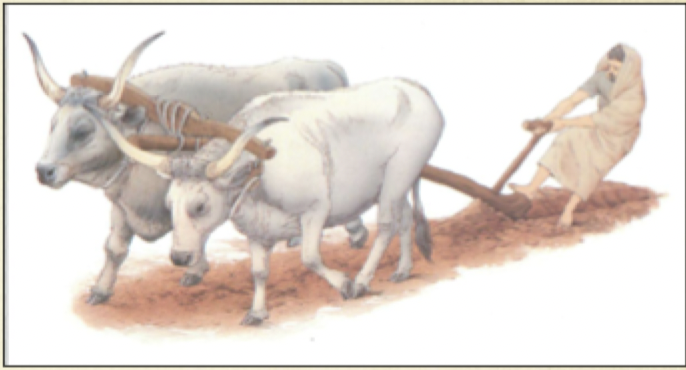
Scratch plow/Ard
Called the “Scratch plow”—because it doesn't dig deep, just scratching the surface
Simple wooden tool
Used since Neolithic period
The plow was yoked to animals
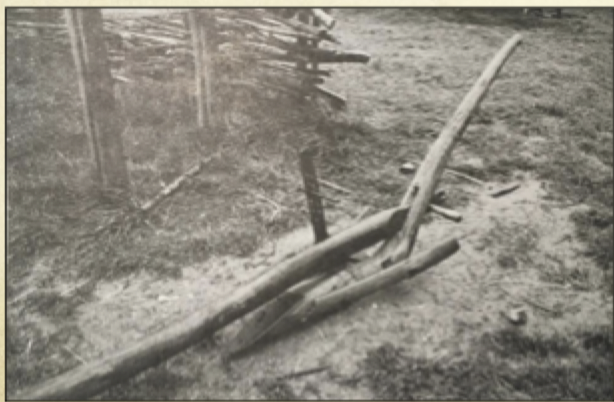
Eared plow
The distinctive “ears” helped turn over the soil (made of wooden posts)
The plow was yoked to animals
Discussed in Virgil - key terms = “ears”, “yoke”, “plowshare”
Wheeled Plows and Moldboard Plows
Evidence of plow innovation - wheels
As plows became heavier and included more metal, wheels would make it easier to lift and move
A Moldboard plow includes a coulter (an attached knife to crease an initial cut in the soil, making it easier for the ground to be broken up)
Deeper digging allowed for more wheat cultivation

The vallus
A wheeled device with teeth on the front, that cuts and collects the heads of wheat - faster than reaping by hand
One man to push the animal and machine, another man to flatten the ears of the crop
Mainly known from Pliny's writing in the Natural History 1st c. CE

Pliny the Elder
1st c. CE (died investigating the eruption of Vesuvius)
Equestrian class - high socio-political class
Served in the military
Natural History: 37 books - wrote on a variety of subjects: astronomy, geography, human anatomy, zoology, botany, natural medical remedies, minerals, metallurgy
Threshing
Separating the grains from their husks, which can be done by:
hand beating it
Treading (walking on it — people or animals)
would need a treading/threshing floor (concrete)

Rotary Stone Mills
Rotary Mill:
Two disk-shaped stones were on top of one another, and you could rotate the stones using a stick to crush the grain that would be fed in through the top
Larger stone rotary mills could be turned by animal power

Barbegal Mills
Water Mills in southern France, 1st- 3rd c. CE
The site with the most concentrated amount of power in the Roman world
Water gets diverted into chutes on either side of the main central staircase
8 water wheels on either side
Used to power the millstones under the little huts (grind grains)
Calcium deposits were found where the decayed wooden components were - allowed for the reconstruction
Discovered the wheels were only used in certain seasons, not year-round

Uses of Olive oil
Cultural significance: Used for cooking, bathing, light
Simple but laborious cultivation, mostly by hand (weeding, pruning, harvesting, digging)
Allows for efficient use of hilly terrain, often terraced
harvest fruit every 2 years (after trees mature - takes 10+ years)
The Roman Agronomists: Cato the Elder, Varro, Columella, Palladius
Cato the Elder (2nd c. BCE), De agri cultura
Varro (1st c. BCE), De re rustica
Columella (1st c. CE), De re rustica
Palladius (5th c. CE), Opus Agriculturae
Mola olearia
A Roman stone roller mill used to crush olives into a paste during the first stage of olive oil production
newer innovention than the Trapetum

Trapetum
An ancient Greek and Roman stone olive mill designed to crush olive flesh and separate it from the pit before pressing.

Lever-and-weight Press
Lever and weight is the simplest press
As weight gets added to one end, the see-saw motion will crush the olives on the other side
The pully system would be animal or human powered

Lever-and-drum Press
You would rotate the lever by pulling the wooden beam to crush the fruit.
Example in the villa of the mysteries for wine processing

Lever-and-screw press
The people would pull the wooden beams (levers), which would turn a vertical screw to crush the fruits
Advantages:
Faster production and a more robust and reliable machine (no fragile ropes, therefore fewer injuries)
Cons:
It requires a lot of hard labour (people turning the screw)
requires a lot of construction and resources.

Direct screw press
The direct screw press is very small (not much bigger than a person)
Saves space (can be used in an urban setting)
would be cheaper to set up

Dolia yard
spaces designed to show agricultural production in the house
Emphasizing the morays of the past (being a good farmer)
Shows off agricultural production
Dining room is near the production area, so people eating could see
Picture = Villa Regina, Pompeii

Convertible husbandry
agricultural method where plots of land alternate periodically between growing crops and serving as grass pasture for livestock
the animals would produce manure to fertilize the crops when they are planted in that area next
discussed in Columella’s work called On Agriculture
Piscinae
artificial fishponds
Materials impermeable to water to create the canals (concrete)
Made by cutting into the natural rock or using concrete to create a man-made pond
Sluice gate with holes to allow water in and out of the pond, but to keep the fish inside; also controlled the salinity (amount of salt) in the ponds, keeping the fish healthy
Amphora could be placed in the wall to provide fish with shelter from the hot sun
Discussed in Columella’s work called On Agriculture

Greenland ice cores
High lead concentrations in the ice cores showed an increase in mining
greater demand for coins, tools, and weapons.
The amount of mining in Roman society was the highest in ancient times, up until the Industrial Revolution

Cupellation
The high temperature separation of silver from lead deposits
Types of metals and their common uses
Bronze: easy to cast/work with, and is hard/durable
used for jewelry, statues, tools, and weapons
Iron or steel : good for tools and weapons as it is very hard
Lead: resistant to corrosion - pipes, clamps, tools
Gold: Jewelry, coins, and vessels
Lack of tin in the Mediterranean - shipped from Britain
Beneficiation (Second step in the Iron Production Process)
Used to separate the ore from lighter sediments and impurities
Reduces the size of metal ores to a pea-sized shape; it becomes concentrated/smaller by washing it
The heavier/larger pieces of stone will sink, and the lighter stuff will get carried away by the water down the shaft
Smelting (Third step in the Iron Production Process)
heat + charcoal to melt out molten metal and reduce other metals to make slag
Refining (Last step in the Iron Production Process)
Removing impurities, usually by re-melting the iron
Laurion
Location of the large silver mines in Attica
Silver, but also copper and lead
Starting in Bronze Age, most intense exploitation in 5th c. BCE
Source of wealth for Athens
Archaeological remains of beneficiation "washeries" that reused water, since it was a dry region

Rio Tinto
Roman mines in Spain
Was initially run by the Carthaginians but later by the Romans
Mined into the 20th c.
Had complex drainage - used a series of man-powered waterwheels to carry water away, so they could mine below the water level in the ground
Vipasca tablets
Roman regulations for leasing mining rights from the state, suggesting the emperor kept tight control of mining
details the mines at Rio Tinto Spain
the government of Rome owned the land and leased it to someone else for profit
arrugiae and ruina montium
Aspects of hydraulic mining
"Arrugiae" - related to digging channels
"Ruina montium" - the destruction of mountains
Techniques used in the mines of Northwest Iberia - described by Pliny

Smithing
Blacksmithing - heating, hammering, tempering, and quenching metals
Berlin Foundry Cup
5th c. BCE Athens
Created using the lost-wax process

Lost-wax process
Artist's model in clay
Clay or plaster mould taken of model, brushed with wax to create shell of desired thickness
Shell covered in and filled with clay; fired, melting wax and leaving a mould to be filled with molten metal
Niello
A deep-black metallic alloy made of sulfur combined with silver, copper, and lead. It is used as a decorative inlay to fill engraved designs on metal surfaces
appears blueish blacafter heating
used in the Mycenean dagger from the Shaft Grave at Mycenae, 13th c BCE

Steel
is harder and more durable than iron
steel = heated iron + charcoal (adds carbon for enrichment
Tesserae
used in mosaics - small stones
Tuff/Tufo
A local and practical common type of stone - used in the ancient Roman world
used in the forum of augustus

Pentelic marble
A type of white marble that was used in many monuments in the ancient world
A quarry of it is found at Mount Pentelicus in Athens; used for many Greek buildings (Parthenon)
Later imported to Rome

Porphyry
A type of coloured stone - that was often imported from great distances to the roman world
used in the portraits of the tetrarchs in a purpleish style stone

Lucius Lucullus
Introduced a type of marble to rome which is named after himself (lucullan marble)
an entirely black marble
found on the island of melos
Described in Plinys Natural Histories
Trench-and-wedge technique
You would cut trenches around the desired blocks of rock using a quarry pick

Stone Transport Techniques
crane lifted the stone to be placed on an animal-driven cart
A roller and lever (the stone would be rolled over logs to move)
Slopes that were used with anchored cables to slide the block down

Common stone carving tools
Picks with a wide point (wood or iron)
Wedges (inserted into rocks to break off a block)
Hammers

Stone carving tools - Drills and Saws
A basic drill - A piece of metal that you rub back and forth with your hands to rotate
A cord drill - someone pulls a strap while the other holds the drill to rotate it
The depth created in the hair of statues was done by drills
Saws: manual saws were a piece of stone moved back and forth with added sand for grit

Water Saws
shown in the sarcophagi relif of Marcus Auerilius 3rd c. CE
Mentioned in Ausonius’s writings - 4th c. CE
The crank turns due to the power of the water, the circular motion pulls the slider back and forth, which would move the saw from rotary to back and forth motion

Ratio marmorum
The roman marble bureau
Increased development with roman empire growth
quarrying = under the control of the state (emperor)
used in the emperors building projects - imperial monuments
Kept records of the construction
Excess stones would be sold to wealthy individuals or cities, and eventually to the mass market
Mons Claudianus
a quarry in Egypt which is the source for imperial granite
Monolithic columns were found still in place of the quarry
middle of the dessert, so stones had to be dragged down to the Nile, and then shipped to final location

Lapis Gabinus
a volcanic tuff from central italy - found in Gabii
A common building stone for the monuments in Rome
Has good compression strength but is easy to cut through

Corvée
temporary unpaid labour as a part of ones obligation to a ruler or state
the people who build the pyramids of Egypt were this kind, not the slaves like the romans
Wattle and daub
Used in early Iron Age architecture (housing) in the Mediterranean
Used to create walls
Wooden support beams driven into the ground, woven wooden sticks around the beams, then filled in with a clay/manure mixture

Ashlar masonry
The use of large square stone blocks in architecture/construction
Ictinus and Callicrates
Architects of the Parthenon in the 5th c. BCE greece
Written about in Vitruvius’s work
Demetrias of Ephesus
A slave associated with the temple of Diana (Artemis) - who completed the temple of Artemis at Ephesus after the first builders couldn’t
Written about in Vitruvius’s work
Apollodorus of Damascus
architect for the emperor trajan - 1st c. CE
designed the forum of trajan, temple of trajan, and trajans column
Is said to have been executed for insulting the following emperors (Hadrians) designs

Arsenal of Philon at Athens
4th c. BCE - a naval arsenal in the port of Athens
meant to hold the rigging and other equipment of the naval ships
is discussed in a marble inscription

Forma Urbis Romae
3rd c. CE - map of the city of Rome
very large
Probably decorative and not functional, but still reflects the city plan at that time period
Only fragments of the map survive

Polygonal masonry
Harder to fit together, but easier when chipping/forming the stone blocks
Makes for a solid wall as none of the joints line up (so it has no weak point)

Tripaston
The “triple-haul” crane
decsribed by vesuvius
Wooden supports balanced with cables
Two guys twisting an axle which pulls the rope down
The stone gets attached to the rope, and brought up by the men twisting the axle

Pulleys
used to help lift heavy stones in cranes more easily
Two-pulley system ("gun tackle") cuts in half the force needed to lift a given weight
A double block and tackle system reduces the force to 25%
Adding rope segments that run between pulleys continues to reduce the force needed

Lewis bolt/holes
Methods/tools of fastening a stone block to cranes
Tennon and rope - You leave a little nub of stone when chiselling to wrap rope around
Forceps - Small holes cut into the sides of stone so forceps could attach and lift
Lewis bolts - Angled pieces with a bolt attached to top of rock

Rustication
masonry techniques used in classical architecture giving visible stone surfaces a rough finished texture - looks old and historical

Anathyrosis
Masonry technique used to connect the joints of stone blocks without mortar
Finely smoothed only around the edges of the stone face, creating a tight-fitting frame

Treadwheel crane
Uses people in a wheel to create the force to lift the stone blocks
shown in the Relief of the Mausoleum of the Haterii; 1st c. CE, Rome

Imbrex and tegula
Overlapping roof tiles used in ancient Greek and Roman architecture as a waterproof and durable roof covering
mainly made of fired clay - terracotta

Parthenon building process
5th c. BCE Athens
We can reconstruct the building processes of the Parthenon- because Athens was a democracy with traditions of carving inscriptions in stone
Public accounting describing what was purchased and who is being paid to do construction work
Amount of money spent = on the left side
Description of what was being paid for = on the right side

Entasis
The “stretching” of a column - a convex bulge in the columns
Not much evidence to support the optical illusion theory - briefly mentioned by an ancient author
More likely that this was just due to aesthetic purposes
Used in the parthenon

Arch
Corbel arch:
Starting from the bottom, the stones are smaller, getting longer towards the top (e.g. Treasury of Atreus)
A true arch relies on the compressive strength of stone as a building material (e.g. Falerii Novi); allows for larger openings

Pont Du Gard
An aqueduct that is three rows of arches, very tall and long
made of limestone without mortar - held together based on compressive force
1st c. CE

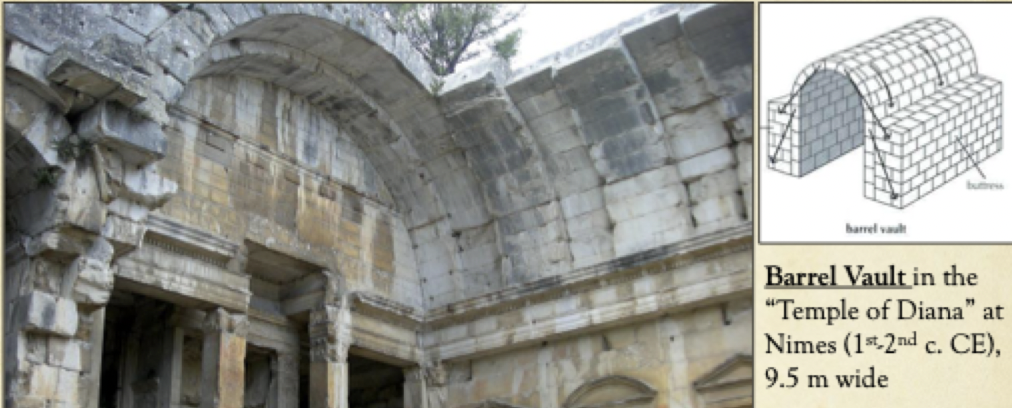
Barrel vault
Barrel vault - a room covered by an arch (the roof)
Opus caementicium
Concrete
Started to emerge around 2nd. Century BCE
Lime mortar (Lime and sand)
could add pozzolana to strengthen it
Pozzolana
a volcanic ash with silica that is used to strengthen and make concrete waterproof
forms extremely hard cement
will harden even though it is underwater; does not need to dry
Vitruvius
1st c. BCE
military engineer,
wrote the De Architectura ("Ten Books on Architecture") dedicated to Augustus, the first Roman emperor
Lime process and kiln
Lime is the most complicated material within concrete; it needs to be processed
Limestone or marble can be used by heating it to 900 degrees C.
The product is chemically changed (quicklime); it loses its CO2 and is left with CaO
It is then rehydrated to form cement
Kiln = A pit in the ground lined with stones; Often found built into the hillsides

Opus incertum
stone facing that is not evenly placed - no pattern
used in concrete walls

Opus reticulatum
diamond shaped stone faced concrete

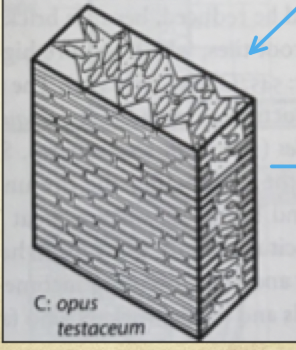
Opus testaceum (a.k.a. opus latericium)
Stone brick faced concrete
Annular vault
Concrete can be used to create curves
Annular = curved
Annular barrel vault = a barrel vault that also has a curve to the concrete

Groin vault
The groin vault : allows the illusion of a larger open space
Two barrel vaults that intersect - creating an open space in the center
used in the baths of caracalla

Pantheon
Rome, rebuilt in the 2nd C. CE
means "all the gods”
Monolithic columns
Concrete dome: the largest dome until the 15th c.
An oculus (hole) in the top of the ceiling - lets natural light in
Is only able to be done through the use of concrete
Coffered ceiling inside
The building materials get lighter in weight as it gets to the top
40-foot monolithic granite columns from egypt ; was originally supposed ot have 50 ft columns

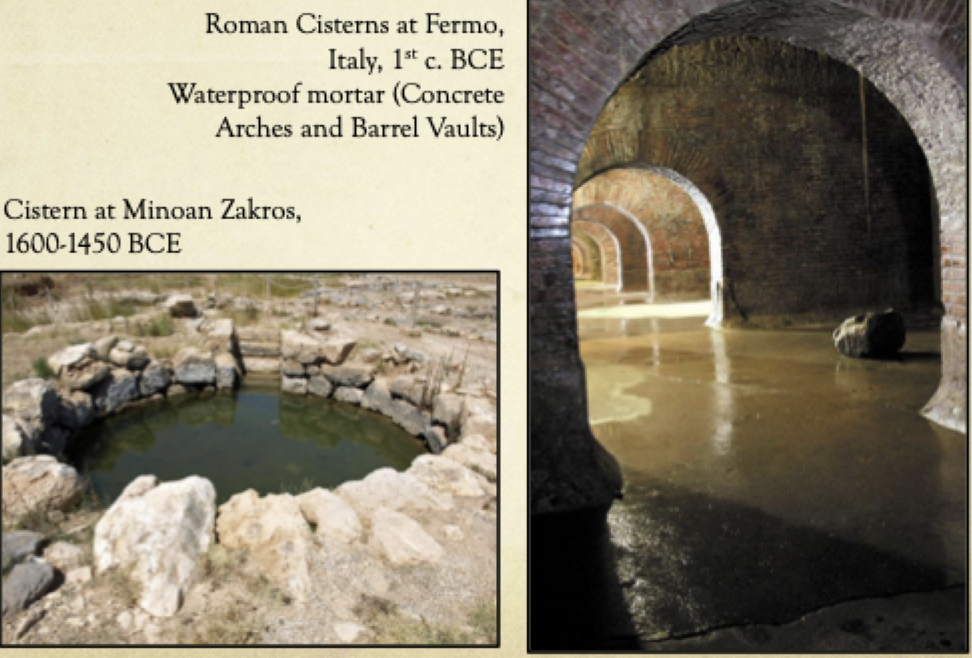
Cistern
Water is often collected by rainfall
Large storage tanks were often built right into the bedrock in the ground
Lined with waterproof mortar (concrete)
Qanat
Shaft-and-gallery tunnel that uses gravity to bring aquifer (ground-) water to settlements or fields at a lower ground elevation
Useful in hot, arid regions near hills or mountains - keeps water cold underground
Origin in Achaemenid Persia

Aqueduct
Spring or river-fed artificial channels (sometimes cut as tunnels or built up with bridges) using gravity to transport water from a distance
Athenian aqueduct built by Pisistratus (late 6th c. BCE) = Ceramic pipe (but not pressurized), partly in a tunnel
Common for pipes to have the makers mark - the person who constructed the pipes
Segments of ceramic piping with a hole on the top
The hole = for cleaning, for easier construction of the pipes, and for sealing pipes together
The hole would have a cap plugging it, to prevent things from getting in the water

Greek Fountain Houses
Often monumentalized and highly decorated
Mainly women or slaves going to collect water
Jars were brought to collect water from the fountains
Behind a columned façade would be the basin of water - which filled due to the spout that always ran (could not turn off water)

Inverted siphon
Pressurized: requires closed pipe of sufficient strength (lead or metal)
Height difference (hydraulic gradient on diagram above) required for pressure to overcome friction in the pipe
If there is one crack in a pipe, than the whole thing wouldn’t work - too much effort

Stilling basin
manage the flow of the water in aqueduct pipes (reducing the speed of the flow to preserve the lining of the pipes)
a chute cut into the ground, to reduce the speed of water continuing on

Dropshaft
used for aerating the water int he aqueducts, collecting the silt in the water, and dissipates some of the kinetic energy of the water
Frontinus
1st c.CE
Successful general and politician, becoming consul three times
wrote a work called De Aquaeductu (On Aqueducts)
Important insight on urban network, which is archaeologically less well known
Castellum aquae
The water distribution center
Pompeii 1st c. CE
Inside the building, water is divided into 3 main pipes, where the water then gets transported to different areas of the city
Was pressurized (due to lead pipes), not just relying on gravity
