Equip - Unit 2, Wk 8, Radiation Protection
 Call Kai
 Learn
 Practice Test
 Spaced Repetition
 Match
 Flashcards
 Knowt Play
1/50

Earn XP
51 Terms
3 Cardinal Rules for Radiation Protection:
Time: reduce the amount of time spent in the vicinity of the radiation source
Distance: increase the distance between the radiation source and the individual
Shielding: wear lead shielding, which will attenuate the radiation from the source
What is Equivalent Dose and what is it measured in?
Used to assess how much biological damage is expected from the absorbed dose of radiation. Measured in rem
Equivalent dose takes into account which 2 things?
Absorbed dose and type of radiation
Somatic Effects:
Evident in the irradiated individual (I can see it in myself)
Somatic effect examples:
Erythema in the individual
Cataracts in the individual
Radiation-induced malignancies in the individual
Genetic Effects:
Not in the exposed individual, but may appear in the descendants of the exposed individual
Nature of Ionizing Radiation
From both natural and human-made sources and has the ability to affect the various organs and tissues within the body. Capable of affecting atomic electric bonds resulting in chemical changes.
True or False:
It is very likely that an x-ray tech to suffer somatic or genetic effects from x-ray exposure during diagnostic exams
False.
It is highly unlikely
Dosimeters may be adversely affected by:
heat
intense light
humidity
Electromagnetic Radiation includes:
X-rays (human-made) and gamma rays which are ionizing
X-ray interaction with matter involves the transfer of _____ from photons to _______
energy
matter
Ionizing radiation is capable of affecting atomic electron bonds that hold the molecules of matter together, resulting in _______ changes that can lead to _______ changes in the body, with resulting harmful effects
chemical
metabolic
Biological Effects of Ionizing Radiation (6):
Cancer
Cataracts
Genetically determined ill health
Nonspecific life shortening
Developmental abnormalities
Degenerative diseases
Where does the #1 overall radiation dose come from?
Radon and thoron background (37%)
Occupational exposure radiation percentage:
<0.1%
Dosimeters:
Employed for detection and measurement of radiation exposure
Radiation exposure limits applicable to the protection of radiation workers are known as ____ limits.
dose
Proper Use of Dosimeters (6)
Worn only by the individual it is assigned to
Worn in proper location (collar levle, outside apron)
Facing the source of radiation
Worn only for the prescribed time period
Turned in for processing when due
Dose Report Includes (3):
Participant identification information
Type of dosimeter used
Radiation exposures that were received
50 Sv is equal to ____ rem.
5,000
50 Sv / 0.01 = 5,000 rem
RRCC is required to have students review and sign their dose report within ___ days of receipt
30
Exposure Categories are:
Dose equivalent in millirem for the wear period
Quarterly accumulated dose equivalent
Year-to-date dose equivalent
Lifetime dose equivalent

Deep Dose (DDE) measures what?
External whole body exposure at tissue depth of 1 cm
Lens of the Eye Dose (LDE) measures what?
External lens of the eye at tissue depth of 0.3 cm
Shallow Dose (SDE) measures what?
External exposure of the skin at tissue depth of 0.007 cm
_______ rays are emitted from the nuclei of radioactive materials.
Gamma
NCRP (National Council on Radiation Protection and Measurements):
An advisory group that makes recommendations for radiation protection.
NRC (Nuclear Regulatory Commission):
Federal Agency charged with licensing facilities and controlling the use of radioactive materials
Roentgen description & equation for Units of Radiation Measurement:
Ionization in air
R x 0.01 = Gya
Gya / 0.01 = R
Radiation Absorbed Dose description & equation for Units of Radiation Measurement:
Absorbed by matter
rad x 0.01 = Gyt
Gyt / 0.01 = rad
Radiation Equivalent in Man description & equation for Units of Radiation Measurement:
Equivalent dose
rem x 0.01 = Sv
Sv / 0.01 = rem
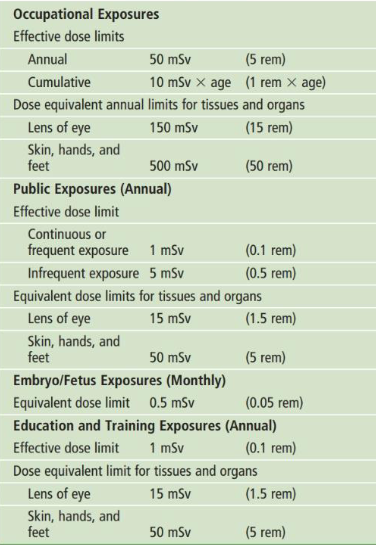
Group: Occupational
What is the effective dose?
Lens of eye?
Skin, hands, and feet?
50 mSv
150 mSv
500 mSv
Group: Public and Ed/Training (same for both)
What is the effective dose?
Lens of eye?
Skin, hands, and feet?
1 mSv
15 mSv
50 mSv
How do we get radiation equivalent in man from mSv to rem?
Move decimal 1 place to the left (Sv / 0.01 = rem)
Conventional symbol “R” matches to what other symbol?
Gya
Conventional symbol “rad” matches which other symbol?
Gyt
Conventional symbol “rem” matches which other symbol?
Sv
Dose Limits (memorize)
Possible effects are influenced by (6):
Total dose received
Rate at which the dose was received
Age at exposure
Type of radiation
Sensitivity of the irradiated cells
Portion of the body that was irradiated
Individuals in education and training have the same effective dose limit as the general public. What is it for continuous exposure?
0.1 rem or 1 mSv per year
(1/50 of the effective dose limit for radiation workers)
The level of recommended dose limits is 1/10 of the effective dose limit for
radiation workers. What is it for infrequent exposure?
0.5 rem or 5 mSv
What is the annual effective dose limit for occupational exposures?
50 mSv or 5 rem
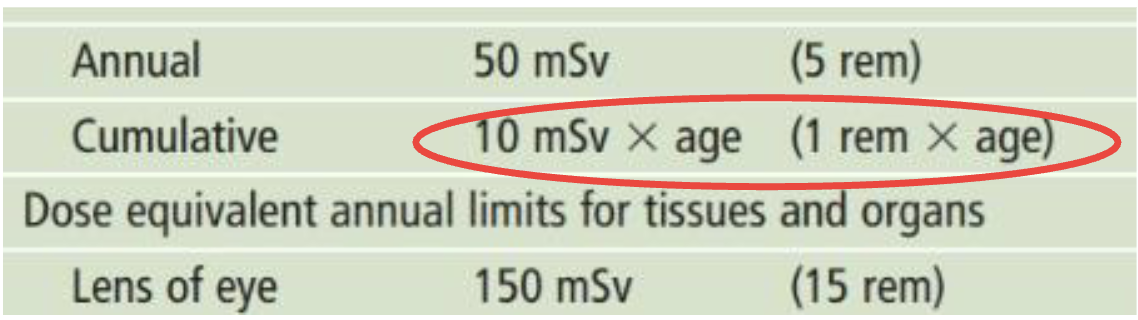
What is the cumulative effective dose limit for a 20 year old radiographer?
200 mSv or 20 rem
What is the equivalent dose limit for embryo/fetus exposures monthly?
0.05 rem or 0.5 mSv
Cumulative Dose:
Convert 190 mSv to Sv
.19 Sv
Move the decimal 3 places to the left

True or False:
During a fluoroscopy procedure, if your assistance is not needed, back away from the radiation source and use a barrier if available
True
Types of Shielding (3):
Lead apron and thyroid shield
Lead gloves
Lead glasses
Protective aprons and gloves are made of lead-impregnated vinyl within the range of ________ of lead equivalency
0.25-1 mm
For fluoroscopic procedures with a kVp of 100 or more, the protective apron must possess a minimum of ____ lead equivalent.
0.5 mm
How should you protect your patient?
Collimate to anatomy of interest only (also increases image quality)
High kVp and low mAs, but balance it
Patient shielding (if they prefer it)
Of the following scenarios, which would have the highest potential for scatter radiation exposure to the x-ray tech?
Fluoroscopy,
KUB,
CXR
Fluroscopy