Viruses
 Call Kai
 Learn
 Practice Test
 Spaced Repetition
 Match
 Flashcards
 Knowt Play
1/23

There's no tags or description
Looks like no tags are added yet.
24 Terms
Tobacco Mosaic Disease
prevents growth of tobacco leaves
gives tobacco leaves a mosaic pattern
How did researchers find out that bacteria was not to blame
Researchers extracted sap from tobacco plants, passed it through a filter, to trap bacteria, and then rubbed the sap on uninfected tobacco leaves. When the plants still ended up infected, it implied that the infectious agent was smaller than bacteria.
virus
an acellular infectious particle consisting of genes packaged in a protein coat (capsid)
True or False:
Viruses are simpler than prokaryotic cells
true
Viruses cannot (blank) or carry out (blank) outside of the host cell
Reproduce, metabolism
Are viruses cells?
A virus is a (blank) infectious particle consisting of a (blank) enclosed in a (blank), and in some cases, a (blank)
no
small, nucleic acid, protein coat, membranous envelope
viral genomes can consist of what?
Viruses are classified as (blank) viruses or (blank) viruses
double or single stranded DNA OR double or single stranded RNA
DNA, RNA
definition of a Capsid
capsids are made from subunits called
A capsid can have a variety of structures; associated viruses may be referred to as (blank) or (blank)
the protein shell that encloses the viral genome
capsomeres
helical, icosahedral
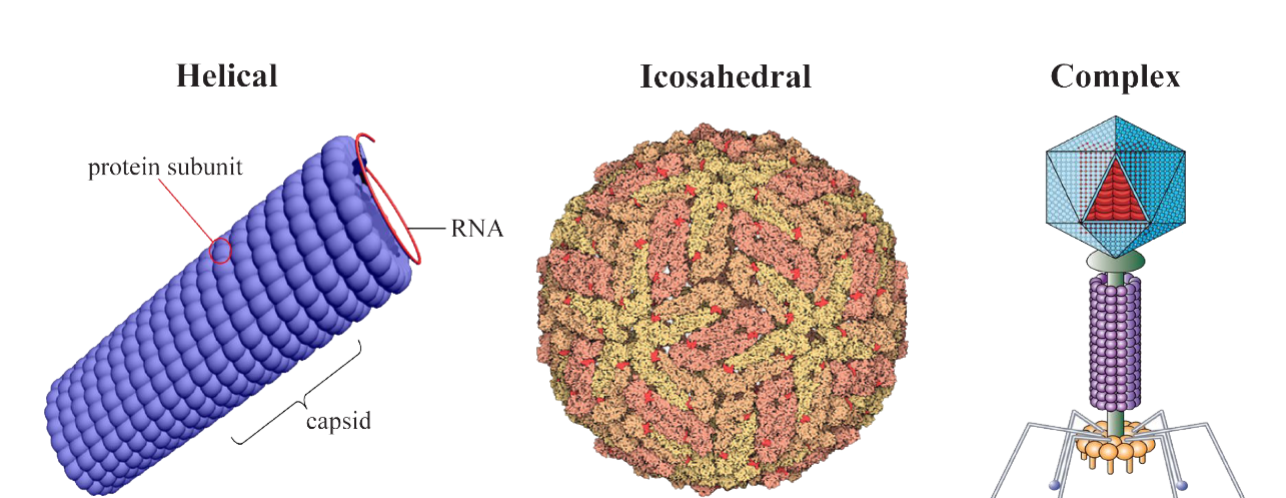
function of the capsid
Genome protection
site of attachment in nonenveloped virus
virus symmetry
A virus particle outside of the host cell
Virion
Viral envelope
derived from membranes of host cells
surround the capsids of viruses (i.e. influenza viruses have a viral envelope)
contain a combination of viral and host cell molecules
bacteriophage
(phages), viruses that infect bacteria
elongated capsid head that encloses their DNA
what attaches a bacteriophage to a bacteria
a protein tail piece attaches the phage to the host and injects the phage DNA inside
what does it mean that viruses are obligate intracellular parasites
they can only replicate inside a host
host range
the limited number of host species a virus can infect
some viruses have a broad host range while others can only infect one species of cell
ex: measles virus only infects humans
once a viral genome enters a cell, what does it start to do?
the virus makes use of what from the host cell
what do viral nucleic acids and capsomeres do
manufacture viral proteins
enzymes, ribosomes, amino acids, etc.
self-assemble into new viruses
Virus-Cell Interactions
productive
non-productive
infection occurs
infection does not occur
different cases of non-productive virus-cell interactions
virus couldn’t replicate itself
virion destruction
oncogenic transformation (virus prompts uncontrolled cell division)
latent infection (virus remains dormant and genome is not expressed)
Examples of productive virus-cell interactions
100% of the cell’s resources go towards making copies of the virus (lytic infection)
only some of the cell’s resources go towards making copies of the virus (persistent infection)
Stages of Infection
Attachment: Virus is recognized by cell receptors
Penetration: Direct injection (virus doesn't enter but injects genome), Endocytosis, Direct Fusion (viral envelope fuses with cell membrane)
Uncoating: changes in virion structure allow for viral gene expression
Gene Expression: Viral genome - transcription - mRNA - translation - new virions
Genome Replication: Progeny viral genomes are generated
Assembly: Capsid forms and genome and enzymes are packaged within
Release: Viruses accumulate until the cell bursts (budding-nucleocapsids push their way out and acquire an envelope as they leave)
Maturation: changes in the virion requires to make it an infectious agent
the best understood of all viruses
phages
two alternative reproductive mechanisms of phages
lytic cycle
lysogenic cycle
lytic cycle - culminates in death of the host cell, produces new phages and lyses the host's cell wall, virulent phages
lysogenic cycle - doesn't destroy the host genome, viral DNA molecule is incorporated into the host cell's chromosome, integrated viral DNA is known as a prophage
phages that use the lytic and lysogenic cycles are called temperate phages (lambda)
Bacterial defenses against phages
natural selection favors bacterial mutants with surface proteins that cannot be recognized as receptors by a particular type of phage
foreign DNA can be identified and cut up by restriction enzymes
bacterium’s DNA is protected by the restriction enzymes by being methylated
two key variables used to classify viruses that infect animals
RNA or DNA genome, single or double stranded
presence or absence of a membranous envelope
(bacteriophages usually have either an envelope or RNA genome but viruses that infect animals usually have both)