Translation
 Call Kai
 Learn
 Practice Test
 Spaced Repetition
 Match
 Flashcards
 Knowt Play
1/23

Earn XP
Description and Tags
24 Terms
What is the genome?
Genome is the entire set of genes or genetic material present in a cell or organism.
What is the proteome?
The proteome is the entire complement of proteins that can be expressed from those genes.
What does the sequence of bases, in a gene, code for?
The sequences of bases in a gene codes for which amino acids are needed (in the right order) to build the protein.
What does a group of 3 bases code for?
A group of 3 bases codes for a particular amino acid. It also known as a codon.
What is the genetic code described as? Why?
Described as degenerate/redundant as each amino acid may be coded for more than one codon.
What should the genetic code not do?
The genetic code should not overlap.
Why is it important that the genetic code doesn’t overlap?
Overlapping shouldn’t happen because each nucleotide is part of only one codon, a single nucleotide cannot be part of two codons.
What are ribosomes made of?
They are are mostly made or ribosomal RNA, but also some proteins.
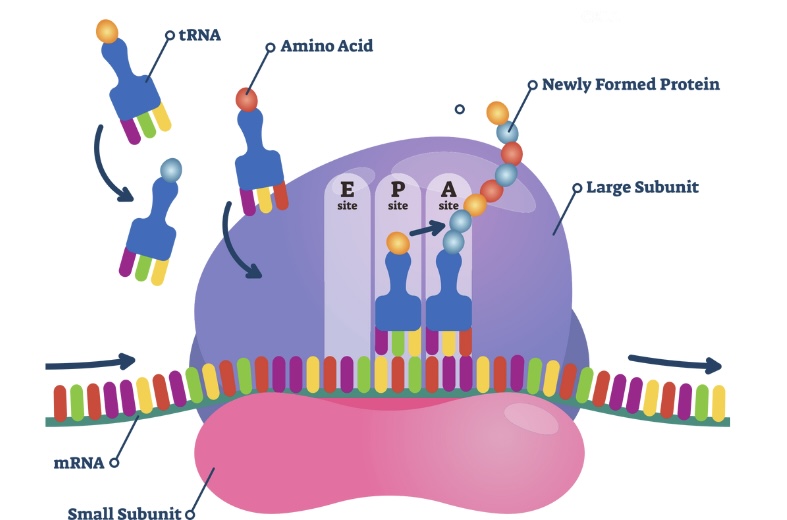
What are the two parts of the ribosome?
Ribosomes have a large(above) and a small(underneath) subunit which fit either side of the mRNA strand - burger like.
What do ribosomes not have, that other organelles do?
Ribosomes do not have a membrane, unlike mitochondria and chloroplasts.
Where are ribosomes found?
They are found free in the cytoplasm or bound to the endoplasmic reticulum - forms rough ER.
How many ribosomes can a cell have up to?
As many as 10 million.
How many ribosomes can be attached to same mRNA?
Several ribosomes can be attached to the same mRNA strand at once.
What happens to an mRNA after it has been transcribed?
It travels to a ribosome where it translates into a polypeptide chain.
Other than mRNA, what else does translation require?
Translation requires transfer RNA (tRNA).
What is mRNA?
A complementary copy of the DNA sequence of a gene.
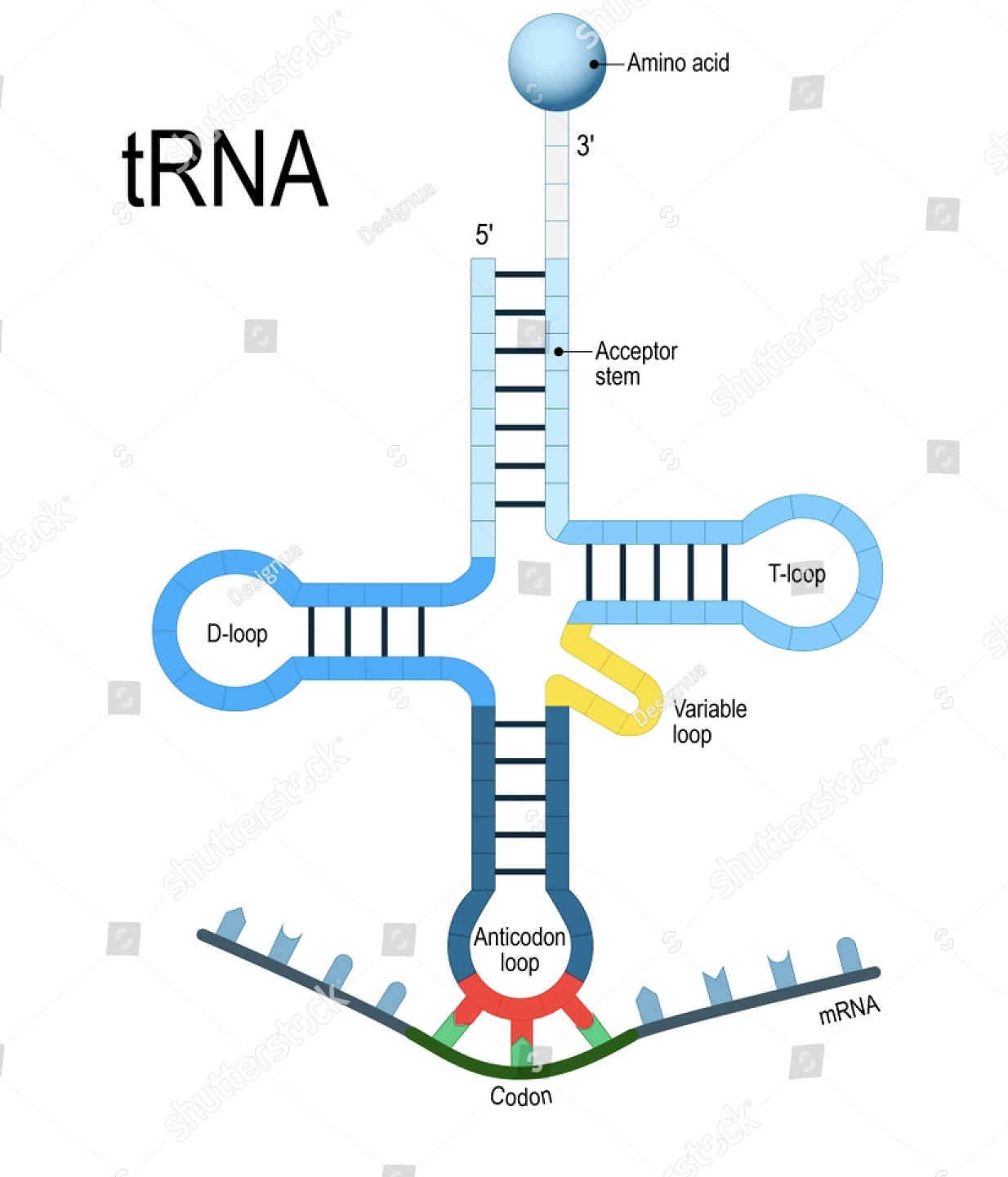
Give the structure of tRNA.
• It is a short single strand of RNA (fixed length)
• It is folded into a ‘clover leaf’ shape and held together by hydrogen bonds between paired bases.
• It has an amino acid binding site - three exposed bases.
• It has an anticodon binding site - a series of three bases which are complementary to the codon on the mRNA which codes for the amino acid the tRNA carries.
What stage is translation in protein synthesis?
It is the second stage of protein synthesis. In both prokaryotes and eukaryotes, translation occurs at the ribosomes.
What’s the first step of translation?
A ribosome attaches to the start codon on the mRNA. A tRNA molecule with complementary anticodon to the start codon binds to the mRNA, where a specific amino acid is attached to the tRNA (always Methionine - AUG).
What’s the second step of translation?
The ribosomes move along to the next codon; ribosomes can fit two at a time. The process is repeated and enzyme catalyses the condensation reaction between amino acids to join them with a peptide bond, forming polypeptide.
What is the third step of translation?
Ribosome continues to move along mRNA and tRNAs arrive with amino acids at each codon until a stop codon is reached. The ribosome, mRNA and tRNA separate - polypeptide is complete.
What’s a mutation?
Change to the DNA base sequence, where one base could be substituted for another or one could be deleted.
What could a mutation do in a gene?
As the order of the DNA bases in a gene determines the order of amino acids in a protein, it could change the primary structure of a protein. If a base is changed in a codon, it could then code for different amino acids (not always) and the sequence of amino acids would be altered; protein made could be different or damaged.
What is translation? (Short summary)
It is where the mRNA is read by a ribosome and the code is ‘translated’ into a polypeptide chain.