Greek and Roman Mythology Midterm 2
 Call Kai
 Learn
 Practice Test
 Spaced Repetition
 Match
 Flashcards
 Knowt Play
1/46

There's no tags or description
Looks like no tags are added yet.
47 Terms
“The goddess Aruru, she washed her
hands, took a pinch of clay, threw it down in the wild. In the wild
she created Enkidu, the hero, offspring of silence, knit strong by
Ninurta. All his body is matted with hair, he bears long tresses like
those of a woman: the hair of his head grows thickly as barley, he
knows not a people, nor even a country. Coated in hair like the god
of the animals, with the gazelles he grazes on grasses, joining the
throng with the game at the water-hole, his heart delighting with
the beasts in the water.”
Epic of GIlgamesh - Sin leqi- unninni: The civilizing power of close relations
“She did for the man the
work of a woman, his passion caressed and embraced her. For six
days and seven nights Enkidu was erect, as he coupled with Shamhat.
When with her delights he was fully sated, he turned his gaze to his
herd. The gazelles saw Enkidu, they started to run, the beasts of the
field shied away from his presence. Enkidu had defiled his body so
pure, his legs stood still, though his herd was in motion. Enkidu was
weakened, could not run as before, but now he had reason, and
wide understanding. He came back and sat at the feet of the harlot,
watching the harlot, observing her features. Then to the harlot’s
words he listened intently, [as Shamhat] talked to him, to Enkidu:
‘You are handsome, Enkidu, you are just like a god! Why with the
beasts do you wander the wild? Come, I will take you to Uruk-the
Sheepfold, to the sacred temple, home of Anu and Ishtar, where
Gilgamesh is perfect in strength…”
Epic of Gilgamesh - Sin leqi unninni: Civilization of enkidu
The stars of heaven [appeared] above
you, [like a] rock from the sky one fell down before you. You
lifted it up, but it weighed too much for you, you tried to roll
it, but you could not dislodge it. You lifted it up, set it down
at my feet, and I, Ninsun, I made it your equal. Like a wife
you loved it, caressed it and embraced it: a mighty comrade
will come to you, and be his friend’s savior. Mightiest in the
land, strength he possesses, his strength is as mighty as a
rock from the sky. Like a wife you’ll love him, caress and
embrace him, he will be mighty, and often will save you.”
Epic of GIlgamesh - sin leqi unninni: Ninsun(mother of Gilgamesh) has a dream that they will be best friends

Odysseus in the middle, Tireseus in the bottom corner. He drew his sword and stood on guard. He is asking Tireseus how to get home. Homer’s Odyssey: Tireseus warns him that Poseidon is punishing him because he blinded Polyphemus, tells him and his crew not to eat Helios’ cattle, and that he must kill the suitors that have overrun his home.
“By the men you left, the
absent ones! And by your wife! And father, who brought
you up from babyhood! And by your son Telemachus,
whom you abandoned alone at home, I beg you! When
you sail from Hades and you dock your ship again at
Aeaea, please, my lord, remember me. Do not go on and
leave me unburied, abandoned, without tears or
lamentation—or you will make the gods enraged at you.
Burn me with all my arms, and heap a mound beside the
gray salt sea, so in the future people will know of me and
my misfortune.”
Homer’s Odyssey: Elpenor is asking Odysseus to give him proper burial rites. He fell off of Circe’s roof while he was drunk which is not the most honorable death. He shows up at the edge of the world as Odysseus summons Tiresias. It highlights the importance of Greek burial traditions and this connection to honor.
My child! How did you come here through
the darkness while you were still alive? This place is
hard for living men to see. There are great rivers and
dreadful gulfs, including the great Ocean which none
can cross on foot; one needs a ship. Have you come
wandering here, so far from Troy, with ship and crew?
Have you not yet arrived in Ithaca, nor seen your wife
at home?”
Homer’s Odyssey: Antikleia gives view on underworld and it’s geography. She is Odysseus’ mother. He is very sad when he sees her. She perhaps hints at the recklessness of his actions with “its hard for living men to see'“. She died of grief and longing while he was at war.
“Oh my child! You are the most unlucky
man alive. Persephone is not deceiving you. This is the
rule for mortals when we die. Our muscles cease to
hold the flesh and skeleton together; as soon as life
departs from our white bones, the force of blazing fire
destroys the corpse. The spirit flies away and soon is
gone, just like a dream. Now hurry to the light;
remember all these things, so you may tell your wife in
times to come.”
Homer’s Odyssey: Antikleia(Odysseus’ mother) shows Ancient Greek perspective on death.
“Alcinous replied, “Odysseus, the earth sustains all different
kinds of people. Many are cheats and thieves, who fashion
lies out of thin air. But when I look at you, I know you are
not in that category. Your story has both grace and wisdom
in it. You sounded like a skillful poet, telling the sufferings of
all the Greeks, including what you endured yourself. But
come now, tell me if you saw any spirits of your friends, who
went with you to Troy and undertook the grief and pain of
war. The night is long; it is not time to sleep yet.”
Homer’s Odyssey: Alcinous, the king of the Phaecians who welcomes Odysseus and hears his story. Shows the performance context of what Odysseus is saying.
“I cried out, “Curse her! Zeus has always brought
disaster to the house of Atreus through women. Many
men were lost for Helen, and Clytemnestra formed
this plot against you when you were far away.”
Homer’s Odyssey: Odysseus is speaking on the women in the house of Atreus. He is trying to comfort and appeal to Agamemnon when he visits the underworld. Trying to appeal to the idea of fate rather than his own actions.

Odysseus and Elpinor in a scene of necromancy. Odysseus is wearing a traveling hat and holding a sword in waiting as described in Homer’s Odyssey.
I beg you by the lovely light
of sky, the air, by your father, and your hopes for young
Iülus [Aeneas’ son], save me from this hell, since you’ve
overcome it, and throw soil on my corpse if you reach
Velia. Or if you have a way, if your goddess mother shows
you one (you couldn’t ford this stream and Styx’s swamp
without divine assistance), take my poor hand, take me on
board with you, so that at least in death I’ll find a place of
rest.”
Virgil’s Aeneid: Palirnurus has an Elpinor'-like desire to be buried and honor.

Sarpedon is being carried into the underworld by Sleep and Death. His soul is leaving his body as you can see by the winged character.

The ghost of Patroklus and Hector being dragged by Achilles on the chariot in his grief. Can tell by the winged figure representing his soul. This aligns with Homer’s Illiad. In the Illiad Apollo took pity on Hector and protects his body until Thetis convinces Achilles to give the body back to Priam.
“However, she was
seduced, as some say, by Proetus, whence arose the
quarrel between them; but some say that Zeus had
intercourse with her in the shape of a stream of gold
which poured through the roof into Danae’s lap. When
Acrisius afterwards learned that she had got a child
Perseus, he would not believe that she had been seduced
by Zeus, and putting his daughter with the child in a
chest, he cast it into the sea. The chest was washed
ashore on Seriphus, and Dictys took up the boy and
reared him.”
Apollodorus - Library: This describes how Danae came to concieve Perseus. Acrisius was scared that his grandson would one day overcome him, so he set Danae and the baby across the sea.

This is Danae. It is said in Apollodorus’ Library that she came to concieve Perseus through Zeus and a stream of gold.

Danae is being ordered into the chest by Acrisius. This aligns with Apollodorus’ Library text because Acrisius is scared that his grandson will overtake him, so he sends them to sea.

This is Danae and Perseus mid-sea. In Apollodurus’ text, King Acrisius is scared his grandson is going to overtake him so he locks them in a chest and sends them out to sea.
“When the Phorcides had
shown him the way, he gave them back the tooth and the eye,
and coming to the nymphs got what he wanted. So he slung the
wallet (kibisis) about him, fitted the sandals to his ankles, and
put the cap on his head. Wearing it, he saw whom he pleased,
but was not seen by others. And having received also from
Hermes an adamantine sickle he flew to the ocean and caught
the Gorgons asleep. They were Stheno, Euryale, and Medusa.
Now Medusa alone was mortal; for that reason Perseus was
sent to fetch her head. But the Gorgons had heads twined
about with the scales of dragons, and great tusks like swine’s,
and brazen hands, and golden wings, by which they flew; and
they turned to stone such as beheld them.”
Apollodorus’ Library: This characterizes Perseus. It shows how Perseus was sent to kill Medusa and decieve her.

Perseus and Medusa. Apollodorus’ Library.

Medusa. As described in Apollodorus’ Library. Medusa depictions often apotropaic - meant to ward off evil with disturbing and freightening images

There will be long time for weeping by and by; but time for
helping is very short. If I sought this maid as Perseus, son of
Jove and that imprisoned one whom Jove filled with his life-
giving shower; if as Perseus, victor over Gorgon of the snaky
locks, and as he who has dared to ride the winds of the air on
fluttering wings, surely I should be preferred to all suitors as
your son-in-law. But now I shall try to add to these great gifts
the gift of service, too, if only the gods will favour me. That she
be mine if saved by my valour is my bargain.” The parents accept
the condition—for who would refuse?—and beg him to save her,
promising him a kingdom as dowry in addition.”
Ovid’s Metamorphoses: Perseus agrees to save Andromeda from the ketos if they let him have her as his wife.
Third, he slew at Crommyon the sow that
was called Phaea after the old woman who bred it; that sow, some say, was
the offspring of Echidna and Typhon. Fourth, he slew Sciron, the Corinthian,
son of Pelops, or, as some say, of Poseidon. He in the Megarian territory held
the rocks called after him Scironian, and compelled passers-by to wash his
feet, and in the act of washing he kicked them into the deep to be the prey of
a huge turtle. But Theseus seized him by the feet and threw him into the
sea…Fifth, he slew Damastes, whom some call Polypemon. He had his dwelling
beside the road, and made up two beds, one small and the other big; and
offering hospitality to the passers-by, he laid the short men on the big bed and
hammered them, to make them fit the bed; but the tall men he laid on the
little bed and sawed off the portions of the body that projected beyond it.
Apollodorus’ Library: Theseus’ early exploits. He did these to prove his worth and claim as a hero.

Theseus’ early exploits. Apollodorus. Club, Bed, Cliff, bull, pine tree, sow,minotaur
“In this labyrinth Minos
shut up the monster of the bull-man form and twice he
fed him on Athenian blood; but the third tribute,
demanded after each nine years, brought the creature’s
overthrow. And when, by the virgin Ariadne’s help, the
difficult entrance, which no former adventurer had ever
reached again, was found by winding up the thread,
straightway the son of Aegeus, taking Minos’ daughter,
spread his sails for Dia; and on that shore he cruelly
abandoned his companion. To her, deserted and
bewailing bitterly, Bacchus brought love and help
Ovid’s Metamorphoses: Theseus’ exploits of the minotaur(late exploits).

Theseus and the Minotaur. Ovid’s Metamorphoses. Often carried a club from the pine bender,

Theseus abandonding Ariadne on Naxos
12 Labors of Heracles, ordered by
Hera (?), in service of Eurystheus
of Argos, to expiate murder of
wife Megara and his children in
fit of madness brought on by
Hera (?)
Nemean lion, lernean hydra, Erymanthean boar, Cerynthian hind, Stymphalian birds, cleaning the stables of Augias, Cretan bull, man-eating horses of Diomedes, capturing belt of Amazonian Hippolyte, the cattle of geronyous, bringing up cerberus, the apples of Hesperides. Hesiod’s Theogony.
“Of Heracles the son of Zeus I will sing, far the finest of men
on earth, born in Thebes of the beautiful dances to Alcmena
in union with the dark-cloud son of Kronos. Formerly he
roamed the vastness of land and sea at the behest of King
Eurystheus, causing much suffering himself and enduring
much; but now in the fair abode of snowy Olympus he lives
in pleasure and has fair-ankled Hebe as his wife. I salute you,
lord, son of Zeus: grant me status and fortune.”
Homeric Hymn to Heracles. Demonstrates how rare the privelage of non-gods getting to live on Olympus is.
“Since I have undertaken it, these waters shall be overcome.” And in he plunged; nor did he seek out where the stream was easiest, and scorned to take advantage of the smoother waters. And now he had just gained the other bank, and was picking up his bow which he had thrown across, when he heard his wife’s voice calling [=Deianeira]; and to Nessus [the centaur], who was in act to betray his trust, he shouted: “Where is your vain confidence in your fleetness carrying you, you ravisher? To you, two-formed Nessus, I am talking: listen, and do not dare come between me and mine. If no fear of me has weight with you, at least your father’s whirling wheel should prevent the outrage you intend. You shall not escape, however much you trust in your horse’s fleetness. With my deadly wound, if not with my feet, I shall overtake you.” Suiting the action to his last words, he shot an arrow straight into the back of the fleeing centaur."
Ovid’s Metamorphoses. Centuar tries to rape Deianira, Hercules swims across the river and shoots Nessus with his bow. Eventually this leads to Nessus giving Deianeira a bloody tunic which ends up killing Heracles in the Metamorphoses as well as Sophocles’ Women of Trachis.
There is an ancient saying among men,
once revealed to them, that you cannot
understand a man’s life before he is
dead, so as to know whether he has a
good or bad one. But I know well, even
before going to Hades, that the one I
have is unfortunate and sorrowful.”
Sophocles’ Women of Trachis. Deianeira is speaking here. She has found out that the tunic she giften Heracles whom she thought would be impacted by the love potion was actually poisoned. She realizes this through seeing what the tunic has touched has disintegrated.
I heard this man saying, before many witnesses, that it was on
account of this girl that Herakles brought down Eurytus and
the high towers of Oechalia, and that it was Eros alone among
the gods that bewitched him into this deed of arms... And now
he pushes this story aside and tells a different one! No, when
he failed to persuade her father to give him his daughter, to
have as his secret love, he trumped up a petty accusation and
a pretext, and marched against her country [in which he said
this Eurytus was king, killed the king her father,] and sacked
the city. And now, as you see, he has come back, sending her
not without forethought, lady, or as a slave; do not expect
that, nor is it likely, if indeed he is inflamed with desire.
Women of Trachis. A messenger tells Deianeira that Heracles is infatuated with Iole at fault of Eros.

Heracles conquering snakes. Ovid’s Metamorphoses.


12 labors of Heracles. Nemean lion, Lernean hydra, Eramanthian boar, cerynthian hind, symphalian birds. Metamorphoses or Theogony mentions a few of them.
For my mother Thetis the goddess of the silver feet tells
me I carry two sorts of destiny toward the day of my
death. Either, if I stay here and fight besides the city of
the Trojans, my return home is gone, but my glory shall
be everlasting; but if I return home to the beloved land
of my fathers, the excellence of my glory is gone, but
there will be a long life left for me, and my end in death
will not come to me quickly.”
The Illiad. Achilles is talking about his destiny.
“Her pleading, her shrieking for
her father, the girl’s short life — these were worth nothing to the lovers of battle,
her judges. Her father prayed first, then he told the attendants to lift her high up,
over the altar, like a goat — though, frantic, she clung to his legs in their robes —
to keep her facing the ground, and to guard her exquisite mouth, keeping in
sounds of a curse for his house, With a bit forced in, a power that silenced her.”
Agamemnon - Aeschylus: Iphigenia is being sacrificed by Agamemnon in order to have good sailing seas.

Clytemnestra perhaps mourning the death of Iphigenia. Aeschylus’ Agamemnon. Two servants are carrying her and following Agamamenon.
“Now, after enduring all this, with a heart no longer grieving, I shall speak of this man as the watchdog of his homestead, the forestay that saves the ship, the firmly-footed pillar that supports a lofty roof, a father’s only son; as land appearing to sailors in despair, as the daylight that is such a fair thing to behold after a storm, as a flowing spring to a thirsty traveller. Such, I say, are the appellations I hold him worthy of—but let us not court jealousy, for we have endured many sufferings already. Now then, please, dear heart, step out of this carriage—but do not set your foot on the earth, my lord, the foot that sacked Troy! Servants, why are you waiting, when you have been assigned the duty of spreading fine fabrics over the ground in his path? Let his way forthwith be spread with crimson, so that Justice may lead him into a home he never hoped to see.”
Aeschylus’ Agamemnon: Clytemnestra is deceptively welcoming Agamemnon home from war although she is angry at him for killing their daughter.
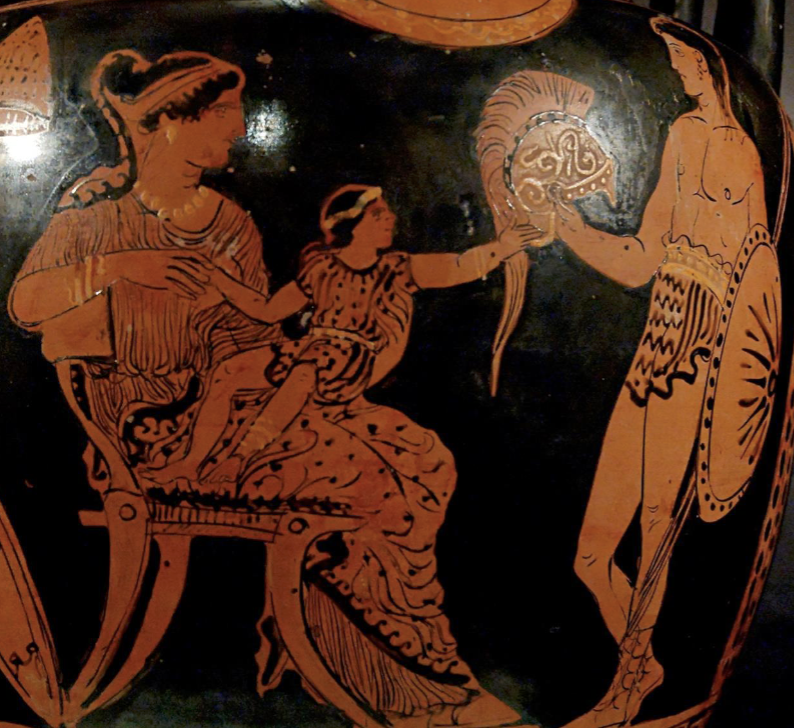
Hector saying goodbye to Andromache and his son. Illiad. Andormache begs him to stay so she does not become a widow. His son recoils from his helmet and is scared. Perhaps reinforcing the fear they have of the effects of war.

The Illiad. Odysseus approaches Achilles. Patroclus next to Achilles, Phoenix next to Odysseus. They ask Achilles for peace from Agamemnon, he rejects because he is not fighting. Everyone is disappointed.

Patroklus kills Sarpedon. This is the reason why Patroclus is killed eventually. This aligns with Illiad.
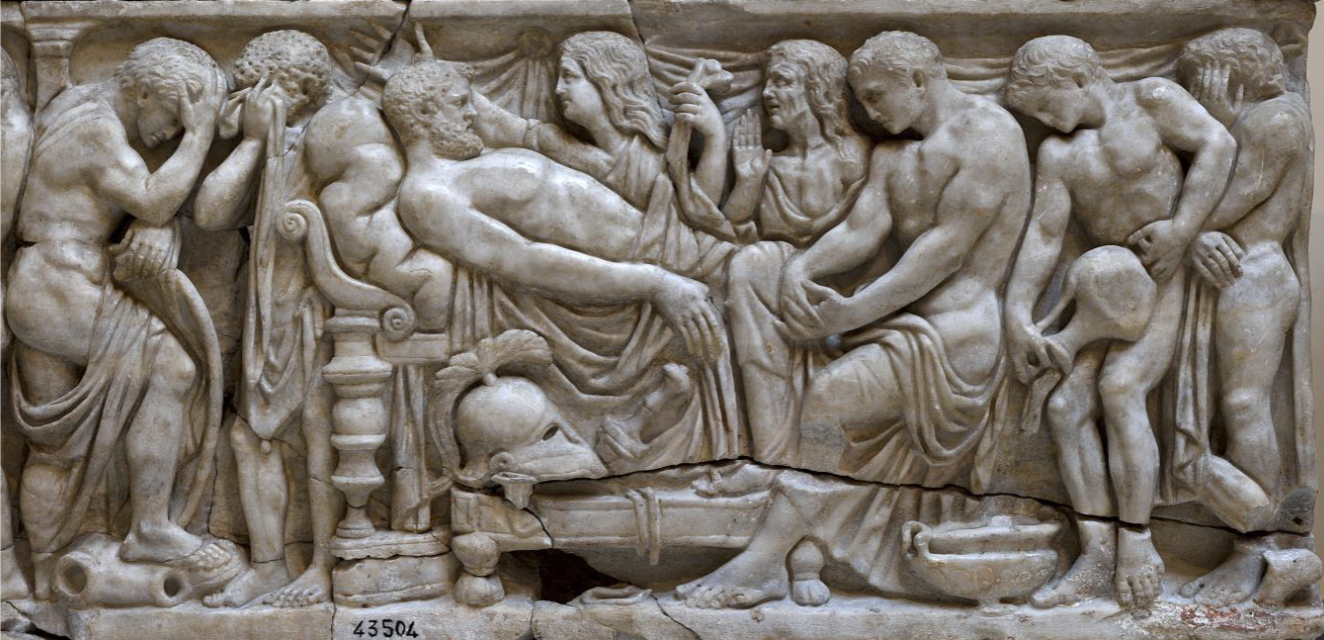
Achilles mourning Patroclus. Illiad.

The death of Agamemnon. Aeschylus’ Agamemnon.

Homer’s Odyssey. Escaping polyphemus.
Then with her wand Athena tapped him: his handsome
body withered up; his limbs became arthritic. She
bleached out his hair, and made his skin look old and
wrinkled, and dimmed his fine bright eyes. She turned
his clothes into a tattered cloak and ragged tunic, dirty
with soot. She wrapped around his shoulders a massive
leather deerskin, and she gave him a threadbare
satchel and a walking stick. Their plans were set; they
parted.”
Homer’s Odyssey. Athena is recasting Odysseus for his return home so that he can plan his attack and stay safe from the suitors.
Nanny! Why are you trying to destroy me? You fed me
at your breast! Now after all my twenty years of pain, I
have arrived back to my home. You have found out; a
god has put knowledge in your mind. Be silent; no one
must know, or else I promise you, if some god helps
me bring the suitors down, I will not spare you when I
kill the rest, the other slave women, although you
were my nurse.
Homer’s Odyssey. Odysseus sees that Eurycleia sees his scar that he recieved from the Pernassian boar. He asks her to remain quiet to not reveal his disguise.

Ajax carrying off Achilles’ dead body. The Odyssey. He carries him off so that he may recieve proper burial and not be desecrated.

Trojan horse. Homer’s Odyssey.